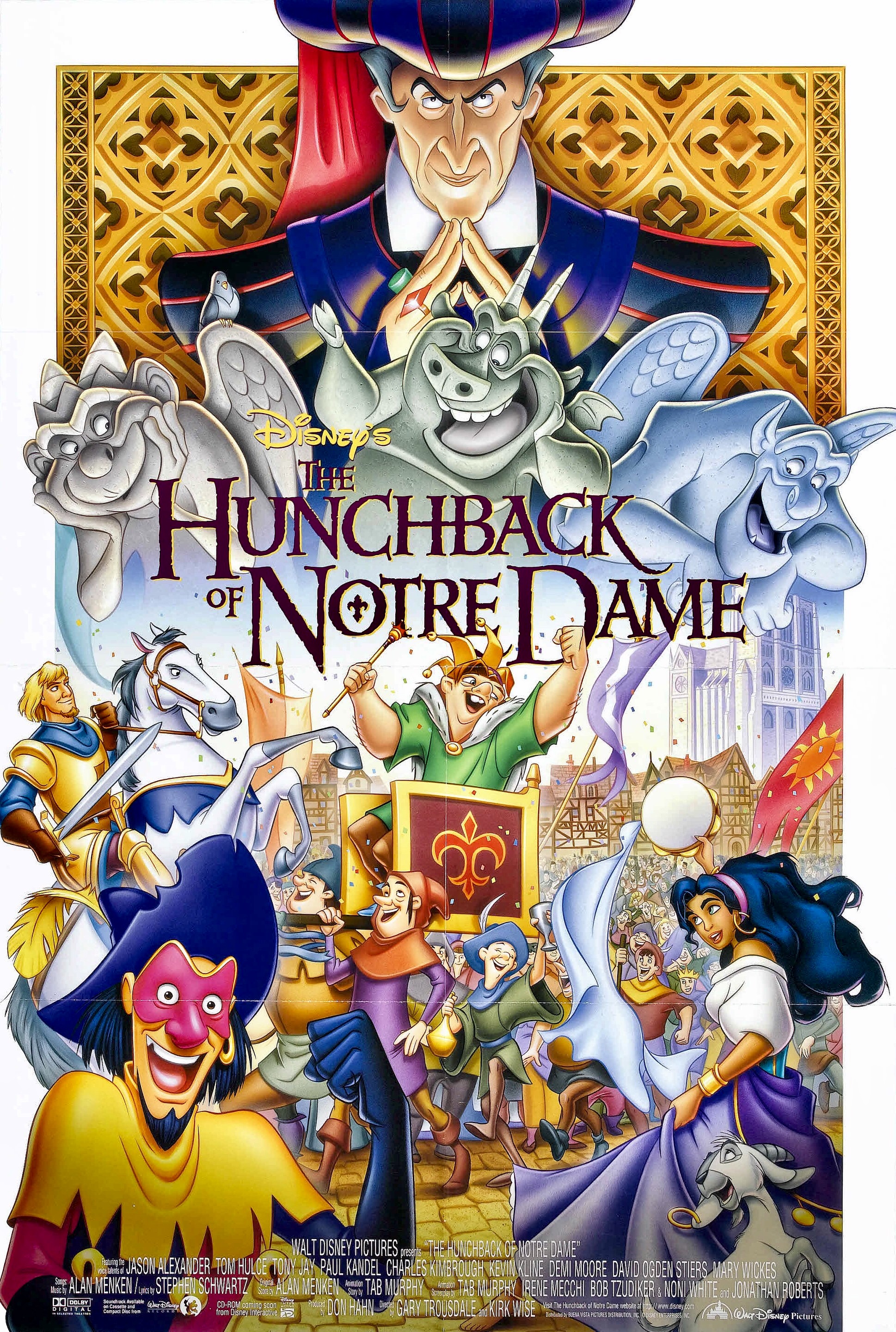
Disney's Hunchback Of Notre Dame (1996)

In 15th-century Paris, Clopin the puppeteer tells the story of Quasimodo, the misshapen but gentle-souled bell ringer of Notre Dame, who was nearly killed as a baby by Claude Frollo, the Minister of Justice. But Frollo was forced by the Archdeacon of Notre Dame to raise Quasimodo as his own. Now a young man, Quasimodo is hidden from the world by Frollo in the belltower of the cathedral. But during the Festival of Fools, Quasimodo, cheered on by his gargoyle friends Victor, Hugo, and Laverne, decides to take part in the festivities, where he meets the lovely gypsy girl Esmeralda and the handsome soldier Phoebus. The three of them find themselves ranged against Frollo's cruelty and his attempts to destroy the home of the gypsies, the Court of Miracles. And Quasimodo must desperately defend both Esmeralda and the very cathedral of Notre Dame.
Join the Party June 21st!
Laverne: [to Quasimodo] Quasi, take it from an old spectator. Life's not a spectator sport. If watchin' is all you're gonna do, then you're gonna watch your life go by without ya.
Walt Disney Feature Animation - 500 S. Buena Vista Street, Burbank, California, USA
1400 Air Way, Glendale, California, USA
(additional animation)
For the scene where Judge Frollo sings "Hellfire" and sees Esmeralda dancing in the fire before him, the MPAA insisted that the Disney animators make Esmeralda's clothing more well-defined, as she seemed nude.
The song "Hellfire" is considered one of the darkest songs written for a Disney film, and was nearly cut from the film.
The opening musical number, "The Bells of Notre Dame," is, according to Alan Menken, the best opening number he has ever written.
According to the audio commentary on the DVD, the gargoyle that resembles a warthog (which can be seen during the climactic battle atop Notre Dame Cathedral) is actually not Pumbaa from The Lion King (1994) but the actual gargoyle that can be seen in that location on the real Notre Dame Cathedral in Paris.
While Quasimodo is singing "Out There," the camera pans over Paris and zooms in on a street. In this scene, Belle from Beauty and the Beast (1991) is seen walking and reading her book (walks out the bottom of the screen, to the right of the well), Pumbaa from The Lion King (1994) is being carried on a pole by two men (carried out of the bottom of the screen, but left of the well), and another man (in a gray-blue tunic) is shaking out the Carpet from Aladdin (1992).
Continuity
The gargoyles used for drainage are supposed to be hollow, but when Frollo breaks them during the final battle, they are solid.
In the scene where Phoebus is arriving in Paris and looking for the Palace of Justice, Achilles sits on one of the soldiers and Phoebus cuts off half of his mustache with his sword. However, in the scene where Quasimodo is being tormented at the festival, the focus goes back to the same soldier. In some scenes he has his entire mustache, in other scenes only half.
The lead that Quasimodo pours soon disappears.
When Phoebus is shot the arrow strikes him in the back. Later the wound is seen to be in the front, with no wound visible in the back.
Quasimodo swings down from the top of the bell tower to the ground on a rope that was previously only about 15 feet long.
Factual errors
The Festival of Fools takes place on Twelfth Night, January 6 - the song "Topsy Turvy" mentions "the sixth of 'January'". But in a later scene, Frollo brings Quasimodo fresh grapes. Grapes are not ripe in January in France.
When Quasimodo and Esmeralda slide down the roof on the loose "shingle", there are sparks shooting out behind. Only ferrous materials, like iron, will spark. Notre Dame's roof is made of lead, a metal that will not spark.
The real Palace of Justice in Paris, also known as the Palais de la Cit?, looks nothing like the building shown in the movie.
Incorrectly regarded as goofs
At the time of the movie, the use of digital technology to create large crowds of people was fairly new. Thus in many places if the crowds are watched instead of the main characters, it can clearly be seen how the crowd members all have simple, almost undefined faces and move in very computerized ways. This is especially easy to see at the end of the movie when the little girl pulls Quasimodo into the crowd - watch the crowd that parts for them. Other good examples are just after that when the crowd carries Quasimodo across the square (watch individual crowd members), at the Festival of Fools, and in the shot during the final battle where the gypsies and villagers, moving en masse towards the cathedral, are seen from above.
During the final battle scene, Frollo grabs a sword from another soldier and holds it in his left hand. When he enters the cathedral later the sword is in his right hand. The sword's position continues to switch back and forth between his left and right hand until he drops it right before plummeting to his death. It is possible that this is not a mistake and simply the animators' way of showing that Frollo is ambidextrous. But the inconsistency is still very distracting.
Revealing mistakes
Near the end of the final battle, when Phoebus catches Quasimodo as he is falling, as heavy as Quasimodo is (with plenty of muscle mass from a lifetime of ringing the bells), the sheer weight of the impact should have caused Quasimodo to forcibly continue on falling, slipping through Phoebus' arms, or at the least, the impact should have severely injured Phoebus, possibly even breaking his back.
Two shots before Quasi rears up to fight off the townspeople trying to tie him down and pelt him with food, a loose piece of fabric is seen on the left shoulder of his tunic to mark the spot where he tears it seconds later.
Anachronisms
All the exterior sculptures on the cathedral are shown as plain, natural-colored stone. At the time the story is set, they were polychromatic - painted in colors.
When Quasimodo is seen singing "Out There" on the cathedral's roof, a set of copper green statues - the 12 apostles - can be seen around the central needle. These statues, and the needle itself, were not added until the 19th century during a general restoration directed by Viollet-le-Duc, a French architect who had read Victor Hugo's novel and was concerned about the possibility of Notre Dame being demolished, as some authorities of the time had considered. Consequently, it would have been impossible to see those statues at the time the movie is set.
In the movie, Notre Dame is seen with a wide square in front of it. However, during the time the movie is set (15th-16th century) this square did not exist. It was occupied by the Hotel Dieu, a medieval hospital which was not demolished until the 19th century.
During the song "A Guy Like You", the gargoyles compare Quasimodo to a croissant and refer to Paris as "the City of Lovers". In reality, croissants were not introduced in France until the 1700s by Queen Marie Antoinette, being first made in Austria in the late 1680s. Also, the nickname "City of Love" was not given to France until the 1920s by American writers. However, it is obvious that these anachronisms are deliberate, as a period-accurate Paris would be unrecognizable for a modern audience.
During "Heaven's Light", the gargoyles are drawing on A4 paper with pencils. Later during "A Guy Like You", Victor, Laverne, and Quasimodo are seen playing on a modern-day gambling table, and Victor plays a grand piano. These items did not exist in the 15th century.
Audio/visual unsynchronized
Just as Frollo starts scolding Quasimodo for helping Esmeralda escape Notre Dame, he knocks Quasi to the floor. In the next shot, Quasi is seen mouthing something like, "But I...", but no sound is heard." However, listen closely in this shot. He is heard saying, "But I...", before Frollo interrupts him.
Errors in geography
After Quasimodo is crowned the King of Fools, among the food thrown at him are tomatoes. Tomatoes are native to Central America, which the Europeans had yet to discover at the time the film takes place.
The Feast of Fools, which takes place in this film occurs in January yet the weather seems like it is spring instead of winter. Paris is in the Northern Hemisphere, and therefore it should be winter.
Plot holes
Before the final battle, Frollo locks the door to the stairs, but later, Phoebus saves Quasimodo from falling into the pool of molten lead. It is unknown how this happened.
When Quasimodo is caught at the Feast of Fools, a man in the crowd identifies him as the "bell ringer from Notre Dame". Given Quasimodo has never left the cathedral, he shouldn't know this.
Character error
When Quasimodo is pulled on stage, Frollo only recognizes him after a person in the crowd identifies him as "the bell-ringer of Notre Dame", even though he should have been able to recognize him immediately as his adoptive son.
After Quasimodo slaps Phoebus on his right shoulder (when they call a truce to help Esmeralda and her people), Phoebus is shown rubbing his left side, not his right.
Clopin describes Frollo as "a figure who's clutches were iron as much as the bells of Notre Dame". The bells in the Notre Dame cathedral are not made out of iron, but bronze.