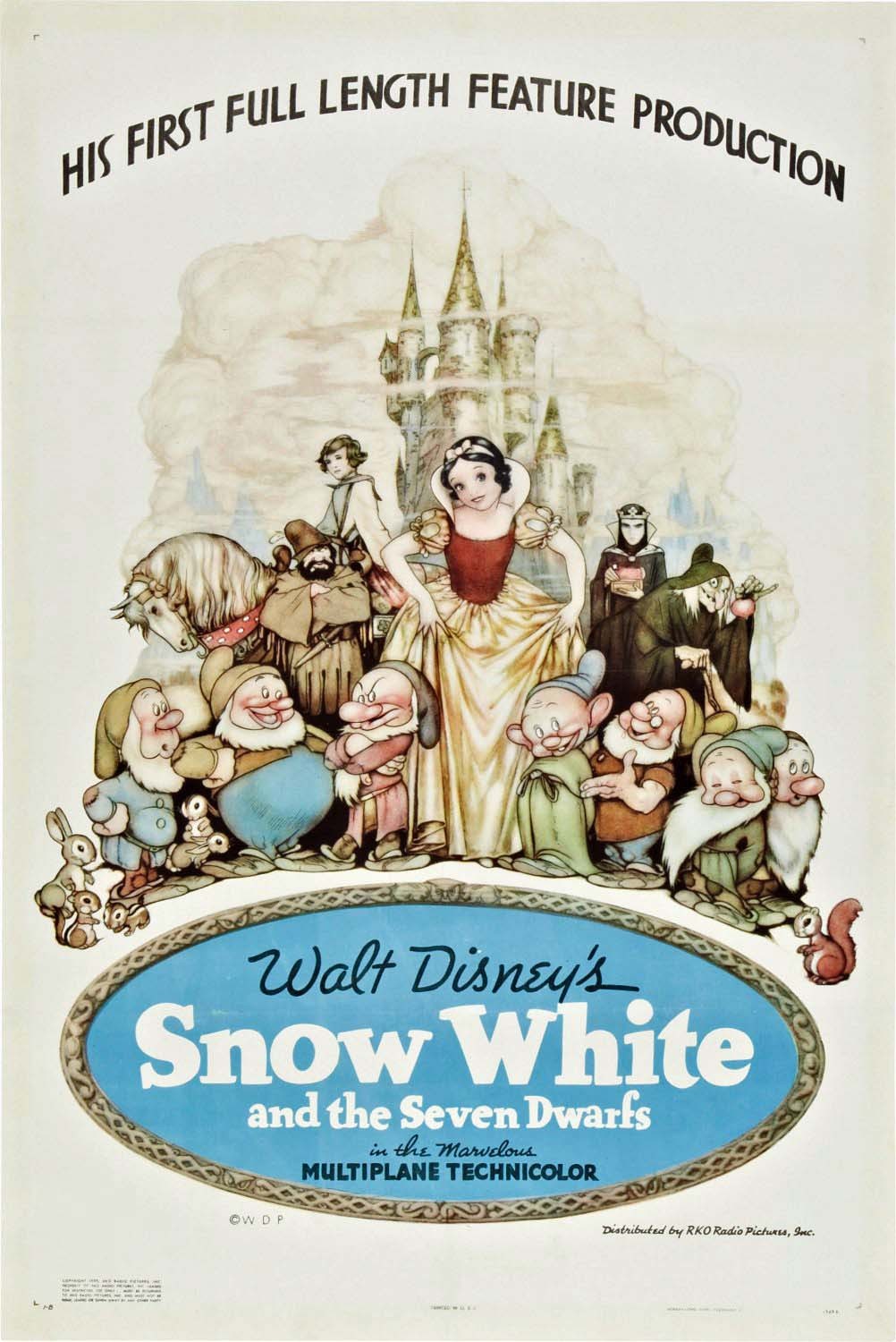
Disney's Snow White (1938)

It was called "Disney's Folly." Who on earth would want to sit still for 90 minutes to watch an animated cartoon? And why pick a well-worn Grimm's Fairy Tale that every schoolkid knows? But Walt Disney seemed to thrive on projects which a lesser man might have written off as "stupid" or "impossible". Investing three years, $1,500,000, and the combined talents of 570 artists into Snow White and the Seven Dwarfs, Disney produced a film that was not only acknowledged a classic from the outset, but also earned 8,500,000 depression-era dollars in gross rentals. Bypassing early temptations to transform the heroine Snow White into a plump Betty Boop type or a woebegone ZaSu Pitts lookalike, the Disney staffers wisely made radical differentiations between the "straight" and "funny" characters in the story. Thus, Snow White and Prince Charming moved and were drawn realistically, while the Seven Dwarfs were rendered in the rounded, caricatured manner of Disney's short-subject characters. In this way, the serious elements of the story could be propelled forward in a believable enough manner to grab the adult viewers, while the dwarfs provided enough comic and musical hijinks to keep the kids happy. It is a tribute to the genius of the Disney formula that the dramatic and comic elements were strong enough to please both demographic groups. Like any showman, Disney knew the value of genuine horror in maintaining audience interest: accordingly, the Wicked Queen, whose jealousy of Snow White's beauty motivates the story, is a thoroughly fearsome creature even before she transforms herself into an ancient crone. Best of all, Snow White clicks in the three areas in which Disney had always proven superiority over his rivals: Solid story values (any sequence that threatened to slow down the plotline was ruthlessly jettisoned, no matter how much time and money had been spent), vivid etched characterizations (it would have been easier to have all the Dwarfs walk, talk and act alike: thank heaven that Disney never opted for "easy"), and instantly memorable songs (Frank Churchill, Leigh Harline, Paul J. Smith and the entire studio music department was Oscar-nominated for such standards-to-be as "Whistle While You Work" and "Some Day My Prince Will Come").
Walt Disney's New characters in his first full-length production!
Queen: Magic Mirror, on the wall, who is the fairest one of all?
Walt Disney Studios, Burbank, California, USA
Fifty ideas for the dwarves' names and personalities were listed in the film's proposal; the list included all of the names finally included except Dopey and Doc (Dopey being the last to be developed). Some of the dwarves were: Awful, Biggy, Blabby, Dirty, Gabby, Gaspy, Gloomy, Hoppy, Hotsy, Jaunty, Jumpy, Nifty, and Shifty. Sneezy was a last-minute replacement for Jumpy.
The "special" Academy Award granted to the picture consisted of one regular sized award and seven smaller sized awards.
Convinced that it would fail, the Hollywood film industry labeled the film "Disney's Folly".
Scenes planned, but never fully animated: - The queen holds the prince in the dungeon and uses her magic to make skeletons dance for his amusement. - Fantasy sequence accompanying "Some Day My Prince Will Come" in which Snow White imagines herself dancing with her prince in the clouds beneath a sea of stars - Dwarves building Snow White a coffin with help from woodland creatures. - The song "Music in Your Soup" where the dwarves sing about the soup that Snow White had just made them. - A musical number, "You're Never Too Old to Be Young", featuring the dwarves. It was pre-recorded, but never animated.
Pinto Colvig, who voiced Sleepy and Grumpy, was the voice of Goofy.
To keep the animators minds working, Walt Disney instituted his "Five Dollars a Gag" policy. One notable example of this policy is when Ward Kimball suggested that the dwarfs' noses should pop one by one over the foot boards while they were peeking at Snow White.
The Prince was originally a much more major character, but the difficulty found in animating him convincingly forced the animators to reduce his part significantly.
When comedian Billy Gilbert found out that one of the dwarfs' names was Sneezy he called up Walt and gave him his famous sneezing gag and got the part.
Most of the voice actors reprised their roles for an appearance on "The Lux Radio Theater".
25 songs were written for the movie but only eight were used.
The first full-length animated feature film to come out of the United States. (The first ever were Ap?stol, El (1917) and Sin dejar rastros (1918) by Quirino Cristiani but both films are considered lost. The oldest full-length animated feature film that can still be seen today is Die Abenteuer des Prinzen Achmed (1926), which clocks in at 65 minutes, and was animated entirely in silhouette.)
Publicity material relates that production employed 32 animators, 102 assistant, 167 "in-betweeners", 20 layout artists, 25 artists doing water color backgrounds, 65 effects animators, and 158 female inkers and painters. 2,000,000 illustrations were made using 1500 shades of paint.
Deanna Durbin auditioned for the voice of Snow White, but was not chosen because Disney felt her voice was too mature.
Dopey initially was to be a talking dwarf, but was made mute when a suitable voice was not found.
Snow White and the Seven Dwarfs became the first release in Disney's new Platinum Edition DVD series, hitting stores on October 5, 2001. On its first day, more than 1 million copies were sold.
Was the first film to ever have a soundtrack recording album released for it.
One of the first films to have related merchandise available at the time of premiere.
At a recording session, Lucille La Verne, the voice of the Wicked Queen, was told by the Disney animators that they needed an older, raspier version of the Queen's voice for the Old Witch. Ms. Laverne stepped out of the recording booth, returned a few minutes later, and gave a perfect "Old Hag's voice" that stunned the animators. When asked how she did it, she replied, "Oh, I just took my teeth out."
The British Board of Film Censors (now, the British Board of Film Classification) gave the film an A-certificate upon its original release. This resulted in a nationwide controversy as to whether the enchanted forest and the witch were too frightening for younger audiences. Nevertheless, most local authorities simply overrode the censor's decision and gave the film a U-certificate.
Held the title of highest grossing film ever for exactly one year, after which it was knocked out of the top spot by Gone with the Wind (1939).
Spoonerizing comedian Joe Twerp was earlier considered for the role of Doc, according to the DVD supplementary material. The part went to Roy Atwell instead, but Twerp did perform as the voice of Doc on the radio.
Sergei M. Eisenstein, director of Bronenosets Potyomkin (1925), called it the "Greatest film ever made."
Sterling Holloway, who later appeared in many Disney films, was considered for the role of Sleepy.
Because Disney did not have its own music publishing company when the earlier animated films were produced, all the rights to publish the music and songs from this film are actually still controlled by the Bourne Co. In later years, the Studio was able to acquire back the rights to the music from all of the other films, except this one. Prior to Snow White, a movie soundtrack recording was unheard of and with little value to a movie studio.
The first animated feature to be selected for the National Film Registry.
It took animator Wolfgang Reitherman nine tries to get the animation of the Slave in the Magic Mirror just right. He achieved it by folding the paper in half, drawing one half of the face, then turning the paper over and tracing the other half. He was then dismayed when his hard work was obscured by fire, smoke and distortion glass for the film.
For the scene where the dwarves are sent off to wash, animator Frank Thomas had Dopey do a hitch step to catch up to the others, as suggested in the storyboard. Walt Disney liked it so much he had the step added to other scenes - much to the chagrin of the other animators, who blamed Thomas for the extra work they had to do.
The film came third in the UK's Ultimate Film, in which films were placed in order of how many seats they sold at cinemas.
Was the first of many Disney films to have its premiere engagement at New York City's Radio City Music Hall. At the end of the film's initial engagement there, all the velvet seat upholstery had to be replaced. It seems that young children were so frightened by the sequence of Snow White lost in the forest that they wet their pants, and consequently the seats, at each and every showing of the film.
Walt Disney came up with the idea for "Snow White" when he was only 15, working as a newsboy in Kansas City. He saw a major presentation of a silent film version of the tale starring Marguerite Clark. The screening was held at the city's Convention Hall in February, 1917, and the film was projected onto a four-sided screen using four separate projectors. The movie made a tremendous impression on the young viewer because he was sitting where he could see two sides of the screen at once, and they were not quite in sync.
Mel Blanc was considered for the voice of Dopey.
The movie was to start with scenes involving Snow White's mother, but they had to be cut to avoid the wrath of the censor.
Marge Champion served as a movement model for Snow White; some of this animation was later reworked for Maid Marion in Disney's Robin Hood (1973).
Some animators were opposed to the name Dopey, claiming that it was too modern a word to use in a timeless fairy tale. Walt Disney made the argument that William Shakespeare used the word in one of his plays. This managed to convince everyone, although any reference to the term "dopey" is yet to be found in any of Shakespeare's work.
Ward Kimball nearly quit after his two main sequences (the dwarfs eating soup and building a bed for Snow White, respectively) were cut. Walt Disney convinced him to stay by giving him the character of Jiminy Cricket in the next feature, Pinocchio (1940).
To give Snow White a more natural look, some of the ink and paint artists started applying their own rouge on her cheeks. When Walt Disney asked one how they would apply the rouge correctly for each cel, she responded, "What do you think we've been doing all our lives?"
Film Daily- Los Angeles, Thursday, April 6, 1939: Suit was filed yesterday in Supreme Court by Modest Altschuler against RKO Radio Pictures, Walt Disney Enterprises, Walt Disney Productions, Irving Berlin, Inc. and Frank Churchill. Plaintiff asks $250,000 damages, plus injunction and accounting of profits, claiming he is composer of "Russian Soldier's Song," which he alleges was plagiarized by the Frank Churchill composition, "Whistle While You Work."
In the original fairy tale, the Queen dies when she is forced to dance in burning metal shoes. Disney dropped the idea.
[June 2008] Ranked #1 on the American Film Institute's list of the 10 greatest films in the genre "Animation".
Disney Studios in Burbank was built with the profits from Snow White and the Seven Dwarfs (1937).
Dancer Marge Champion, whose movements as a dancer were rotoscoped to be used as guide for Snow White, married and divorced one of the Disney animators on the film, 'Art Babbit'. She later married, danced and acted on film and stage with famed choreographer and director Gower Champion.
Continuity
Doc's lantern disappears when they reach the house after working in the mine.
Dopey breaks off the front door handle and seconds later it's there again.
When the dwarfs reach the house after working, they drop some tools and scurry behind the trees. A couple of minutes later they have tools again.
When the birds are putting yellow flowers in the vase, right before they put the final one in that sticks up a bit in the middle, a flower that ends up right behind it appears out of nowhere.
The string changes on the apple while being poisoned. It starts out plain and dark, but turns pink with a bow on the end.
As Snow White is piling clothes on top of the deer, birds drop a green cloth over the chipmunk on the deer's back. In the next shot, the cloth is now a shirt sleeve.
Marching home from the mine, the dwarfs march with left down on the downbeat. After returning from a short cut away scene, the dwarfs then march with their right foot on the downbeat.
When Snow White first decides to clean the dwarves' house, she takes off her cape and hangs it on the wall. When the dwarves' return from the diamond mine later and are shocked to find the house clean, the cape is gone.
When Snow White is cleaning the cabin, the birds put daffodils in the vase. Later when Sneezy goes to the flowers on the table and sneezes, the flowers have turned into goldenrod.
The size of Doc's "swanette" changes size and appearance before the end of "The Silly Song".
The famous sequence where the dwarves race back to the cottage to save Snow White is filled with continuity errors
- if you pause the film just when the turtle is passed for the last time, you can see Sleepy is mounted on a stag. However, for the rest of the film he is mounted on a doe.
- Bashful is originally in front of Sneezy, yet for the rest of the chase the order is mysteriously reversed.
- In another scene, just before Snow White bites the apple, Sleepy and Sneezy are seen on the deer, while Bashful is riding another deer by himself (Sleepy and Bashful have been switched).
- In one scene, the whole order of the dwarves is changed (Dopey riding a stag, Sneezy sitting alone on a doe...)
Sleepy and Bashful's beards are the longest in most of the film, with Grumpy's beard shorter. However, when the dwarves peer over the edge of the cliff to see the Witch's demise, Grumpy's beard is suddenly longer than the others by far.
The seat on the organ when Snow White comes to the cottage is a bench. Then when Snow White and the dwarfs are dancing and singing, the seat is no longer a bench.
When Dopey investigates the bedroom and runs out, the door was left open, but when all the dwarfs go to investigate, it's closed.
During the Dwarfs' first trek home from the mine, Dopey suddenly has a lantern hanging off his pickax that wasn't there when the trip started.
Revealing mistakes
In the last scene, the Prince shimmies. The cels weren't lined up correctly when the scene was shot, and his body shakes. Walt Disney was horrified when he saw the mistake in the color dailies, and wanted it corrected. No money was available to make the correction (the film was already far over budget), so Walt's brother and business partner, Roy Disney, declared "Let the Prince shimmy!" And so he did... until 1993, when the mistake was corrected during Disney's digital restoration of the film.
When the crag the Witch is standing in is hit by lightning, the splashes of rain on the wall behind the boulder are seen over it. Apparently the cameraman placed the cels on the wrong order, placing the splashes over the boulder instead of underneath. The splashes form the silhouette of the background behind the boulder, which is made evident as it rolls off the cliff.
Miscellaneous
Just before Dopey tries to jump towards the piece of soap, the soap moves a few inches towards him.
Factual errors
When Doc is assaying the (already cut) gemstones from the mine, he puts the jeweler's loupe into his eye backwards.
Character Errors (possibly deliberate errors by the filmmakers)
During the final scene where Snow White kisses the dwarves goodbye, she only kisses six of them.