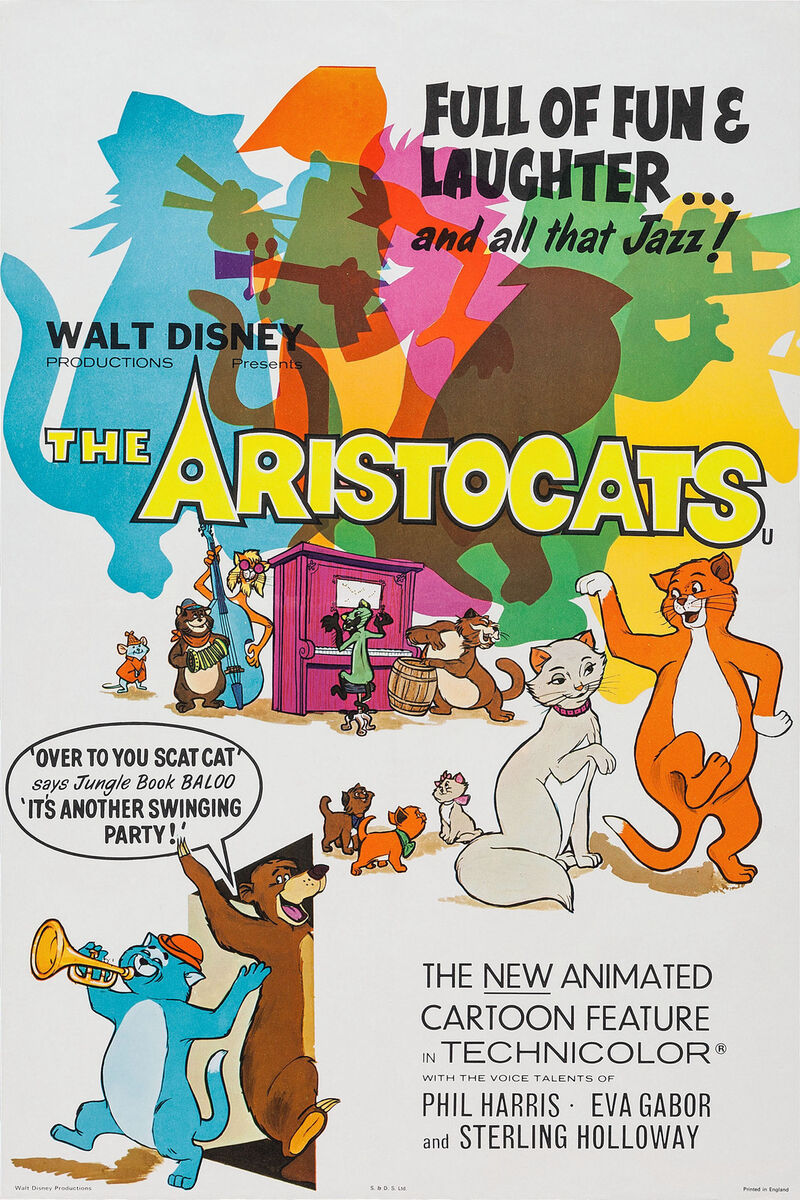
Disney's The Aristocats (1970)

Retired opera star Adelaide Bonfamille enjoys the good life in her Paris villa with even classier cat Duchess and three kittens: pianist Berlioz, painter Toulouse and sanctimonious Marie. When loyal butler Edgar overhears her will leaves everything to the cats until their death, he drugs and kidnaps them. However retired army dogs make his sidecar capsize on the country. Crafty stray cat Thomas O'Malley takes them under his wing back to Paris. Edgar tries to cover his tracks and catch them at return, but more animals turn on him, from the cart horse Frou-Frou to the tame mouse Roquefort and O'Malley's jazz friends.
DIG THESE CATS...and all that JAZZ!
Scat Cat: [singing] Everybody wants to be a cat / Because a cat's the only cat who knows where it's at.
Thomas O'Malley: Tell me! Everyone is picking up on that feline beat / 'Cause everything else is obsolete.
Scat Cat: Strictly high-buttoned shoes.
Walt Disney Feature Animation - 500 S. Buena Vista Street, Burbank, California, USA



The Aristocats was inspired by the true story of a Parisian family of cats, circa 1910, that inherited a fabulous fortune.
This was the last animated feature to be approved by Walt Disney and the studio's first animated feature to be entirely completed after his death. It should be noted, however, that Disney had spent time working on the story for The Rescuers (1977) (released seven years later) around the time The Jungle Book (1967) entered production.
The character of Scat Cat was designed to be voiced by Louis Armstrong. The character's look was modeled after Armstrong - the way he played his trumpet, his roly-poly physique, right down to the prominent gap between his teeth. However, Armstrong was unable to record a single line due to illness. His replacement, Scatman Crothers, was directed to "Pretend you're Satchmo."
The Sherman Brothers (Richard M. Sherman & Robert B. Sherman) talked Maurice Chevalier out of retirement to sing the title song. It was his last work before his death in 1972.
The characters of Toulouse and Berlioz are named after two famous French artists - painter and illustrator Henri de Toulouse-Lautrec and composer Hector Berlioz.
Continuity
The character of Duchess is very different in the second scene (the will) than in the rest of the film. In particular she has her nose more clearly defined. The rest of the scene seems also to have been designed by different animators, who used a more "sketchy" style.
When Scat Cat and his gang are playing "Everybody Wants To Be A Cat", one of the cats is playing the guitar left-handed, and a moment later right-handed.
As the crate with Edgar in it slides through the barn door, the padlock suddenly appears on its latch.
In the country lane shot right before we first meet Napoleon and Lafayette, Edgar's motorcycle's side car switches sides. This is due to the series of cells being photographed backwards while editing.
The studs on Duchess' collar disappear and reappear throughout the movie.
Factual errors
When Edgar first hears that the cats were the primary inheritors, he begins to plot their demise. He imagines millions of dollars, with "$" signs dancing in his eyes. But since the movie was set in France, the money unit should have been francs.
During Edgar's motorbike chase he passes a signpost showing directions to Tour Eiffel and Pl(ace) de L'etoile spelled in the French, but 'Park' Monceau which in French would be 'Parc' Monceau.
Incorrectly regarded as goofs
In the beginning of the movie, Edgar is driving the carriage from the left of the bridge to the right of the bridge on the way home. Later in the movie, when Edgar is driving his motorcycle with the cats in the sidecar, he travels from left to right on the bridge but going away from home. However, the Eiffel Tower is visible in the first scene but not the second, so the bridge may be being viewed from the opposite direction.
Revealing mistakes
In the opening scene when Edgar helps Madame off the carriage, Madame feeds Frou Frou, but no food is visible in her hand.
When Marie, Berlioz, and Toulouse race each other to their little cat door, they fight over who will go first through the door. When Marie mentions that she's a lady and should go first, it can be seen through the door that it is nighttime. After Toulouse comments she's not a lady, and Berlioz pulling her tail saying she's nothing but a sister, it is once again daytime as seen through the door.
When Thomas O'Malley is singing to Duchess, in one shot her collar is completely blue.
Miscellaneous
In the beginning credits, they show that the song She Never Felt Alone by Robert B. Sherman and Richard M. Sherman is in the movie - but the song never played in the film. The first part was supposed to be played before the lawyer came into the bedroom that the will was created at by the old woman, and the second part was supposed to play when Duchess explaining to Thomas why she has to return to Paris.
Anachronisms
Traffic lights are shown during Edgar's drive through Paris with the cats. Apart from a traffic light installed in 1868 (which exploded in 1869) in London outside the Houses of Parliament, traffic lights were first used in 1914 in Cleveland, Ohio, four years after this movie takes place. (with three-color traffic lights first used in Detroit in 1920.)
When singing, "Everybody Wants to be a Cat," Shun Gon mentions fortune cookies. The film takes place in Paris, France in 1910. Fortune cookies were first baked in San Francisco in 1918, eight years after the events of the film.
The milk van that the cats catch a ride on is a Fordson BB, which didn't go in to production until the late 1920's, and the film takes place in 1910.
The truck at the end of the film is a Morris-Commercial FE Series, which wasn't made until 1955, which was 45 years after the film is set, and 15 years before the film was released.
In the scene where Edgar is ironing his clothes, he is wearing striped boxer shorts, where this kind of underclothing wasn't invented until 1925 - 15 years after the setting of this movie.
Audio/visual unsynchronized
When Marie hops up onto the piano, the lowest keys are hit, but the sounds come from keys in a much higher register. The same thing happens when Berlioz slides down the keyboard to get back at Marie for pulling him off the bench; the keys sound much higher than they should.
When Berlioz leans on the piano keyboard right before practicing, two notes are heard, which are D and G-sharp, which are three steps apart. However, the keys he are leaning on are A and B, which are only one step apart and not the notes that were heard.
Errors in geography
The label on the trunk says "Timbuktu, French Equatorial Africa", but Timbuktu (now in Mali) was in French West Africa (specifically the colony of Upper Senegal and Niger), not French Equatorial Africa.
The daily newspaper is titled "Le Journal de Paris" that is French which roughly translates to "The Paris Newspaper" or "The Journal of Paris", but the headlines and text within them are shown are in English.
Plot holes
Why does Edgar think he needs to get rid of the cats in the first place? They can't use money, so he'll effectively be in charge of it anyway. Not only that, he seems to overestimate the lifespan of each cat, basing his calculations on their "nine lives." Most cats only live 10-15 years, meaning that Edgar would inherit the money within a relatively short time.
Why is Edgar thinking the inheritance is happening right away, to the point that he has to hurry to get rid of the cats? Madame Adelaide is not dying.
Madame Adelaide and her lawyer Georges Hautecourt fail to acknowledge Edgar's vicious plot towards the former's cats.
Character error
Near the end, after George notices the music coming from elsewhere in the house, the scene changes to the alley cats playing their instruments and dancing. Scat Cat is two places at once--on the top of the piano with other cats (third from the right), and also on the floor in the bottom right of the screen.
When Thomas O'Malley tells Roquefort to fetch Scat Cat and the alley cats, he doesn't tell him where to go.
After Edgar is kicked into the box that he was planning to use to send the cats to Timbuktu, it is shown with the padlock once again locked and sealed on the front, despite the fact that Roquefort had removed the padlock and there had been no time for anyone to put it back on before it was kicked outside.
Edgar refers to the money that he would inherit as "dollars" and the American dollar sign flashes in his eyes; however, the film takes place in France.
When the Alley Cats fight Edgar, Roquefort orders everyone to be quiet while he works on cracking the padlock. Even Edgar stops. This is strange since Madame Adelaide Bonfamille and the other humans can't understand animals. It's especially strange since Edgar can't understand his horse.