
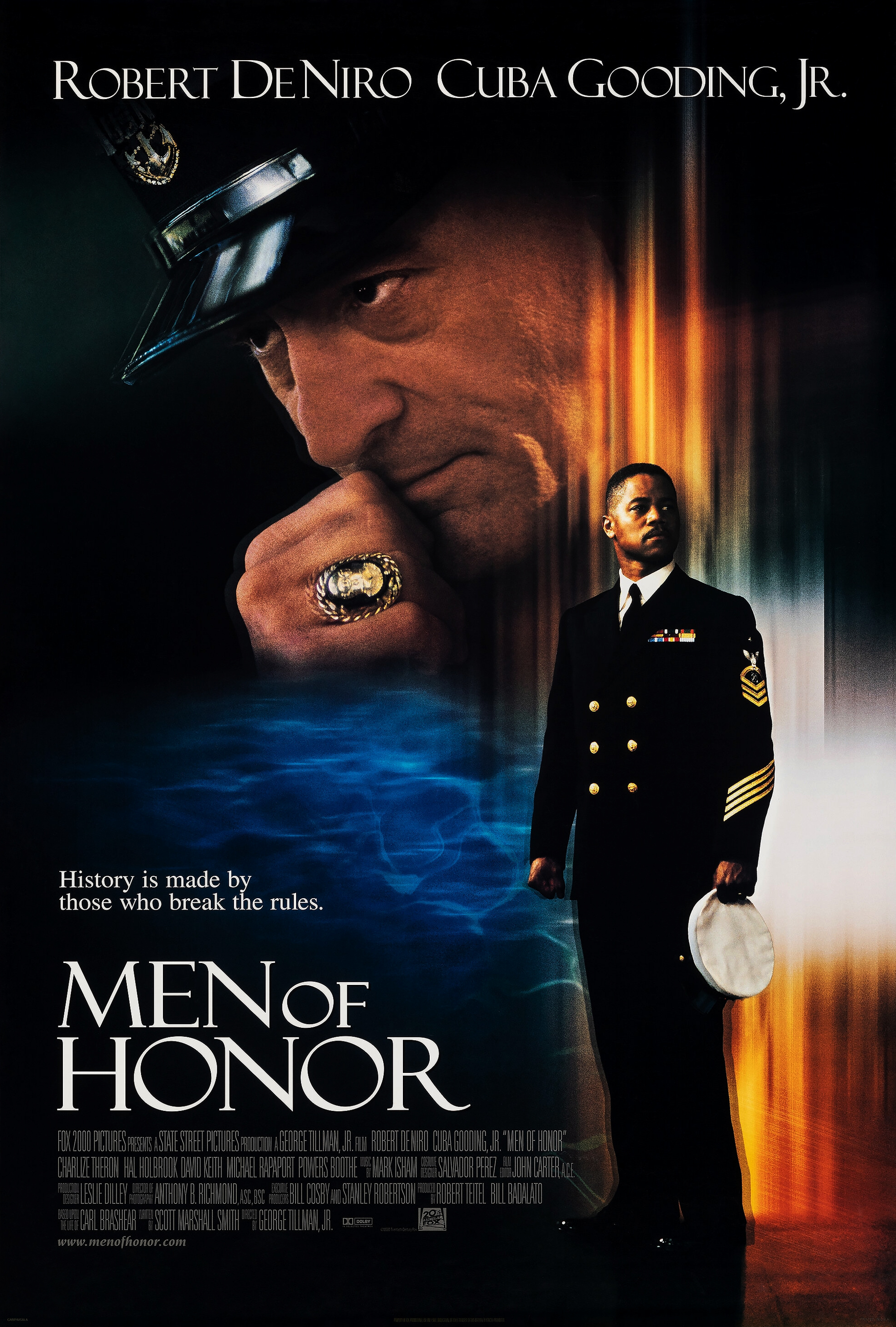
Men of Honor (2000)

The story ultimately revolves around two "men of honor"; their relationship, their individual and joint failures and triumphs. Carl Brashear is determined to be the first African American Navy Diver in a time where racism is rife. Leslie Sunday is his embittered trainer, determined to see him fail. Fate, challenges and circumstances eventually draw these two men together in a tale of turbulence and ultimately triumph.
History is made by those who break the rules.
Billy Sunday: The Navy Diver is not a fighting man, he is a salvage expert. If it is lost underwater, he finds it. If it's sunk, he brings it up. If it's in the way, he moves it. If he's lucky, he will die young, 200 feet beneath the waves, for that is the closest he'll ever get to being a hero.
Cathlamet, Washington, USA
Diblee Point, Rainier, Oregon, USA
Long Beach, California, USA
Longview, Washington, USA
North Plains, Oregon, USA
Portland, Oregon, USA
(Restaurant, exteriors)
Rainier, Oregon, USA





Brazilian diver Alberto Jos? do Nascimento was the only one that supported Brashear since the beginning in the team, but was ignored in the movie and replaced by different characters along the film.
Master Chief Billy Sunday (Robert De Niro) was based on two people in Carl's career.
In 2009, the USNS T-AKE 7 was named the USNS Carl Brashear, in honor of Master Chief Boatswain's Mate (Master Diver) Carl M. Brashear (1931-2006), who joined the U.S. Navy in 1948. He was one of the first African-Americans to graduate from the Navy Diving School, and was designated a Navy salvage diver. He was the first African-American to qualify and serve as a master diver while on active duty, and the first U.S. Navy diver to be restored to full active duty as an amputee, the result of a leg injury he sustained during a salvage operation. After thirty-one years of service, Brashear officially retired from the U.S. Navy on April 1, 1979.
This picture was made with the blessing and cooperation of the U.S. Department of the Navy.
The year after this film was released, Cuba Gooding, Jr. portrayed Doris Miller, the first African-American to be awarded the Navy Cross, in Pearl Harbor (2001).
Continuity
At the beginning of the final diving exercise, the big Navy clock says 2:00. A few hours later, when a diver comes out of the water, Sunday says that he's been down for over four hours. The next scene shows a nervous Jo waiting for a phone call from Brashear, and the clock says 3:40.
In every scene with a diving helmet, it's screwed on clockwise. However, when Carl Brashear is on television searching for the H-Bomb, it's screwed on counter-clockwise.
While Carl puts his wedding band with his tags, he takes off his ring, removes his tags from around his neck and puts them on his chest. Nothing is around his neck. In the next shot, the tag chain is around his neck. In the next shot, he puts the ring on the tags and puts the chain back around his neck.
During the hearing when Carl takes 12 steps, as he finishes step 3, his left foot is clearly on a black tile. When he takes step four, the left foot is now on a white tile.
When Gwen visits Billy in the rehab center, during their conversation outside, the length of her cigarette keeps changing.
Factual errors
The bomb was found at 2500+ feet by submersibles. Recovery was attempted but failed. The bomb was re-located at nearly 3000 feet by submersibles. Hard-hat diving was limited to 350 feet, therefore divers could not be used in the recovery until it was raised to about 100 feet by submersibles, so divers could attach recovery cables to the bomb and raise it from the water. The recovery ships were USS Petrel and USS Cascade.
The news report in the film says that three 50-Megaton nuclear warheads were lost in the accident, two were immediately recovered, and the third was being searched for. In real life, four Mk28 bombs were lost in the accident, three were located almost immediately, and the fourth was searched for. They were gravity bombs, which fall freely to earth, not warheads, which are carried on missiles. Their largest possible yield was 1.45 Megatons. The only 50-Megaton bomb produced was the Tsar Bomba, a prototype tested by the Soviet Union on Oct 30, 1961.
When Jo meets Carl, she says that she hasn't seen her father since she was 9 years old. When she comes to the Navy bar, she tells Carl that she pulled her father out of enough bars and she couldn't do it anymore. It's highly unlikely that she was pulling her father out of bars at such a young age.
Carl Brashear recovers a Hydrogen bomb. The newspaper that Billy Sunday reads says "A-Bomb recovered." In civilian and military parlance, a Hydrogen bomb is called H-bomb, and an Atom Bomb is called an A-bomb.
People often shown saluting while not wearing a hat. Sailors and Marines do not salute while uncovered. The only exception is when in the company of Army or Air Force people, who do salute uncovered, because it might appear discourteous.
Incorrectly regarded as goofs
Brashear uses a pay phone in a different way from the posted instructions, but in a way that quite likely worked (inserting his dime first instead of after the called party answers).
Revealing mistakes
Even by the standards of the 1950s, some of the racism seen at the Divers Training School would have been excessive. Chief among them, the order of the Training School Commander to let Carl Brashear die during his final diving exam, would simply not have been followed by Navy personnel since this was in a sense a criminal order even in those days.
When Sunday is found guilty of assaulting Hanks and is handed his sentence, the camera zooms into Sunday's face and Sunday blinks backward twice.
Miscellaneous
After the Russian submarine passed Carl looking for the bomb it makes a sharp right turn. The footage appears to be the same footage used in the sub battle USS Alabama against the Russian Akula class submarine in 1995's "Crimson Tide"
After his wife's visit to the rehab facility, Sunday reads the Navy Times newspaper. The text to right of the photo contains several misspellings and typos.
Anachronisms
When Brashear is preparing for the final meeting to review his readiness to be reinstated, the US flag visible in the background has 48 stars. In 1968, it should have 50.
Everybody in the movie has embroidered name tapes on their uniform shirts and trousers. That wasn't fully implemented until 1999. During the period in which the movie is set, names would have been written in black India ink using a stencil. Sometimes it was scrawled in marker.
The pay grade of Senior Chief Petty Officer was not created until June 1, 1958. Service-wide exams were conducted for eligible Chief Petty Officers on August 5, 1958. The first batch of Chiefs to be promoted to Senior Chief occurred on November 16, 1958.
When Carl Brashear is in his hospital bed, in 1968, Admiral French and Captain Hanks wear the Navy Sea Service Deployment Ribbon. That ribbon was established in May 1980, and made retroactive to August 1974.
When the divers are inside the sunken ship, the hose is taped. The MkV diving helmet was replaced by the Mk12 in 1979, and taped hoses were not used until 1984.
Crew or equipment visible
When Carl swims away from the warship at the beginning of the movie, bubbles from the safety divers pop up in front of the camera.
Errors in geography
Mountains are clearly visible in the scenes set in Bayonne, NJ. In real life, Bayonne is nowhere near any mountains.
Plot holes
Twice early in the movie, Jo just shows up where someone like her would never have gone by herself, like into the Navy bar where Brasher and Sunday had their breath-holding contest, or unescorted onto the Navy base the night of Carl's final diving exam.
Character error
Throughout the film, sailors salute chief petty officers and address them as "sir." Enlisted personnel only salute and address officers as "sir." A sailor addresses a chief petty officer (senior enlisted person) as "chief," "senior chief," or "master chief," not "sir." When an enlisted man is referred to as "sir", the usual response is, "Don't call me sir...I work for a living."
Throughout the film, sailors salute chief petty officers and address them as "sir." Enlisted personnel salute and address as "sir" officers only. A sailor addresses a chief petty officer (senior enlisted person) as "chief," "senior chief" or "master chief," not, "sir."