
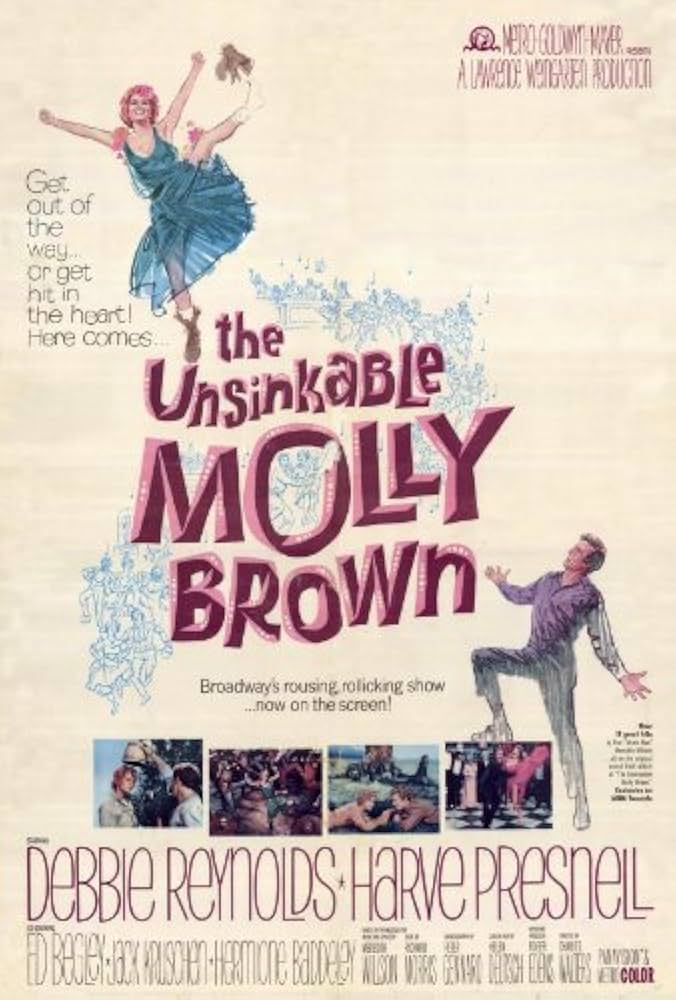
The Unsinkable Molly Brown (1964)

Majestic mountains are in the background and a waterfall in the foreground. Is that a canoe on the river? No it's a cradle with a baby. The buoyant Molly Brown has survived the first crisis of her life -- a flood. Sixteen years later she sets out to make her way in the world. Can she sing and play the piano? She assures the Leadville saloon keeper that she can and learns quickly. Soon she is the bride of Johnny Brown, who in a few years will be able to replace the original cigar wrapper wedding ring with a replica in gold and gemstones. But it takes more than a few million dollars to be accepted by Denver society. The Browns head for Europe and bring a few crowned heads back to Denver for a party that turns into a ballroom brawl. Molly goes to Europe alone, returning on the Titanic. She didn't survive a flood as a baby for the story to end here. ?Dale O'Connor
Can a girl find happiness with $20,000,000? YOU BET!
Molly Brown: I'm interested in everything because I don't know nothing.
Black Canyon of the Gunnison National Park, Colorado, USA
Metro-Goldwyn-Mayer Studios - 10202 W. Washington Blvd., Culver City, California, USA
St. Louis Street, Lot 3, Metro-Goldwyn-Mayer Studios - 10202 W. Washington Blvd., Culver City, California, USA
(demolished in 1972)
Scott House, St. Louis Street, Lot 3, Metro-Goldwyn-Mayer Studios - 10202 W. Washington Blvd., Culver City, California, USA
(Molly Brown's Denver residence, demolished in 1972)

As with most Hollywood biopics, there are liberties taken with the real story, most notably in that Margaret (Molly) and J.J. never reconciled. They separated in 1909, although they remained good friends who cared deeply for each other until his passing. She was also not quite the social outcast depicted in the film. Other aspects of her life that were missing from the movie: they had two children, a son and daughter. Margaret Brown was a passionate social crusader and philanthropist; she was a champion of women's rights, including education and the vote. She championed workers' rights, historic preservation, education and literacy, and child welfare, including helping to found the modern juvenile court system. After the sinking of the Titanic, she was noted for her efforts to commemorate the heroism of the men aboard the ship. After WWI, she helped to rebuild France and to aid wounded soldiers, and received the French Legion of Honor. She also ran twice for the U.S. Senate. She died in 1932.
This is Debbie Reynolds' personal favorite of her movies.
The sequence where J.J. Brown accidentally burns his money after Molly has hidden it in the stove didn't really happen. It was made up by a Denver journalist, after Molly Brown became a hero on the Titanic. When her daughter asked why she didn't refute the false story, Molly Brown supposedly replied, "It's better that they write
something
about me than nothing." (Kathy Bates, as Molly Brown, repeats the story in James Cameron's Titanic (1997).) Molly Brown is also said to have reported the story with a slightly different ending. Molly did hide money in the potbelly stove in their Leadville cabin, and Johnny unknowingly started a fire on a particularly cold night. According to Molly, as reported in newspapers interviews during her lifetime, "Just think if it had been paper money!" The money was gold and silver coins, which melted and adhered to the stove. Miners didn't trust paper money in those years. The stove had to be broken apart and resmelted to separate the iron, gold and silver.
Margaret Brown was in Paris visiting daughter Helen when she got a cable alerting her that her infant grandson was very ill. She cut her visit short and hurriedly caught the earliest ship home -- thus, she was very much an accidental passenger on the Titanic.
Film debut of Harve Presnell, who had originated the role in the Broadway production.
Continuity
When the Duchess is coming down the staircase at Molly's party, Molly elbows Gladys and tells her to curtsey. In the next shot, which is from farther back and takes in the guests and the staircase, the same exchange between Molly and Gladys is shown again.
In the long shot showing the Titanic approaching the iceberg, the iceberg is coming up on the starboard (right) side of the ship. In the next shot, an underwater close-up of the ship striking the iceberg, the iceberg is on the port (left) side of the ship.
When Buttercup Grogan is drinking beer with Molly, Johnny and Shamus, the level of beer in her glass goes from nearly full to nearly empty and back to nearly full.
Factual errors
The Molly Brown House in Denver is actually quite small. Only one room had a smidgen of red wallpaper (she also thought too much red to be gauche). Her parties were well-attended (although the orchestra played from the balcony outdoors and serenaded the whole neighborhood), and she was accepted by her peers even before the Titanic. The larger house, which she named Avoca, was at the time outside of Denver. Both houses are restored and open to the public.
Mrs. McGraw's (really Mrs. Crawford Hill) mansion was located on Sherman Street between 9th and 10th on the West side of the street. The Brown home is on Pennsylvania between 13th and 14th on the East side of the street. The Brown home is a museum and the Hill mansion is now the location of a law firm.
A long shot during the Titanic sinking shows just the ship's bow deck being submerged, the water not even reaching the bridge. Yet the entire rest of the steamer is raised out of the water. The weight of the water filling only such a small section of the hull wouldn't be enough to accomplish that.
Miscellaneous
The pie thrown at the end of Molly's party appears to be in a disposable aluminum pie pan. The disposable pie pans were not used until 1948.
Anachronisms
When Molly first meets John, in the 1880s, they look at some picture postcards she has with her. The picture occupies one entire side of each card, but postcards of this type were not available in the USA until 1907.