Scrooge (1951)

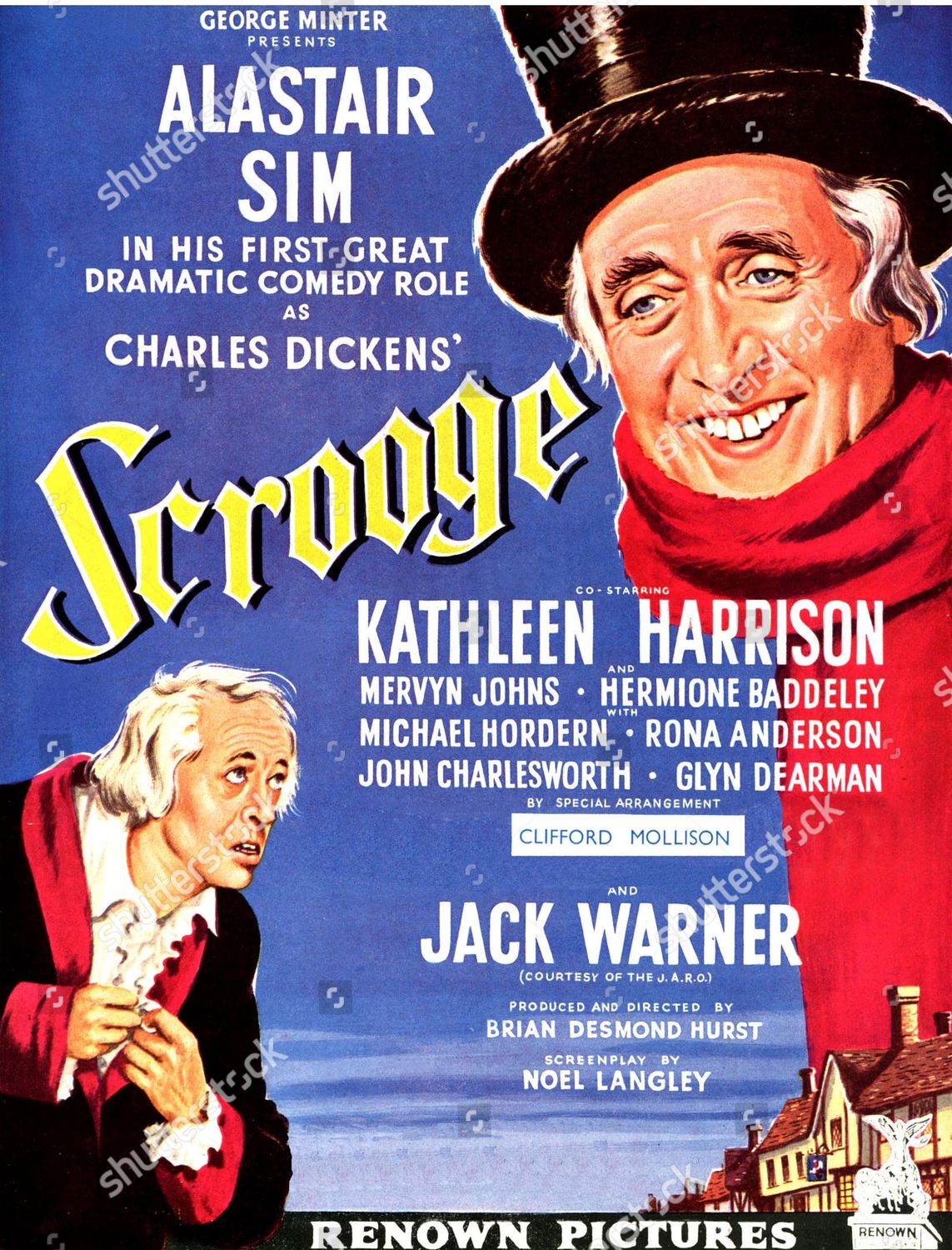
Parsimonious Victorian money-lender Ebenezer Scrooge, a hated misanthrope stubbornly refusing to believe in Christmas and share his inexhaustible wealth, can't be bothered with the destitute during the most festive time of the year. After all, the sceptical curmudgeon is bent on spending the holy night alone. Instead, a sympathetic old friend pays Ebenezer an unexpected visit, paving the way for an otherworldly, eye-opening encounter. As the pale spirits of Christmas Past, Present, and Future make their presence felt, pressing questions arise. What do the unwelcome ghosts want? With a heart as cold as ice, can a wicked miser admit the error of his ways and embrace change? Above all, is Scrooge ready to love and be loved?
The Holiday Picture of All Time! Charles Dickens' Joyous Classic!
Jacob Marley: I wear the chain I forged in life! I made it link by link and yard by yard! I gartered it on of my own free will and by my own free will, I wore it!
8 Scandrett Street, London, England, UK
(Scrooges House exterior)
Old Barrack Yard, London, England, UK
(Final scene - Scrooge goes through arch to Tiny Tim)
2 Cathedral Street, London, England, UK
(Scrooge's office/ warehouse, formerly Fezziwig's - now totally redeveloped)
Nettlefold Studios, Walton-on-Thames, Surrey, England, UK
(Studio)
The word "humbug" provides insight into Ebenezer Scrooge's hatred of Christmas, as it describes deceitful efforts to fool people by pretending to a fake loftiness or false sincerity. Therefore, when Scrooge calls Christmas a humbug, he is claiming that people only pretend to be charitable and kind in an effort to delude him, each other, and themselves. In Scrooge's eyes, he is the one man who is honest enough to admit that no one really cares about anyone else, so (to him) every wish for a Merry Christmas is one more deceitful effort to fool him and take advantage of him. This is a man who has turned to profit because he honestly believes everyone else will someday betray him or abandon him the moment he trusts them.
The song that Mr. Jorkin whistles after offering Ebenezer Scrooge a job is "The Lincolnshire Poacher", wherein a poacher sings how much he loves unlawfully entering property and trapping game there. Poaching can also be the practice of hiring an employee away from a competitor, which is what Mr. Jorkin is doing with Scrooge.
Changes to the screenplay from the Charles Dickens book were made, mostly in the Christmas Past sequence. Among these changes are: reversing the birth order of Scrooge and his sister, so as to add that Scrooge's mother died giving birth to him; creating a character named "Mr. Jorkin" and flashbacks of several incidents in Scrooge's past (his sister's death, meeting Jacob Marley, taking over Fezziwig's warehouse, and Marley's death) which do not appear in the book.
Although this movie is widely regarded as the best version of Charles Dickens' story, it is the only one which omits Ebenezer Scrooge's famous line: "If I could work my will, every idiot who goes about with 'Merry Christmas' on his lips should be boiled in his own pudding and buried with a stake of holly through his heart." Alastair Sim would eventually get a chance to say it, however, when he reprised his role in the animated A Christmas Carol (1971), which also featured Sir Michael Hordern returning as Jacob Marley.
Although the word "Scrooge" means a stingy person now, in Charles Dickens' time, the word was a slang term meaning "to squeeze".
Continuity
When Scrooge and Marley offer to buy up the company from Mr. Jorkin, the medium shots show Marley with his hands in his vest pockets, but every close-up has his hands clasped on his stomach.
Early in the movie, Scrooge is complaining about having to give Bob Cratchit Christmas day off with pay. Scrooge puts his scarf on and then Cratchit helps him put his coat on, over the scarf. In the next shot, Scrooge is seen walking outside with the scarf wrapped over his mouth, outside of his of coat.
When Scrooge enters his residence on Christmas Eve, he locks the door and then reaches up and slides a dead bolt so that the door cannot be opened from the outside. The next day, Christmas morning, the housekeeper enters his room while he is still in bed.
The first time the outside door to Scrooge's office is opened; there is no lettering visible on the exterior side of the door's glass. But "Scrooge and Marley", reversed, is clearly visible from the interior side. In later scenes, the outside window is lettered.
Incorrectly regarded as goofs
When Peter Cratchit is reading from the Psalms, after the camera pans away from him, the voice clearly changes to someone else's. Shortly before the camera pans back to him, the voice changes back to Peter's. This was the voice of Mrs. Cratchit and was meant to show she was thinking about the words he was reading.
Alice seems to age very little between the past and present scenes compared to Scrooge. This could be to show the contrast between the two - she chose to stay on the "good" path and has a healthier spiritual condition, whereas he turned to greed and anger and has prematurely aged.
When Marley dies, he wears his dressing gown, but when he haunts Scrooge as a ghost 7 years later, he wears normal attire. This is because ghosts are many times depicted in their burial clothes, not necessarily the clothing they actually died in (as the wandering spirits appeared in their burial clothes earlier in the movie).
In the Ghost of Christmas Past sequence, the young Ebenezer Scrooge and the older one do not talk nor look alike. People can change a lot in their mannerisms and looks over the years and Scrooge even more so given that a big point of the film is to show that he went down the "evil" path and now has much deteriorated mannerisms and looks.
Revealing mistakes
When Scrooge calls to the boy in the street to buy the turkey, he leans on the ledge of the window as viewed from the outside. From inside, however, the ledge is seen to be not more than a foot or two up from the floor.
When Ebenezer first enters his empty house after seeing Marley's face in the door knocker, he picks up an already lit candle in a candle holder.
When Marley's ghost shows Scrooge the wandering spirits of the dead outside of his window, one of the spirits is Mervyn Johns as Bob Cratchit, who was very much alive.
Scrooge first enters his bedroom carrying a single candle in a holder. On the door are multiple shadows of Scrooge, carrying the candle. A carried candle cannot cast a shadow of itself.
When Scrooge goes upstairs; he turns to the left at the top of the stairs and goes into his parlor. When he flees the room into his bedroom, he again goes into the room to the left of the parlor. When he is first walking toward the house, there is a vacant lot to the left next to the home. There isn't enough room on the second floor for two rooms on that side of the house unless one room is toward the back of the house.
Miscellaneous
In an early scene, Scrooge refuses Samuel Wilkins' request for a Christmas extension on his loan repayment by saying, "You'd still owe me ?20 you're not in a position to repay if it was the middle of a heatwave on an August Bank Holiday". This refers to a law enacted in 1871.
When Scrooge enters Marley's bedchamber shortly before Marley dies, there is an audible wind blowing as he crosses through the outer chamber and up to Marley's bed. The wind stops being heard when Scrooge and Marley converse.
Anachronisms
When Scrooge gives his housekeeper a Christmas bonus and increases her wages to ten shillings a week, she runs down the stairs exclaiming in joy, "Bob's your uncle!" This phrase commemorates British Prime Minister Robert Cecil's appointment of his unqualified nephew, Arthur Balfour, as the Chief Secretary of Ireland, in 1887.
From the ledger dates, costumes, etc., it is clear that the film is set in the 1840s. On a wall in the home of Scrooge's nephew Fred, however, hangs a print of "Monarch of the Glen," an 1851 painting.
Mr. Jorkin quotes the line "Curfew shall not ring tonight" as if it is a well-known phrase. Rose Hartwick Thorpe's poem "Curfew must not ring tonight" first appeared in 1867, and the line did not become popular until around 1900.
A group of coal miners perform "Hark the Herald Angels Sing" in the 1840s. The particular version they're singing wasn't arranged until 1855, when musician William H. Cummings synchronized John Wesley's 1739 verse to the tune of Felix Mendelssohn's 1840 Gutenberg Cantata.
In the film Scrooge has his name on the office door. Offices never had names on doors until the 1880s.
Audio/visual unsynchronized
When Scrooge walks into the room of his house and first meets the Ghost of Christmas Present, loud and boisterous laughter can be heard coming from the spirit. This is the kind of laughter that requires someone's mouth to be wide open, yet the spirit's mouth is mostly closed, with a toothy grin.
When the Ghost of Christmas Past says 'Now see yourself in business Ebenezer' his lips do not move.
Crew or equipment visible
After Mrs. Dilber has arrived in Scrooge's rooms on Christmas morning, in two clips when Scrooge is looking at himself in a mirror, a member of the crew is also seen reflected in the lower left corner of the mirror. The first clip begins just before Mrs. Dilber says, "Are you quite yourself, sir?" The second begins just before Scrooge says, "Merry Christmas, Ebenezer! You old humbug!"
When Scrooge and the Spirit of Christmas Yet to Come are looking through the window at Bob Cratchit's house, the Spirit's (Czeslaw Konarski's) face is clearly visible for a second.
Plot holes
Bob Cratchit should have recognized Scrooge's handwriting on the card. Only Tiny Tim believes it is from Scrooge.
Boom mic visible
Upper left corner of the screen as Peter is reading from the Bible (in the future).