
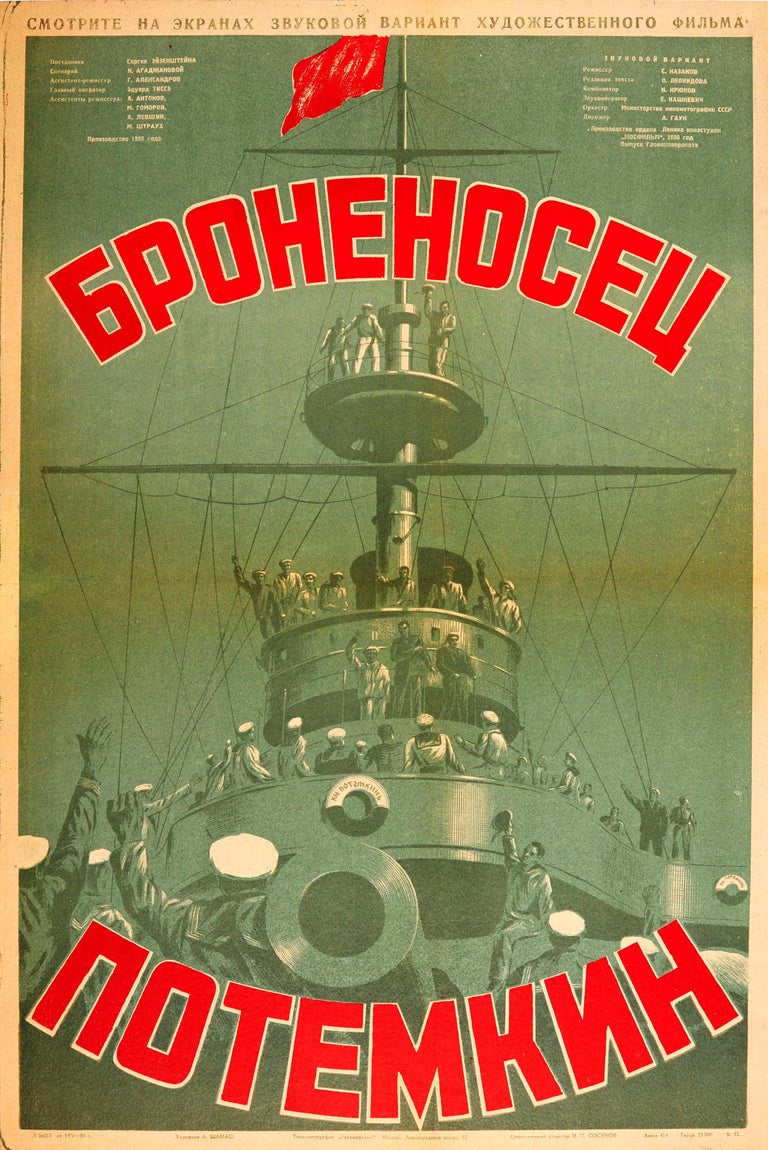
Battleship Potemkin (2026)

After the success of Strike (1924), Sergei Eisenstein was commissioned by the Soviet government to make a film commemorating the uprising of 1905. Eisenstein's scenario, boiled down from what was to have been a multipart epic of the occasion, focussed on the crew of the battleship Potemkin. Fed up with the extreme cruelties of their officers and their maggot-ridden meat rations, the sailors stage a violent mutiny. This, in turn, sparks an abortive citizens' revolt against the Czarist regime. The film's centerpiece is staged on the Odessa Steps, where in 1905 the Czar's Cossacks methodically shot down rioters and innocent bystanders alike. To Eisenstein, this single bloody incident was the crucible of the successful 1917 Bolshevik revolution, and the result was the "Odessa Steps sequence," which is often considered the most famous sequence ever filmed; it is certainly one of the most imitated, perhaps most overtly by Brian De Palma in The Untouchables (1987). This triumph of Eisenstein's "rhythmic editing" technique occurs in the middle of film, not as the climax, as more current film structure might do it. All the actors in the film were amateurs, selected by Eisenstein because of their "rightness" as types for their roles. Pictorial quality varies from print to print, but even in a duped-down version, Battleship Potemkin is must-see cinema.
Odessa, Ukraine
Primorsky Boulevard, Odessa, Ukraine
Ulitsa Suvorova, Odessa, Ukraine




The famous Odessa steps sequence was not originally in the script, but was devised during production.
Charles Chaplin said it was his favorite movie.
The flag seen flying on the ship after the crew had mutinied was white, which is the color of the tsars, but this was done so that it could be hand painted red on the celluloid, which is the color of communism. Since this is a black and white film, if the flag had been red, it would have shown up black in the film.
The movie was released in Moscow in 1925. It was competing for box office with Robin Hood (1922), an American movie starring Douglas Fairbanks. The Soviet government hoped 'Potyomkin' would earn more than 'Robin Hood' in its opening week, as this would be a symbol of the revitalization of Russian arts after the Revolution. In the event, 'Robin Hood' won, but it was a close race.
In 2004, British pop duo Pet Shop Boys were commissioned to write a new score for the film. It premiered on a live concert and screening in Trafalgar Square, London, on 12 September 2004.
The battleship used during the filming was not the "Knyaz Potyomkin-Tavricheskiy", but an older battleship called "Dvenadstat Apostolov" (The Twelve Apostles), as the original battleship 'Potyomkin' had been broken up in 1922.
On 4 November 2005, composer Yati Durant premiered a new score for large orchestra and quadraphonic electronics for the recently restored "Berlin" version of the movie, commissioned by the Cologne University of Music.
The film was rejected for a UK cinema certificate in 1926 by the BBFC following fears of working class insurrection, and remained banned until January 1954 when it was finally released with an X certificate.
Battleship "Dvenadtsat Apostolov", that played a part of "Potemkin", was in fact removed from active service in 1911 and served as a mine hulk until mid-1920s, when the film was made. Despite the fact that she was from a similar period (1892) and of similar size, she had to be heavily modified externally, first of all by addition of dummy gun turrets.
Battleship "Dvenadtsat Apostolov" actually was in the Imperial squadron, sent against "Potemkin". "Potemkin" itself was newest and most powerful of Black Sea battleships, but Imperial forces were more numerous.
"Potemkin" changed name four times. The original full name was "Knyaz Potemkin-Tavricheskiy". As a result of the uprising, the government renamed her "Panteleymon" in 1905. In April of 1917 the ship returned to the name "Potemkin-Tavricheskiy" (without "Knyaz" - prince), but in May 1917 the name was changed to "Borets za svobodu" (the Freedom Fighter).
Continuity
In the firing squad scene, just before the mutiny, the ship's priest taps a crucifix upon his right hand, holding it in his left. As the shot cuts to a close-up of the cross, it instantly switches hands.
During the Odessa Steps sequence as the mother walks with her son towards the oncoming troops, a long shot shows as she approaches, the soldiers halt one flight of stairs above the one she is on. In the next shot, however, the soldiers are marching down another flight of stairs as if they were going to walk right past her. Then, in the next scene, they have stopped again and are on the same flight of stairs as if they hadn't moved at all.
After the woman with her son in her arms approaches the army in Odessa Steps sequence, she gets shot and falls backward with her son draped perpendicular across her. When the army marches down the steps after shooting the woman, the woman has turned 180 degrees, and her son is now lined up with her body.
Revealing mistakes
Vakulinchuk is breathing slightly as his body lies in state.
It has been said that the real Battleship Potemkin does not appear on the film. Not so, the REAL Potemkin appears soon after the film begins for a very short time. It is the three funnels ship clearly seen before the actual story starts Also, after some time, the Potemkin appears very dark, with its three funnels although this scene seems to be a scale model floating on a pond. It has been thoroughly checked how the original Potemkin was and its most prominent feature is that it only has three funnels. There are also several scale models of this ship available both in cardboard and plastic confirming that the ship appearing on the film is actually the Potemkin either full size or scale model.
Anachronisms
In the Imperial squadron near the end of the film, there are close-ups of triple gun turrets of Gangut-class dreadnought. It possibly was made this way to show the power of Imperial fleet, but battleships of 1905 were much smaller pre-dreadnoughts, with twin turrets only, just like "Potemkin". "Ganguts" entered service in 1914.
Crew or equipment visible
A shadow of the camera, complete with an umbrella, can be seen during the scrolling shot of the Odessa Steps.