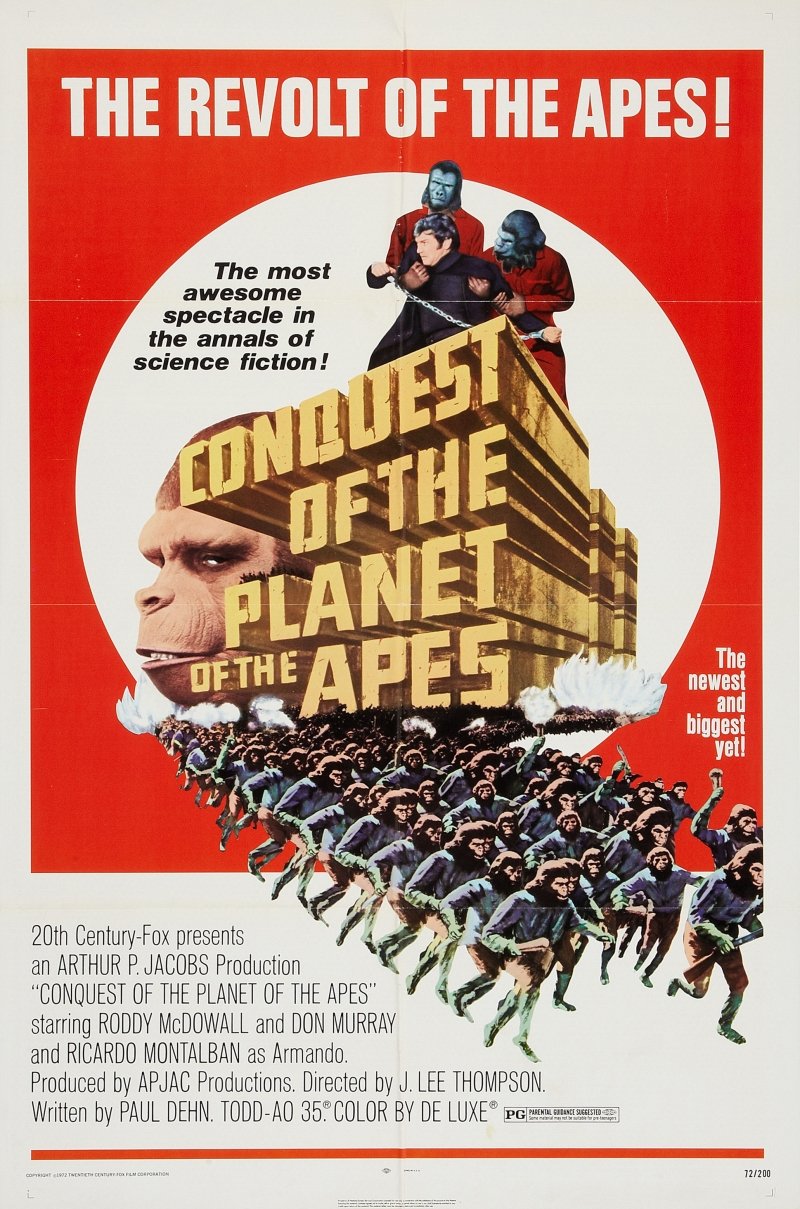
Conquest Of The Planet Of The Apes (1972)

Cornelius and Zira's son Caesar leads apes to revolution in this installment of the apes saga. Dogs and cats have been wiped out by a plague and now apes are household pets that are treated like slaves. Caesar has the intelligence to fight this oppression.
All new! The revolt of the apes. The most awesome spectacle in the annals of science fiction!
Caesar: But now... now we will put away out hatred. Now we will put down our weapons. We have passed through the Night of the Fires. And who were our masters are now our servants. And we, who are not human, can afford to be humane. Destiny is the will of God. And, if it is man's destiny to be dominated, it is God's will that he be dominated with compassion and understanding. So, cast out your vengeance. Tonight, we have seen the birth of the Planet of the Apes!
University of California, Irvine, California, USA
(city exteriors)
Westfield Century City - 10250 Santa Monica Blvd, Los Angeles, California, USA
Avenue of the Stars, Century City, Los Angeles, California, USA
(battle scenes)
Stage 22, 20th Century Fox Studios - 10201 Pico Blvd., Century City, Los Angeles, California, USA


An original script draft showed more of the rapid evolution of the apes from primitive to intelligent and showed the progression of apes from pets to slaves.
The majority of the outdoor scenes were shot in and around the University of California, Irvine campus, which was designed by futurist architect William L. Pereira, and was only six years old at the time of filming. Much of the production centered around the Social Science complex, which was designed by A.C. Martin & Associates and was still under construction during filming. Careful use of camera angles and editing made a handful of buildings and exteriors feel more like action spread across an entire city. Some exteriors, and all of indoor sets were all filmed at the Fox backlot in Century City, Los Angeles.
The budgets on the Apes movies were constantly trimmed because 20th Century Fox was still in financial trouble following the huge flops of Cleopatra (1963), Star! (1968) and Hello, Dolly! (1969). One of the results of the lower budget was the reuse of music cues throughout this film and "Battle for the Planet of the Apes" (1973) ("Escape From the Planet of the Apes" (1971) repeated only one piece of music in the film).
Writer Paul Dehn conceived the film as a simian take on the American Civil Rights movement of the time. Ironically, Dehn was English but brought an astute sensibility to the project. (Not surprisingly, the film was very popular with black audiences.)
The script opened with a fugitive ape being shot by the police. As they walked to it, the body would be revealed to be covered in open wounds and scars, showing the horrible living conditions of the slave apes. This was cut, again, for being too gruesome.
Continuity
(at around 1h 16 mins) When Caesar gets an M-16 during the riot from the armory, he's running along firing. As he's shooting, two riot police with shotguns are firing back at Caesar. The officer on the right of the screen has his shield down, but in the very next shot as he's being killed, his shield is raised.
Early on, when people are protesting in front of a government building, marching in a circle and holding signs, there is an announcement on the loud-speaker being made. The announcement continues without interruption, however, the people marching in the circle cut from two people to two different people in the same position in the circle without disruption of announcement audio.
Right before Caesar gets tortured by electrocution, the operator throws 3 of the 4 switches on the control panel. He then starts moving the dials. In the close up all 4 switches have suddenly been thrown.
When Armando is being questioned by Governor Breck and his men, Armando is shown the taped conclusion from the Presidential Commission regarding the fate of Cornelius & Zira (footage from Escape from the Planet of the Apes (1971)) on a round video monitor, the image changes from an approx. 1.33:1 aspect ratio, then to a wider aspect approx. 1.85:1 in the close-up of the monitor, then to a circular image in a following wide shot and then finally back to the approx. 1.85:1 aspect in the return close-up of the monitor. (Note: the differing aspects are the result of some portions of John Randolph's performance consisting of stock footage from the previous film combined with new footage filmed for this movie).
Factual errors
In fewer than 20 years since Escape from the Planet of the Apes (1971), chimpanzees, gorillas and orangutans have evolved to a perfectly humanoid form, a feat that would take thousands of years, not just one generation.
It's mentioned that some apes are being shipped to "French Cameroon." That part of Cameroon became independent of France on January 1, 1960, with the rest becoming independent of the United Kingdom on October 1, 1961, unifying into the Republic of Cameroon that exists today. Meaning, Cameroon had been completely independent for over ten years by the time the film was released.
Incorrectly regarded as goofs
Armando calls the son of Zira and Cornelius "Caesar" at the start of the film rather than his given name, "Milo". Since this name was well known to the authorities as that of one of the three chimps that had arrived from space in Escape from the Planet of the Apes (1971), this was a wise move. When Breck was having Caesar choose a name for himself, Caesar went through the book of names clumsily, as an illiterate ape would, while quickly scanning for his own given name, making it appear that he chose the name "Caesar" randomly.
Revealing mistakes
(at around 48 mins) Throughout the film, the supposedly wireless telephones are simply standard telephones with the wires removed and the wire outlets taped over. This is most noticeable when Mr. McDonald is talking on a red phone and the tape color does not match. This is due to some passages of John Randolph's speech being stock footage and some having been shot for this film.
(at around 54 mins) When Caesar is being tortured, you can see a small rectangular hole in his mask at the rear of the upper lip, presumably for Roddy McDowall to breathe through.
Throughout the film, the apes have human-looking feet, and not the ape-shaped feet as in the earlier films. This is most apparent when the apes are strapped to the electrical torture device, to which the feet are visibly bound.
Near the end of the film, and at night, when the apes are beginning to rise up, the city center is shown with first, people running to take cover, and then military forces taking positions, while the apes are shown spilling gas around the area, almost none of the very visible public lighting is shown lit.
Miscellaneous
Apes, especially gorillas, are shown to struggle in physical combat against humans, while actual gorillas are very strong and heavy, and could easily tear a human apart.
At 1:09:51 time stamp remaining mark, the Presidential Commission spokesperson says that Zira was pregnant with child as opposed to saying a chimpanzee.
Crew or equipment visible
(at around 1h 11 mins) When the apes rise up against the humans, shortly after an ape throws a flaming torch to start a fire, the camera pans back and for a brief moment you can see a metal tube mounted to the ground shooting gas to create the wall of fire.
Plot holes
Most of the film is taken up with the hunt for Caesar, presumably so he can be killed to prevent the future revealed by his parents. However, at no time is it considered that he may already have fathered numerous children who would continue his bloodline.
In the Command Post, a human worker hands Caesar a red paper pack and says "DO". Even the most intelligent human would not have the slightest idea what to "do" when handed a random item and expected to "know" what to do with it. (Note: Undoubtedly, the Command Post slaves had received training off-screen as to their work function).
DNA testing, which was in its infancy at the time of the filming, was apparently unknown to the writers of the film. If it wasn't, then discovering who Caesar was would have been a relatively simple task.