
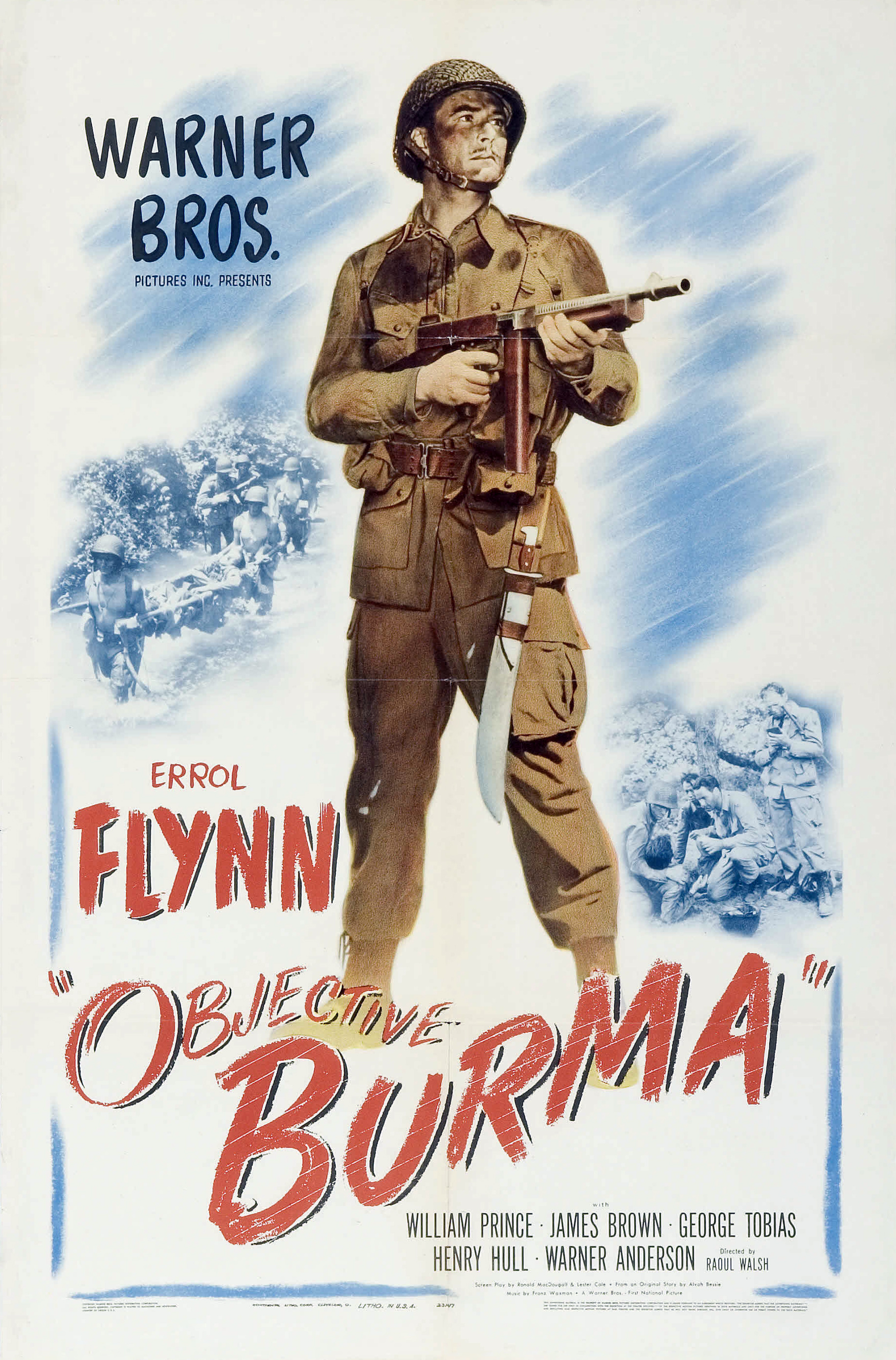
Objective Burma (1945)

A group of men parachute into Japanese-occupied Burma with a dangerous and important mission: to locate and blow up a radar station. They accomplish this well enough, but when they try to rendezvous at an old air-strip to be taken back to their base, they find Japanese waiting for them, and they must make a long, difficult walk back through enemy-occupied jungle.
Doorway to Japan!
Capt. Nelson: [to Williams' dead body] Oh, we won't forget you, Pop. From now on, if I ever get to buy another newspaper, I'll remember what a few cents can buy. So long.
Los Angeles County Arboretum & Botanic Garden - 301 N. Baldwin Avenue, Arcadia, California, USA
Whittier, California, USA
Providencia Ranch, Hollywood Hills, Los Angeles, California, USA
Palm Springs, California, USA
(location shooting)
Santa Anita, California, USA
(the Baldwin Estate)



Members of Merrill's Marauders, who were on location as technical advisers, criticized the fact that Nelson's men killed all the Japanese at the radar station so quickly with none wounded or escaped. That was likely by design because any of the defenders left alive would have to be executed by the special ops troops, something that 1945 audiences would have found objectionable for American troops to do.
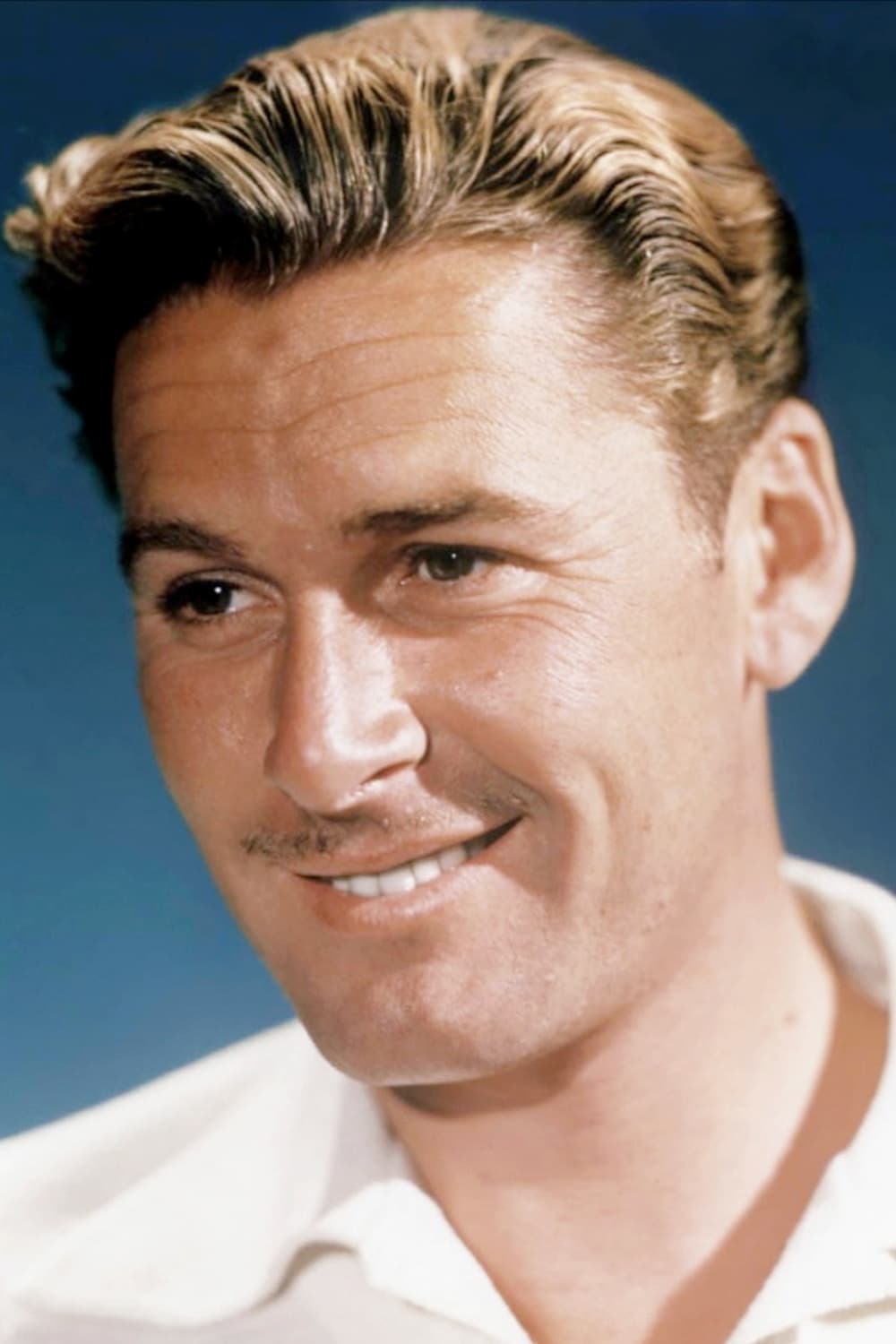
This was one of the few movies Errol Flynn starred in that he liked, although he regretted the controversy it caused.
Errol Flynn was criticized for playing heroes in World War II movies. Tony Thomas in his book "Errol Flynn: The Spy Who Never Was" states that Flynn had tried to enlist in every branch of any armed services he could, but was rejected as unfit for service on the grounds of his health - he had a heart condition, tuberculosis, malaria and a back problem. Flynn felt he could contribute to America's war effort by appearing in war films, and subsequently made such pictures as Edge of Darkness (1943), Northern Pursuit (1943), Dive Bomber (1941) and Uncertain Glory (1944). Reportedly, Flynn was at his most professional and co-operative he ever was while working on these films. The studios apparently were not - all kept quiet about the state of Flynn's health for fear of his box-office draw waning.
The movie was pulled from release in the UK after just one week. It was banned there after heated protests from British veterans groups and the military establishment. As the Burma campaign was a predominantly British and Australian operation, the picture was taken as a national insult due to the movie's Americanization of the Burma operation. The resentment that many felt was seen as yet another example of Americans believing they had won the war single-handedly. It was not shown in Britain again until 1952, and only with an apologetic disclaimer. Incidentally, writer Lester Cole, who co-wrote the somewhat overly patriotic flag-waving script, would be branded an un-American Communist, becoming one of the Hollywood Ten just a few years later. Cole's screenplay was based on a story by Alvah Bessie, who was also a member of the Hollywood Ten.
The story was partially inspired by "Operation Loincloth," a 1943 long-range operation in Burma by the British Chindits. However, producer Jerry Wald also admitted that much of the screenplay was based on Northwest Passage (1940), a film about the adventures of a long-range ranger unit during the pre-Revolutionary French & Indian War.
Continuity
Nelson helps Williams attach his static line. The direction of the hook changes in Nelson's hand as he does this.
At one point when a plane is approaching there is a shot from far away where it can just barely be seen that the plane is dropping supplies. In the timeline of the movie however there is an exchange over the radio and the plane drops the supplies (with a close up shot) about a minute later.
Capt Nelson switches back and forth from carrying an M1 carbine to a Thompson submachine gun.
When Nelson and his men are about to be picked up at the airstrip, a sentry tells Nelson about a hundred Japanese are approaching. Nelson immediately radios the landing aircraft to abort because about two hundred Japanese are waiting.
The position of the Japanese boxes Nelson fires from behind in the village changes between when he is there and the Japanese troops run by them.
Factual errors
Errol Flynn takes both tags off the body of his friend after dies from the effects of torture. This would leave no tags for graves registration to use to identify any bodies buried in that matter. One tag always stays with the body.
When Captain Nelson jumps out of the plane; he is holding his rifle in his hands. No real paratrooper would jump out of the plane holding his weapon in his hands, because the "opening shock" of the parachute canopy opening would jerk the weapon loose and he would lose it in the air. Paratroops jump with their weapons secured to their bodies. The remaining troops in the paratroop "stick" jump correctly, with their arms crossed over their upper torsos.
It's a mistake to think that the design of the radar unit with men sitting on seats on the unit would harm them, as has been said earlier in this section. The American radar units that surrounded Pearl Harbor (SCR-270 model) were operated with four men sitting on the main unit on the same level with the antenna. And the whole unit turned. In the American Military during World War II the radar units did not use microwave radiation like this they do since the Vietnam Era. These units were not powerful enough to be dangerous to humans. Many pictures of this kind of unit and other types can be found on the internet.
After the other platoon leader dies in the Burmese village, and Nelson (Errol Flynn) takes his dogtags, there is a shot of the dogtag, listing the address of the dead soldier. Dogtags contain a soldier's personal information--name, birthdate, blood type, religion, etc.--but not his home address.
The 503rd Parachute Infantry Regiment served in the Pacific - in New Guinea and the Philippines but not in Burma.
Incorrectly regarded as goofs
Capt Nelson is carrying a carbine with the stock folded, but during the fight in the village when the scene switches to show him firing the carbine the stock is extended (unfolded). The next scene in which he appears, the stock is folded. Since it is a folding stock it's very common for the soldier to fold/unfold the stock as needed. The stock can be folded/unfolded in seconds and that action could have taken place off screen.
Revealing mistakes
One of the "dead" Japanese soldiers of the Japanese Radar/Radio installation lying on the ground flops his left foot from a heel outward position, away from his body, (which must have been real uncomfortable) to heel inward.
When Capt. Nelson opens the door of the C-47, readying himself and his crew for the upcoming parachute jump, you can see where he casts a ghost-like "shadow" on the nearby backdrop screen that's being used to display the outside landscape rushing by.
Miscellaneous
After the group secures the radar station, they immediately blow it up. In reality they would have searched the place to obtain code books and other information which would have been at such a location.
As Capt. Nelson gathers and speaks to his men in a clearing after temporarily escaping the enemy at the pickup airfield, a tree in the distant background suddenly falls over and disappears.
When Errol Flynn is signaling the plane with shiny metal plate, from the airplane shot you can see the mirror location moving rapidly across the ground. Flynn, of course, was stationary.
The Japanese soldier that Nelson kills in hand to hand combat helps Errol Flynn get him out of his foxhole by using his legs. He then rolls out of camera range in attempt to make it look like he's been shoved over the edge of the hill.
Audio/visual unsynchronized
In the scenes with the Japanese reacting to the destruction of the radar station, the spoken dialogue is obviously overdubbed and out of sync. The Japanese soldiers were played by Filipino and Chinese actors.
Errors in geography
Early in the movie on several occasions, one of the Jungle noises was the laugh of a Kookaburra - only found in Australia and not in Burma.
The large trees near the village are Eucalyptus trees, only found growing wild in Australia, though there are large groves in California.
Character error
The Chinese captain is with the group that escapes across the swamp from the village but is never seen again.
During the retreat action sequence, after the firefight in the swamp, the machine gun is picked up by the barrel. After firing this much the barrel would have been much too hot to touch.