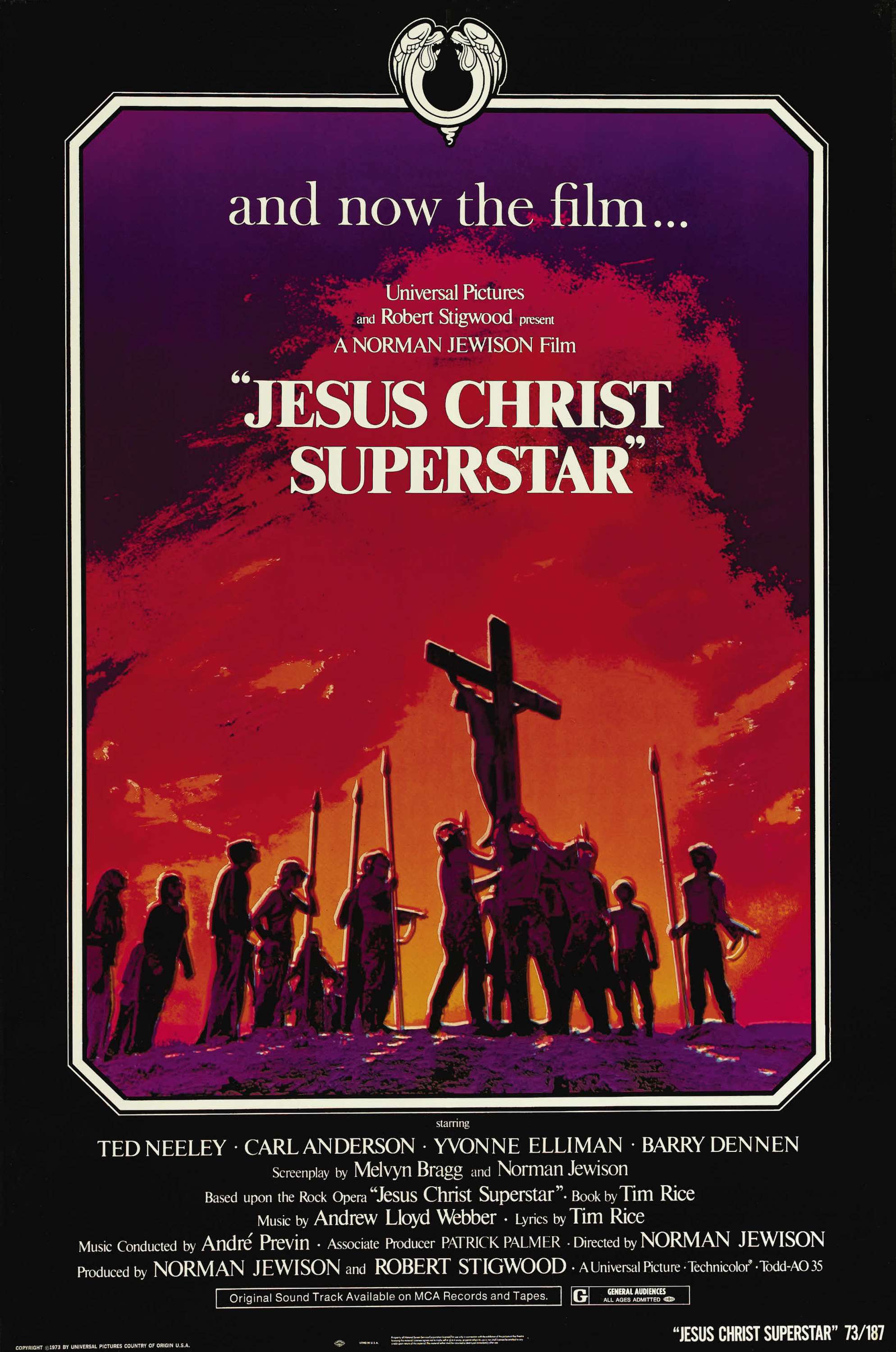
Jesus Christ Superstar (1973)

Based on a concept album project written by Andrew Lloyd Webber and Tim Rice, and the subsequent long-running Broadway performance, this film tells the story of the final 6 days in the life of Jesus Christ through the troubled eyes of Judas Iscariot. Too often mis-labeled a musical, this film is a "rock opera." There are no spoken lines, everything is sung.
and now the film...
Jesus: God, thy will is hard. But you hold every card. I will drink your cup of poison, nail me to your cross and break me, bleed me, beat me, kill me! Take me now, before I change my mind!
Dead Sea, Israel
(King Herod's Song)
Bell Caves, Beit Guvrin, Israel
Bet Shean, Israel
Pratzim, Israel
Avdat, Israel
(main location of the Roman ruins)
Norman Jewison managed only two takes of "The Temple" before he ran out of unbroken props, due to Ted Neeley's unrestrained energy when Jesus smashes everything.
Actors were required to "hydrate" every 20 minutes while on location in the desert. Huge, multicolored blocks of ice were brought in from Tel Aviv.
According to the commentary, all the wind shots in the film were done with natural wind. No machines were used.
Seventeen-year-old John Travolta auditioned for the role of Jesus. He didn't get the part, but producer Robert Stigwood kept him in mind for future productions. Four years later, Stigwood cast Travolta in Saturday Night Fever (1977).
"Then We Are Decided," in which Annas and Caiaphas discuss the threat of Jesus and decide to take it up with the council, was a totally new song written for this version. Owing to copyright issues, it has seldom been used onstage, most recently (and perhaps most notably) in the 2016/17 European touring production featuring Ted Neeley in the title role and directed by Massimo Romeo Piparo.
Continuity
During "King Herod's Song", in a close-up of the pianist, a female is sitting on the piano. Later on, the female gets up to dance. In another close up of the pianist after the dancer leaves, the dancer is still sitting on the piano.
During the crucifixion, the sun casts shadows both behind and in front of the cross.
When Judas hangs himself, the sky changes multiple times between cloudy and clear. Similar alternation is seen when Jesus is crucified.
Incorrectly regarded as goofs
Differences from the source material are not to be counted as goofs. Historical inaccuracies, such as tanks and guns in the year 0033, are also not counted as goofs, especially when related to artistic decisions.
During the "Poor Jerusalem" scene, Jesus sings "Neither you Simon, nor the fifty-thousand, nor the Romans, nor the Jews, nor Judas, nor the twelve, nor the priest, nor the scribes, nor doomed Jerusalem itself". Judas was one of the "twelve", so adding him to the twelve would have made 13 apostles, not 12. However, this redundancy is deliberate to emphasize Judas' importance to the story.
In the title song, Judas asks "could Muhammad move a mountain or was that just PR?" Muhammad wasn't born until 500 years after Judas died. However, this scene is set in a heavenly dimension which need not be bound by conventional linear chronology.
Revealing mistakes
When Jesus is hanging on the cross, he moves his hands away from the wooden crosspieces, showing that the nails are just nail heads stuck to Ted Neeley's palms.
In the long shot of Judas Iscariot hanging himself, the noose is attached to a flesh-colored harness on Carl Anderson's back.
After Jesus finds his apostles asleep, the camera cranes up next to the leaves of a tree. At one point (about 1:00:48 on the DVD) a twigs swings back and forth wildly, indicating that the camera has brushed against it.
During the flogging, Jesus is not struck all 39 times that Pontius Pilate counts off; Pilate counts off some numbers while the flogger is drawing the lash back.
Audio/visual unsynchronized
During "Judas' Death", Caiaphas sings to Judas "What you have done will be the saving of everyone", but his mouth is saying "the saving of Israel", the song's original lyric.
During "Gethsemane", Jesus sings "If I die, what will be my reward? If I die, what will be my reward?" but he is clearly mouthing the words "If I die, what will be my reward? Have to know, I have to know my Lord".
After Judas told the Pharisees that Jesus would be at the Garden of Gethsemane, a chorus is heard singing "Well done Judas / Good old Judas". However, the subtitles mistakenly show "So long Judas / Poor old Judas", which is actually heard after Judas hangs himself. [On the 20th Anniversary remastered BluRay edition]
During the opening of "Superstar", after Judas steps off the chain, his lip sync is out of time with the song. It's corrected after the first cutaway.
Crew or equipment visible
When Jesus is arrested in the garden and says, "Put away your sword," a distorted reflection of the camera man is on the side of the Roman soldier's silver helmet.
During "Superstar", after the first cutaway of Jesus carrying the cross, two big light rigs are in the background. A grip climbs up a ladder just under the "star filter" effect of the light on the right. He's visible just above Carl Anderson's hand.
At the end of "King Herod's Song", the camera shakes when Herod throws a bagel at Jesus.
Plot holes
When Peter denies Jesus 3 times, Mary says that Jesus predicted this. Mary wasn't at the Last Supper when Jesus said this, and it is unlikely that Peter would have told her about the strange claim.
Character error
When Pilate turns to face the crowd after he claims that Jesus doesn't deserve death, Pilate's cape gets caught on a soldier's arm.