
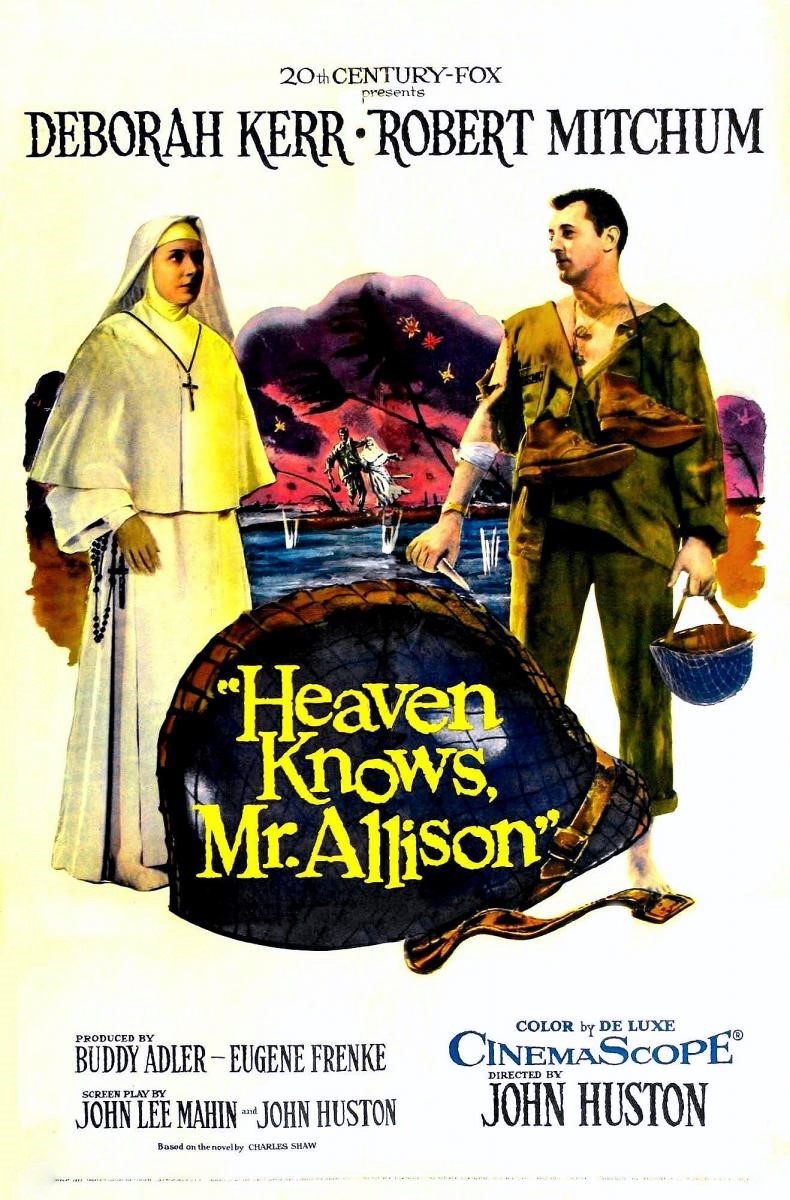
Heaven Knows Mr Allison (1957)

In 1944, the castaway Corporal Allison, adrift in a raft since his submarine was attacked, lands on tiny Tuasiva Island, where he meets Sister Angela. She tells him that she is the only person on the island, having been left behind while trying to evacuate a priest. The nun and the marine are stranded, but the island offers a bountiful supply of food. However, their paradisiacal life ends when the Japanese arrive to build an outpost, forcing "Mr." Allison and the nun to take refuge in a cave. The marine's expertise in such conditions proves to be vital to their survival, and the two grow ever closer.
They were alone on this Pacific Island... trapped behind enemy lines... the marine who had been thru Hell and Sister Angela with her supreme faith in God.
Cpl. Allison, USMC: You don't have to be afraid of me, ma'am. That was just drunk talk. I'd never hurt you! I'd rather die first!
Tobago, Trinidad and Tobago




When filming began, Robert Mitchum worried that Deborah Kerr would be like the prim characters she frequently played. However, after she swore at director John Huston during one take, Mitchum, who was in the water, almost drowned laughing. The two stars went on to have an enduring friendship which lasted until Mitchum's death in 1997.
The script called for several Japanese-speaking officers and a company of Japanese troops to be on the island. There were no Japanese men on the islands of Trinidad and Tobago, where the film was shot. A half-dozen who spoke the language finally were found in a Japanese emigrant community in Brazil and flown to the location to play the officers. For the non-speaking roles of Japanese troops, the company hired 50 Chinese who worked in the island's restaurants and laundries. This caused friction with the local islanders, who found it difficult, if not impossible, to get their clothes cleaned or to get a meal in a restaurant because most of the employees were working on the film.
Robert Mitchum had just returned from spending four months in Tobago on Fire Down Below (1957) with Jack Lemmon and Rita Hayworth when he learned that his agent had committed him to this movie, filming in Tobago.
First of four movies that paired Deborah Kerr and Robert Mitchum.
After spending so much time in Trinidad/Tobago, Robert Mitchum became enamored with Calypso music, so much so that he recorded an album called "Calypso - Is Like So", and was released on Capitol Records. It features him doing spot-on imitations of the style and is still available on CD.
Continuity
When the Japanese soldier returns the bottle of sake to the sack of rice, the bottle is almost empty or about one-quarter full. But when Sister Angela later finds the bottle in the rice sack, it is almost full.
At the beginning, Corporal Allison's raft nears the island. As he looks over the edge of the raft and sees the island, his disheveled hair is dry, as is his shirt. However, in the next shot, facing the island, his hair is much shorter and soaking wet, as is his shirt. His hair is also wet and then dry when he finds the encampment.
(at around 10 mins) Allison wakes up and rushes over to Sr. Angela's altar and extinguishes the lit candles, saying they need to keep a blackout as the Japanese would be able to see the light from 15-20 miles offshore. After about a minute of small talk, the nun then says she'll explain her presence after Allison has eaten. There's a cut to them seated outside the bungalow where Allison is just finishing his dried fruit and biscuits, and their shadows indicate the sun is fully above the horizon. There was not enough time between putting out the candles and finishing the food for them to have gone from "blackout condition" to daylight.
When Allison approaches the island and crawls ashore, the camera shot from the raft shows him several feet into the water's edge, in waist-deep water. However, in the following reverse shot, a view from the island, the raft suddenly is much further up the beach, indicating he has dragged it above the water line.
Factual errors
The flag that the Japanese fly on the island is the Japanese naval ensign (an off center rising sun, closer to the flag pole). But the men on the island are of the Japanese army. Therefore, they should have the Japanese Army flag (the rising sun should be centered, NOT off center).
Incorrectly regarded as goofs
The Japanese Naval Ensign (flag) is correct in the movie. The Japanese troops on the island are NOT Japanese Army Infantry, they are Japanese Naval Special Landing Forces. This is borne out by the white color of the dress uniforms worn by the officers and the Japanese Navy device on their caps. Therefore, the flag being flown is 100% correct.
Revealing mistakes
Allison shoves his knife into a Japanese soldier and kills him. But when he pulls it out and sheaths it, it is perfectly clean with NO blood on it.
Sister Angela had to drag Father Phillips corpse from the beach to the bungalow, dig a grave, get the corpse into the grave, and cover it with sand/dirt. She did all this, and after three more days, her white habit is still immaculately clean.
Allison and Sister Angela are in the cave when the Japanese discover the body of the soldier and begin torching area. Sister Angela asks what is happening, and Allison says they found the dead soldier that had his throat cut. But when the soldier attacked him, Allison only plunged his knife into the soldier's abdomen.
The nighttime scenes are filmed in daylight using a filter to darken and make it appear to be night. BUT the sky remains blue and distant objects remain easily distinguishable. But the night sky is always black and distant objects fade and disappear in the darkness, particularly in the South Pacific where there are NO nearby cities that lighten the horizon.
Anachronisms
Allison is shown throughout the movie wearing a metal expansion bracelet for his wristwatch. Such bracelets were introduced by Speidel in the 1950s.
When Allison is fishing, the Japanese patrol boat is powered by what looks like a 1957-era Evinrude outboard.
Audio/visual unsynchronized
As the barefoot Mr. Allison is walking through the first shack on the island, his shoes are tied together and hanging around his neck, but the sound is of shod feet walking on the floor boards of the shack.
Character error
While in the cave during the Navy shelling, Allison says the four Japanese 105s are "hid real good". In fact, as is clear when Allison takes action against the "big rifles", they are quite exposed, without overhead protection, and would be highly vulnerable to the shelling, although hard to see from aircraft due to the camouflage netting (which had been blown away at one site). The Navy would have concentrated its preparatory fire on the landing beach, where the 105s were, although there would have been no assurance all could have been knocked out.