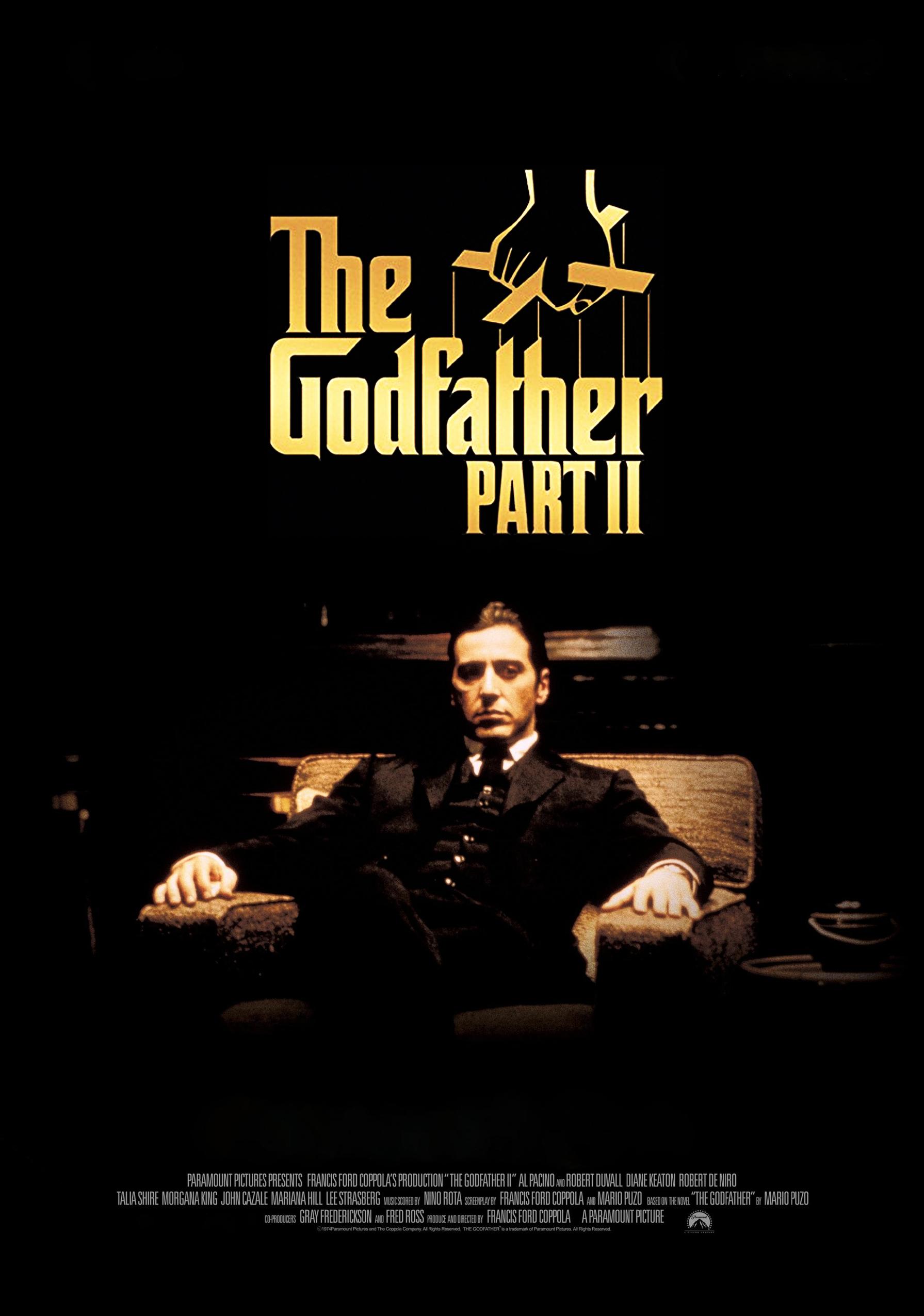
The Godfather II (1974)

Francis Ford Coppola's legendary continuation and sequel to his landmark 1972 film, The Godfather, parallels the young Vito Corleone's rise with his son Michael's spiritual fall, deepening The Godfather's depiction of the dark side of the American dream. In the early 1900s, the child Vito flees his Sicilian village for America after the local Mafia kills his family. Vito (Robert De Niro) struggles to make a living, legally or illegally, for his wife and growing brood in Little Italy, killing the local Black Hand Fanucci (Gastone Moschin) after he demands his customary cut of the tyro's business. With Fanucci gone, Vito's communal stature grows, but it is his family (past and present) who matters most to him ? a familial legacy then upended by Michael's (Al Pacino) business expansion in the 1950s. Now based in Lake Tahoe, Michael conspires to make inroads in Las Vegas and Havana pleasure industries by any means necessary. As he realizes that allies like Hyman Roth (Lee Strasberg) are trying to kill him, the increasingly paranoid Michael also discovers that his ambition has crippled his marriage to Kay (Diane Keaton) and turned his brother, Fredo (John Cazale), against him. Barely escaping a federal indictment, Michael turns his attention to dealing with his enemies, completing his own corruption.
The saga continues.
Michael Corleone: If anything in this life is certain, if history has taught us anything, it is that you can kill anyone.
6th Street, Manhattan, New York City, New York, USA
East Village, Manhattan, New York City, New York, USA
El Embajador Hotel, Santo Domingo, Dominican Republic
Forza d'Agr?, Messina, Sicily, Italy
Greenwich Village, Manhattan, New York City, New York, USA
Hotel Washington - 515 15th Street, Washington, District of Columbia, USA
Kaiser Estate, Lake Tahoe, California, USA
(Corleone Compound)
Las Vegas, Nevada, USA
Los Angeles, California, USA
Miami, Florida, USA
Tomkin's Square, Greenwich Village, Manhattan, New York City, New York, USA
Trieste, Friuli - Venezia Giulia, Italy
Vazak's Bar - 108 Avenue B, East Village, Manhattan, New York City, New York, USA
Francis Ford Coppola had a horrible time directing The Godfather (1972) and asked to pick a different director for the sequel, while taking the title of producer for himself. He chose Martin Scorsese, whom the film executives rejected. Thus, Coppola agreed to direct the film, with a few conditions.
The early buzz on The Godfather (1972) was so positive that a sequel was planned before the film was finished filming.
To prepare for his role, Robert De Niro lived in Sicily.
This was the last film printed in the US in the Technicolor "imbibition" printing process. The lab was held open for about three weeks for the film to be ready to print, and then it was disassembled and sent to Peking, China. The imbibition process was a three-strip dye transfer process that photochemical processes have yet to equal in richness and longevity of color rendition.
Originally the actors in the flashback scenes wore pants with zippers. One of the musicians pointed out that the zipper had not been invented at that time, so some scenes had to be re-shot with button-fly trousers.
Bruno Kirby, who plays the young Clemenza (who was played by Richard S. Castellano in The Godfather (1972)) played Castellano's son in the TV series "The Super" (1972).
Originally it was to be Clemenza who agrees to testify against the Corleones. However, Richard S. Castellano (who was the highest paid actor in The Godfather (1972)) wanted to write his own lines and wanted a large salary increase. Consequently his character was replaced by Frankie Pentangeli (Michael V. Gazzo) who received an Oscar nomination for the performance.
Merle Johnson is played by Troy Donahue, whose real name is Merle Johnson.
As of 2001, Robert De Niro is one of only five actors (with Sophia Loren, Roberto Benigni, Benicio Del Toro and Marion Cotillard), to win an Academy Award for a role primarily in a language other than English, since almost all of his dialogue is in Italian.
Marlon Brando and Robert De Niro are the only two actors to ever win separate Oscars for playing the same character. Brando won Best Actor for The Godfather (1972) and De Niro won Best Supporting Actor for this movie, both in the role of Vito Corleone.
When Michael goes to see Hyman Roth at his house in Miami, the football game on the TV is USC vs. Notre Dame, a major rivalry.
The first sequel to win an Academy Award for Best Picture.
The language spoken by the actors in the flashback part is not Italian, but a combination of southern Italian dialects (mostly Sicilian).
Francis Ford Coppola, having nearly been fired several times from the first film, was given a Mercedes-Benz limousine from Paramount as a reward for the record success of the first film and an incentive to direct a sequel. He agreed on several conditions - that the sequel be interconnected with the first film with the intention of later showing them together; that he be allowed to direct his own script of The Conversation (1974); that he be allowed to direct a production for the San Francisco Opera; and that he be allowed to write the screenplay for The Great Gatsby (1974) - all prior to production of the sequel for a Christmas 1974 release.
Filming was delayed for a month after Al Pacino developed pneumonia on location in Santo Domingo.
Editing continued up to the release date.
Advance bookings totaled $26,000,000 in 340 theaters.
As the "deceased" Mama Corleone, Morgana King only appeared in the coffin for the establishing shot where her face is clearly visible. In all other shots, Coppola's mother, Italia Coppola, stood in for Ms. King since she (King) initially refused to be in the coffin at all.
James Caan asked that he be paid the same amount of money to play Sonny Corleone at the end of the film in the flashback as he was paid to do the first film. He got his wish.
There is a total of 16 deaths in the film.
Francis Ford Coppola considered bringing Marlon Brando back to play Vito Corleone as a young man, convinced that he could play at any age. As he worked on the script, though, he remembered Robert De Niro's exceptional audition for the first "Godfather" and cast him without offering the part to Brando.
Was voted the 7th Greatest film of all time by Entertainment Weekly, thus being the most highly ranked sequel on their list and only 6 rankings behind its predecessor.
In 2007, the American Film Institute ranked this as the #32 Greatest Movie of All Time.
Ranked #3 on the American Film Institute's list of the 10 greatest films in the genre "Gangster" in June 2008.
The flashback sequences with a young Vito were part of the original Godfather novel but not used for the first film.
Francis Ford Coppola and Mario Puzo won the Oscar for Best Adapted Screenplay even though half of the script was adapted and half was original. The story of Michael Corleone is original while the story of the young Vito Corleone came from the "Godfather" novel.
Vito's birthday is December 7. Sonny curses at the "Japs" for dropping bombs in Hawaii on his father's birthday.
In an early version of the script, an ongoing story line was Tom Hagen having an affair with Sonny Corleone's widow. This was later discarded, but the line where Michael Corleone tells Hagen that he can take his "wife, children and mistress to Las Vegas" was kept.
A then-unknown Joe Pesci was briefly considered for the role of Clemenza, which eventually went to Bruno Kirby.
The ship shown transporting the young Vito Corleone to New York was the Moshulu. That ship is now a restaurant docked at Penn's Landing in Philadelphia.
The movie's line "Keep your friends close, but your enemies closer." was voted as the #58 movie quote by the American Film Institute (out of 100).
The movie's line "Michael... we're bigger than U.S. Steel." was voted as the #54 of "The 100 Greatest Movie Lines" by Premiere in 2007.
The shooting script included a scene with an older, diabetic Michael talking with an 18-year-old Anthony but this scene was cut. The discarded scene also included Connie saying that Fredo drowned in the lake. These ideas were eventually used in The Godfather: Part III (1990).
Michael's unnamed bodyguard is listed simply as "Michael's bodyguard" in the closing credits. But in the shooting script he is named "Bussetta".
There was much debate over whether Robert De Niro should grow a mustache for the scenes where young Vito is a few years older but De Niro insisted. For the scenes where Vito returns to Sicily, he gained weight and wore a smaller version of the dental appliance Marlon Brando wore in Part I.
According to the chart shown during the hearings, the Corleone family's buttonmen/soldiers are: Luca Brasi (deceased), Chris Pennari alias 'The Manager', Donato Tolentinicci, Gaetano De Luna alias 'Gary Dee', Roberto Nelenza alias 'Thunder Bob', William Cicci, Pauli Gato [sic] (deceased), Nino Arneldi alias 'The Patch', Victor Vinatonni alias 'Vicky Veal', Calogero Radeni, Rafilo Gernzo, Carmine Caronda alias 'The Plunge', Francis Forducci alias 'The Kid', Ricardo Simmini alias 'Powder', Frank Corteale, Ettore Radeni alias 'Oily Hand', Salvatore Plumari alias 'Sally Pee', Samuel Corocco, Angelo Granelli alias 'The Trojan' (in jail), Gino Corsetta (in jail), Bartolo Neni alias 'O'Neal' (in jail), Joeseph Bronski alias 'Joey Jail' (deceased), Natale Parri alias 'Fat Nat', Alphonse Barino alias 'Al Barret', Gino Fredonna alias 'Pretty Boy' (deceased), Sabastino Sabela (in jail), Lawrence Tippirri, Gaetano Sirillo, Tony Dinegio alias 'Tony Ding', Carmen Della, Frank Darra alias 'Frankie Dare' (in jail), Alphonse Evolloni alias 'Al Ove' (deceased), Peter Leone alias 'The Lion' (in jail), Cassandros Fracca alias 'David Gelly', Charles Locirno (deceased), Cristoforo D'Binna.
In the original script, Don Ciccio was named Don Francesco. "Ciccio" is a Sicilian nickname for Francesco. He is still listed as Don Francesco in closing credits.
In the original script, Tom gains Senator Geary's support by paying off his gambling debts.
The unnamed senators in the committee were played people who were primarily screenwriters and producers: William Bowers, Roger Corman, Phil Feldman, and Richard Matheson.
In an interview, Gordon Willis admitted that he sometimes "went too far" in his use of dark photography. He particularly noted the scene in which Michael asks Mama for advice as an example.
The door to Vito's olive oil business was rigged so that it would not open if a nail was inserted into the lock. Coppola kept this a secret from Leopoldo Trieste, who played Signor Roberto, and his difficulty in opening the door was real. Coppola wanted to film Trieste, a known Italian comedian, improvising his way through the scene. When Genco opens the door, Frank Sivero surreptitiously pulls the nail out.
Lee Strasberg came out of retirement to play Hyman Roth after a specific request from Al Pacino. He was unwilling at first, but agreed to do it after a 45-minute meeting with Francis Ford Coppola's father, Carmine Coppola.
Marlon Brando was scheduled to return for a cameo in the flashback at the end but, because of the way Paramount treated him during The Godfather (1972), he did not show up for shooting on the day the scene was filmed. Francis Ford Coppola quickly re-wrote the scene on the spot.
This was the first film sequel to receive five Academy Award Nominations for acting. Talia Shire (Best Actress In A Suporting Role), Lee Strasberg (Best Actor In A Supporting Role), Michael V. Gazzo (Best Actor In A Supporting Role) and Al Pacino (Best Actor) all received nominations, while Robert De Niro took home the Oscar for Best Actor In A Supporting Role.
Robert De Niro auditioned for and was almost cast in The Godfather (1972) in a minor role. When Francis Ford Coppola was casting this film, he saw Mean Streets (1973) and knew he wanted De Niro for a major role in this sequel.
Hyman Roth's character is loosely based in real-life mobster Meyer Lansky. Lansky, who at the time of the film's release was living in Miami, reportedly phoned Lee Strasberg and congratulated him for the role as Roth.
Danny Aiello said that his line "Michael Corleone says hello" was completely ad-libbed. Francis Ford Coppola loved it and asked him to do it again in the retakes.
The orchestra that plays in the band shell during the party scene at Lake Tahoe was actually the Al Tronti Orchestra that played nightly for big names like Elvis Presley and Tom Jones at the Sahara Tahoe Casino/Hotel on the South Shore of Lake Tahoe while this film was being shot. Al Tronti himself sits in the orchestra in the front room (only seen in shadow). He wasn't allowed to appear as the orchestra conductor since he looked "too Italian" and the orchestra in the movie was supposed to be a West Coast group not able to play any traditional Italian music.
The musical play performed in the film, "Senza Mamma", was an actual early 20th century play composed by Francis Ford Coppola's grandfather, Francesco Pennino.
The golden telephone presented to Cuban dictator Fulgencio Batista is based on an actual event. You can see the actual gold-plated (not solid gold) telephone in Havana's Museum of the Revolution (formerly Batista's presidential palace). The replica made for the movie looks pretty much like the original. No reference to the film is made in the information card of the telephone on display.
A test screening of the film garnered negative reactions from the audience. They found cutting back and forth between Michael and young Vito confusing and bothersome. Francis Ford Coppola and his editors decided to decrease the frequency of the transitions in order to make the parallel stories easier to follow.
The Havana hotel that Michael stays in is the Capri. The location was the El Embajador Hotel in Santo Domingo, Dominican Republic.
While the word "mafia" is never spoken in The Godfather (1972), it is heard three times in this film, during the Senate hearings. Sen. Geary says, "These hearings on the Mafia... ". The committee Chairman says, "You are the head of the most powerful Mafia family in this country". Michael Corleone in his statement says, "Whether it is called 'Mafia' or 'Cosa Nostra' or whatever other name you wish... "
The plot thread with Sen. Geary is a direct reference to The Godfather (1972), when Vito laments that he wanted Michael to be a "big shot" who "pulled the strings." In particular, he had hoped Michael would become a Senator. Michael assures him, "we'll get there, Pop." At the opening of this film, we see Michael explicitly rebuffing the demands of a US Senator, turning the tables by making demands of his own.
Mario Cotone, the film's Sicilian production manager, was cast as Tommasino due to his resemblance to Corrado Gaipa, who played Tommasino in The Godfather (1972).
November 2005: Voted #5 in Total Film's 100 Greatest Movies Of All Time list.
1998: Voted #1 in TV Guide magazine's list of the 50 Greatest Movies on TV and Video (August 8-14 issue). The Godfather (1972) ranked #7.
According to Francis Ford Coppola in the DVD commentary, Michael V. Gazzo gave such a great performance in the rehearsal of his testimony scene that Coppola wanted to start filming it immediately but everyone had to break for lunch. During the break, Gazzo got drunk and was unable to perform as well as he had in rehearsal.
According to Francis Ford Coppola on the DVD commentary, G.D. Spradlin wrote many of his own lines, including his anti-Italian speech to Michael.
Robert De Niro spent four months learning to speak the Sicilian dialect in order to play Vito Corleone. Nearly all the dialogue that his character speaks in the film was in Sicilian.
Filmed in 104 days.
Don Fanucci says that, in order to show proper respect to him, Vito and his friends should allow him to 'wet his beak a little', by giving him a share of their profits. This is Sicilian slang, meaning "to get a piece of the pie", a common expression often used to indicate the extortion activities committed by mafia members.
Widely credited as the film that began the tradition of numbered sequels for film franchises.
Originally, Kay was to truly have a miscarriage. It was Talia Shire's idea that she would have an abortion instead, as the ultimate way to hurt Michael. To thank her for this idea, Francis Ford Coppola wrote in the scene in which she tearfully asks Michael to forgive Fredo.
Continuity
During Roth's birthday party, the pattern on his shirt changes. Due to weather difficulties, the two minute scene took over a week to shoot and the original shirt was lost at some point. The production designer attempted to recreate it by drawing an approximation of the pattern onto a plain shirt, but it didn't quite match.
Shortly after the assassination attempt on Michael in his bedroom, he meets alone in a room with Tom Hagen. They sit at an empty table. After talking for a few minutes, Michael offers Tom a glass of Courvoisier, from a bottle which has randomly materialized on the table.
At the end of the movie in the flashback, they talk about the Japanese attack on Pearl Harbor happening "on Pop's birthday". The Pearl Harbor attacks were on December 7, but according to his tombstone, in The Godfather (1972), Vito's date of birth is April 29.
When Michael Corleone arrives at Hyman Roth's residence in Miami, a large palm tree is in front of one of the front windows. Michael enters the front door and Mrs. Roth ushers him into the lounge adjacent to the entry area. While Michael and Hyman are chatting, the silhouette of a 50s sedan can be seen driving by, through the lounge's window curtain. There is no palm tree trunk visible from the inside, which would've interrupted the passing car's silhouette.
When Signor Roberto visits Vito at work, Signor Roberto counts money on Vito's desk. The arrangement of the money changes between shots.
Factual errors
If the gold telephone was in fact solid gold, it would've been so much heavier than the way it seemed, by how easily it was passed along the table.
Upon his arrival on Ellis Island, a migration official sees that young Vito Andolini comes from Corleone, Sicily, and decides to change his name to Corleone. While it is a popular urban legend, migration officials did not unilaterally make such radical changes to a person's surname. At worst, they might misspell it if they only heard the name instead of seeing it written. Many immigrants did choose to change their names, either the to simplify the spelling or Anglicize them. In the novel, Vito chooses to take the name Corleone to honor his home town.
When receiving payment from Vito Corleone, Don Fanucci removes the spoon after stirring his espresso. There is no coffee on the spoon; it is dry. This indicates the demitasse is empty.
In the beginning, it's shown that young Vito's name was changed at Ellis Island from Andolini to Corleone. Although this is a widely held belief, the fact is that no names were ever changed by officials at Ellis Island, who only confirmed information on the arriving ships' manifest. Any name changes were made by the immigrants themselves.
In the background of the exterior shot of the Hotel Washington's 15th Street NW main entrance (looking north), two late 1960s D.C. Transit buses (1 east- & the other westbound) cross the intersection at the 1500 block of Pennsylvania Avenue (screen left) & the 1400 block of New York Avenue.
Incorrectly regarded as goofs
In his later scenes, Don Fanucci has slash marks on his neck/throat area that weren't there earlier. (This is because of a deleted scene in which Fanucci is jumped on the streets by a group of young thugs, who slash him. The scene doesn't appear in the regular cut of the film, but does appear in the edit of The Godfather Saga (1977), and as a deleted scene in the DVD set.)
When Vito Corleone arrives at Ellis Island, he was marked with a circled X (historically X was a sign for a mental illness), not because he was suspected to have smallpox, but because he was a nine year old who did not speak. Even deaf people at the time were frequently labeled as "retarded" simply because they did not speak.
In Michael's office during Anthony's communion party, it appears the Senator sets down his bottle of pills on the table after he takes them and never picks it up. However, although very brief, immediately after setting down the drink used to take the pills, you can see the Senator motion for his pills. After returning from a shot of Michael, the Senator is then seen closing his right pocket, presumably with the pills inside.)
Revealing mistakes
The supposedly dead prostitute can be seen breathing by the movement of the white sheets.
When they are passing around the solid gold telephone, most of the people show how heavy it is. And yet, when Michael Corleone, and Hyman Roth handle and pass the telephone, it appears light as a feather and no indication is given as to how truly heavy a solid gold telephone is. Thus destroying the illusion that it is real.
Vito Corleone's birthday is revealed to be December 7th; however, his tombstone in The Godfather states his birth date to be April 28, 1887.
At approximately 13:30 mark, four or five of the children sitting at the kids table put their fingers in their ears in anticipation of the fanfare and drum roll that was about to happen; indicating this was not the first take these little actors had to endure.
In the opening scene when Vito's mother touches Paolo's body, his hand visibly moves. His fingers curl up and that is something a dead body just can't do. He is also seen obviously breathing in the subsequent moments.
Miscellaneous
Batista is speaking English to the room full of his American friends and investors, yet his translator is translating his conversation in Spanish. It should have been the opposite; Batista speaking in Spanish and the translation in English.
During the end credits of The Godfather Epic one of the credits is misspelled "The Godather."
You can see the lamination separation in the vent window of the red and black 1958 Ford Michael drives to Roth's house; this would not happen on a then-new car.
When Michael visits Miami in 1958 many high-rise hotels are visible in the background. In reality a great majority of high rise hotels in Miami were built in late 1970s and early 1980s. In 1950 there were hardly any high rise hotels in Miami.
During the New Year's scene, when the rebels are breaking everything, the film can be seen black on the screen for a few seconds. Probable result of the edition at the time.
Anachronisms
When young Vito arrives in New York and the Statue of Liberty is shown, the patina on the statue is clearly bright green. The patina on Lady Liberty would not have been completely developed in 1901. At the time, the patina was covering most of the statue, starting with the torch, arm, head and torso, but not the entire length of the statue's dress as shown in the film. It should have been covered in a patchy patina from the waist down, with a primarily brown color.
The text in the funeral scene says Vito was nine years old in 1901, but according to his headstone in The Godfather (1972) he was born in 1887 and would have been 14 years old.
The American flags visible in the 1917 street carnival should have 48 stars, not 50.
Michael comes home to Lake Tahoe, after Christmas, his car passes through the gate, and the gate is closed by one of his security team. On the gate is an "ADT" security monitoring sign, which was introduced in 1974.
On the driver's side of the windshield of the red and black automobile that Michael Corleone drives to Hyman Roth's home in Miami, there is a 1970s Florida Vehicle Inspection sticker.
Audio/visual unsynchronized
After the attempted assassination on Michael, Tom and Rocco are overlooking the discovery of the dead bodies in the water. When Rocco turns away from Tom to ask where Michael is, his lips do not move while the soundtrack says "Where's Mike?".
When Vito and Genco go to the theatre, and watch the 'Senza Mama' show, the singer's voice is clearly out of sync with the words of the song.
When Vito gets the 50 dollars from both Clemenza and Tessio, Tessio wishes him good luck. His lip movements do not match his dialogue.
When the mule used to sneak young Vito past Don Ciccio's men walks through the piazza, we hear the clacking of its hooves. However, the piazza seems to be covered in dirt rather than stone.
When Michael is having cake at Roth's birthday party, he is heard speaking while the visual shows him about to eat a forkful of cake.
Crew or equipment visible
When Vito is driving and Fanucci hops onto the car, another car passes between the camera and Vito's car - Coppola and the camera can be seen reflected in the car's window.
During the Cuban rebel uprising scene, a store is looted while Michael Corleone makes his escape. Something is stuck to the camera lens and can be seen as a silhouette on the screen.
Errors in geography
When Fredo gets to the hotel in Havana, Cuba, the Dominican Republic flag is clearly visible on the flag pole.
During the final scene flashback, they are talking about the attack on Pearl Harbor happening on "Pop's birthday". It is also revealed that this led Michael to enlist in the army "this morning". Since the attack happened in Pearl Harbor at 8AM Hawaiian time, news of the attack couldn't have reached New York before 1PM.
When traveling into New York Harbor for the first time, young Vito's boat is traveling south, away from Ellis Island toward the ocean.
As Michael and his men head to Florida, there is an external shot of the front of the train they are traveling on. It is clearly a Union Pacific Railroad train with the bright yellow orange diesel engine with the UP emblem, blue wings with a red and blue shield. Their coverage is entirely west of the Mississippi River.
When young Vito is quarantined, we are led to believe that he is still on Ellis Island. As he looks out the window, the shot from outside shows the reflection of the Statue of Liberty. By that reflection (the front of the Statue) Vito would have to be on Governors Island.
Character error
The Chairman of the Senate Investigating Committee points out 1947 as the year Michael Corleone kills Virgil Sollozzo and Captain McCloskey; but in The Godfather (1972) it was established as happening in 1945.
When Michael reads his prepared statement to the Senate committee he states that he received the Navy Cross for his wartime service; however, in The Godfather (1972) he wears the ribbon for the Silver Star instead.
Michael is asked at the senate hearing if he coordinated the murder of the heads of the five families in New York in 1950. Since Michael stood accused of being one of those five people, they should have instead asked him if he planned the murder of the other four bosses. Also, the murder of the other family heads took place in 1954 or 1955.
At the 14 minute mark Senator Geary asks Michael and Kay to stand up. Instead of saying Mike, Kay please stand up he says "Mike, Pat (his own character's name), Kay, please stand up".
While it could be argued that "A real professional would not have made that mistake" of shooting a person in the left side of the chest if the heart (which is really dead center) was the intended target, it has to be noted that this was the gunman's first kill and therefore hardly a seasoned "professional" by a log way yet. Also, the heart residing slightly to the left was a very public and commonly held belief to anyone but maybe the medical profession, certainly at the time of the early 1900's. If anything, that continues to be a common misconception to this very day.