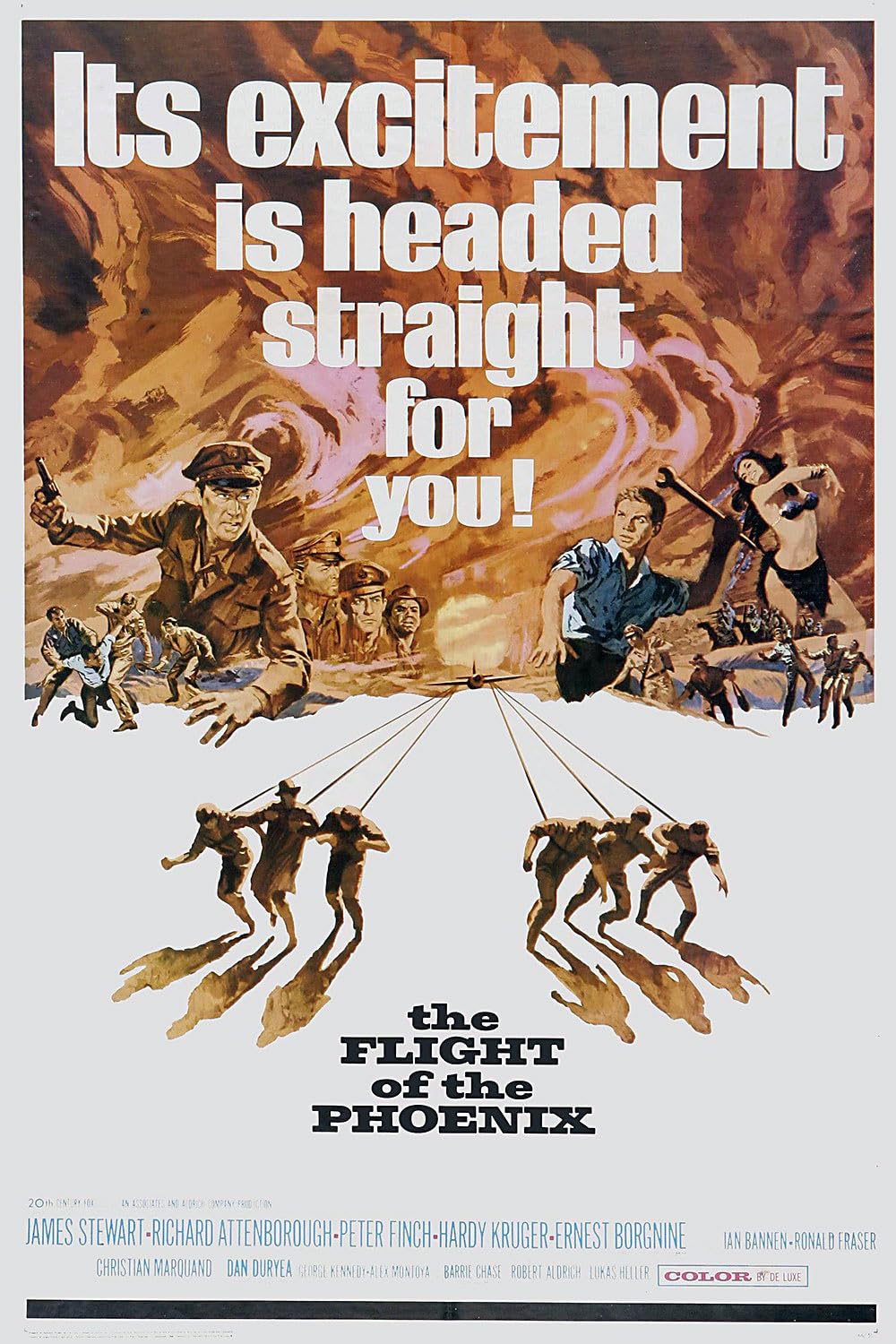
The Flight Of The Phoenix (1965)

A cargo plane goes down in a sandstorm in the Sahara with less than a dozen men on board. One of the passengers is an airplane designer who comes up with the idea of ripping off the undamaged wing and using it as the basis for an airplane they will build to escape before their food and water run out.
Theirs was the triumph - yours, the excitement!
Frank Towns: "The little men with the slide rules and computers are going to inherit the earth".
Pilot Knob, California, USA
Buttercup Valley, California, USA
Yuma, Arizona, USA
Imperial County, California, USA
The Phoenix's take-off was considered too dangerous to stage at the sandy filming location (its actual take-off was from a smoothed, compacted-earth runway), so legendary stunt pilot Paul Mantz was asked to do a "touch-and-go" landing in which he came in low, skimmed his landing gear along the ground, then throttled up to gain altitude, merely simulating a take-off. On the second take, as the landing gear made contact with the ground, the plane's aft boom fractured, causing the aircraft to nose into the ground and cartwheel, killing Mantz. As the second take had merely been a "protection shot," with the necessary footage captured during the first attempt, a vintage North American O-47A observation plane from an air museum was substituted for the remaining necessary close-ups.
According to director Robert Aldrich the cast went out at night in Yuma Arizona where the film sets were, driving around and causing mayhem. They used to drive around with prop dummies (used during the crash scene) and throw them out while the car was moving, so bystanders thought they were real people. Jimmy Stewart was the "outsider" wary of the European actors, but soon got in on the fun, taking a prop machine gun and jumping out to finish off the dummies gangland style. The police stopped them, but when they found it was Jimmy Stewart they let them go. It was also Aldrich's and Stewart's futile job to try to keep Peter Finch sober. (source book is "Jimmy Stewart the Truth Behind the Legend")
James Stewart, playing the pilot Frank Towns, was a highly experienced pilot in real life, having flown many missions in WWII, and was still officially in the United States Air Force Reserve when the film was made.
A surprise failure at the box office, despite its powerhouse cast. In a 1974 interview, director Robert Aldrich opined that it might make back its money "in another five years".
The Phoenix was, in fact, a real cobbled-together plane that actually flew. The cockpit was very spartan, not fully functioning, was very shallow, and was located behind the radial engine, not inside it. There are many videos available that depict the structure and history of the Tallmantz P-1, as the plane was officially called, as well as videos that show the actual crash in which it was destroyed during a filming sequence for The Flight of the Phoenix. This resulted in the death of pilot Paul Mantz, who is eulogized at the end of the film. The aircraft had been built specifically for use in The Flight of the Phoenix.
Continuity
At the end of the movie, when the Phoenix takes flight, there are several times when tires can be seen on the skids.
When the Phoenix reaches the oil-derrick oasis at the film's end, several shots show a totally different aircraft than the stunt plane flying over. This was because during the filming, the original "Phoenix" crashed killing Albert Paul Mantz (August 2, 1903 - July 8, 1965), the stunt pilot. He was eulogized in the credits.
When Cobb dies in the desert, he writes his name in the sand. The (already blurry) letters are disturbed when Towns chases away a vulture, but when he turns to read it, the writing is restored (it now looks like wet sand writing).
A part of the exact same footage of Trucker (Ernest Borgnine) is shown twice: After the crash, as he is standing on top of a sand dune, removing his hat and scratching his head.
At the end of the movie, a ground shot shows the top of the Phoenix's wings with no-one lying on them.
Factual errors
The airflow over the wings would be so compromised by the wind shields and the men behind them that the plane would simply not fly. Indeed, the Phoenix stunt plane built for the film suffered severe aerodynamic drag from the dummies that were put on the wing to simulate the passengers. The dummies had to be replaced with thin plywood silhouettes erected parallel to the fuselage that did not obstruct the airflow.
When Dorfman is describing the flights made by pioneers Henson and Stringfellow, he states that both men made a rubber powered model airplane that flew for 60 meters or so. Messrs Henson and Stringfellow never built a rubber powered model. Stringfellow did build a model airplane, but not powered with rubber. It had a steam engine and it was the first airplane ever to fly, although it was a model. Henson designed an "Aerial Steam Carriage" in 1842-43, but it was never built or flown. The rubber powered model was made by a Frenchman called Alphonse P?naud (1850-1880) in the year 1871. It flew for 40 meters in 11 seconds approximately.
There would be no room inside an airplane engine to build a cockpit, and the heat generated to the pilot would be impossible to withstand.
Captain Towns refers to having cleaned the carburetor jets thoroughly. The Pratt and Whitney R-2800 has a pressure carburetor that could not be disassembled in that desert without contaminating it. Also, it could not have been reassembled correctly without the use of a pressure bench to re-calibrate all the regulating springs and diaphragms.
When the port wing and engine section are being separated from the rest of the plane, it is necessary to use a hand crank winch with a couple of operators because the wing is so heavy. The winch is sitting on loose desert sand. It seems much more probable that the winch would be drawn toward the much heavier wing rather than the wing being drawn to the winch.
Incorrectly regarded as goofs
The film does not depict the installation of a cockpit inside an airplane engine. The cockpit is located behind the engine in the tail boom, and the engine exhaust is discharged out the side. This is the standard configuration used by most single-engine propeller-driven aircraft. In fact, the stunt plane that was built to represent the Phoenix actually flew.
Revealing mistakes
After The Phoenix has taken off, there are views, allegedly from the plane, of the wreckage remaining on the ground. The Phoenix had been pulled away from the wreckage site prior to takeoff, and then appeared to have proceeded even further from it in a straight line direction. There was no indication that The Phoenix, once in flight, had circled back to the wreckage site, and its return back to that area makes no sense, in any case.
In the scene where the 'Phoenix' is rolling along the ground and trying to get aloft, you can see small buildings on the horizon.
The movie opens with a cargo plane that is supposed to be taking off. The plane is actually already in the air. A plane taking off from a sandy runway would kick up a considerable amount of dust behind it from the wheels on the ground and the flaps forcing air down onto the sand. The wheels are not on the ground in the initial "distance" shot of the plane. As the plane passes the camera and climbs, there are no flaps down to assist with lift. Apparently, the plane was simply flown very close to the ground in an attempt to give the illusions of a takeoff.
The catalog of the fictional company "Baecker Flugzeuge" that Dorfmann works for is actually a real one by German model manufacturer Schuco. The company logo can be seen in several shots.
Early in the movie, whilst Cobb is taking a walk in the dunes around the crash site, the camera looks back at the downed aircraft and shows the port (left) tail boom broken in half. In every other part of the movie, the starboard (right) tail boom is broken in half.
Miscellaneous
Incorrectly regarded as a goof: "When Captain Harris is preparing to walk across the desert, he declares that he had better get going because it is almost dark. However, the length of his shadow indicates it is much closer to noon than it is to dusk." From the tone of Captain Harris' voice, and congruent with pilot Frank Towns' prior attempts to dissuade him by challenging his abilities...one being an inability to precisely navigate by the stars...Captain Harris is obviously being sarcastic in stating it's almost dark despite the midday hour.
After the plane is pulled into takeoff position , Bellamy goes over to the port wing and disconnects the harness, then he goes over to get the monkey, the camera scans back and shows Towns holding the ladder and the harness is still attached.
3 things about Tucker Cobb dying in the sand: 1) His name is Tucker Cobb, yet he wrote "E" Cobb not "T" Cobb. 2) When the pilot is chasing away the vulture, his foot pushes up a mound of sand that slightly covers the top of the second "B", yet when he looks at the name afterwards, neither the mound nor the covering of the top of the "B" is shown. 3) When he's shooing away the vulture we can see where Cobb's right hand is next to the bottom of the first "B", yet when we see his name, as the pilot is looking at it, Cobb's hand in now next to the bottom of the 2nd "B".
When the pilot inserts a cartridge into the Coffman Starter, the cartridge has an empty primer pocket. Coffman Starter cartridges use shotgun-style primers, so the hole in the base of the empty pocket is large enough to see into the empty interior of the cartridge.
When Captain Harris is talking about the pressed dates he says, "I think that's about all" and Ratbags says, "That's enough". At this point an insect runs across the upper left of the camera lens.
Crew or equipment visible
The crew is reflected in Dorfmann's eyeglasses during a camera closeup of his face.
Errors in geography
The vultures in the movie are Turkey Vultures. Turkey Vulture is an American species (from North America to Tierra del Fuego). There are no native Turkey Vultures in the Sahara.
Plot holes
Capt. Towns shoots the lame camel, but doesn't think to use the dead animal for food.
Throughout the story much is made of the fact that they don't know where they are, or what direction to head. This would apply equally once they are aloft in their makeshift plane: they would still not know where to go.
The oil company is depicted as a threadbare operation that hires washed-up pilots and maintain its airplanes poorly. Libya's oil industry in 1965 was actually in the hands of wealthy multinational oil companies, including British Petroleum, Amerada Hess, and Standard Oil of New Jersey (later known as Exxon). There was no room for wildcatters.
Character error
When Ratbags goes to Watson for a 3/8" 'spanner', Watson gives him a, clearly, much larger than 3/8" spanner.