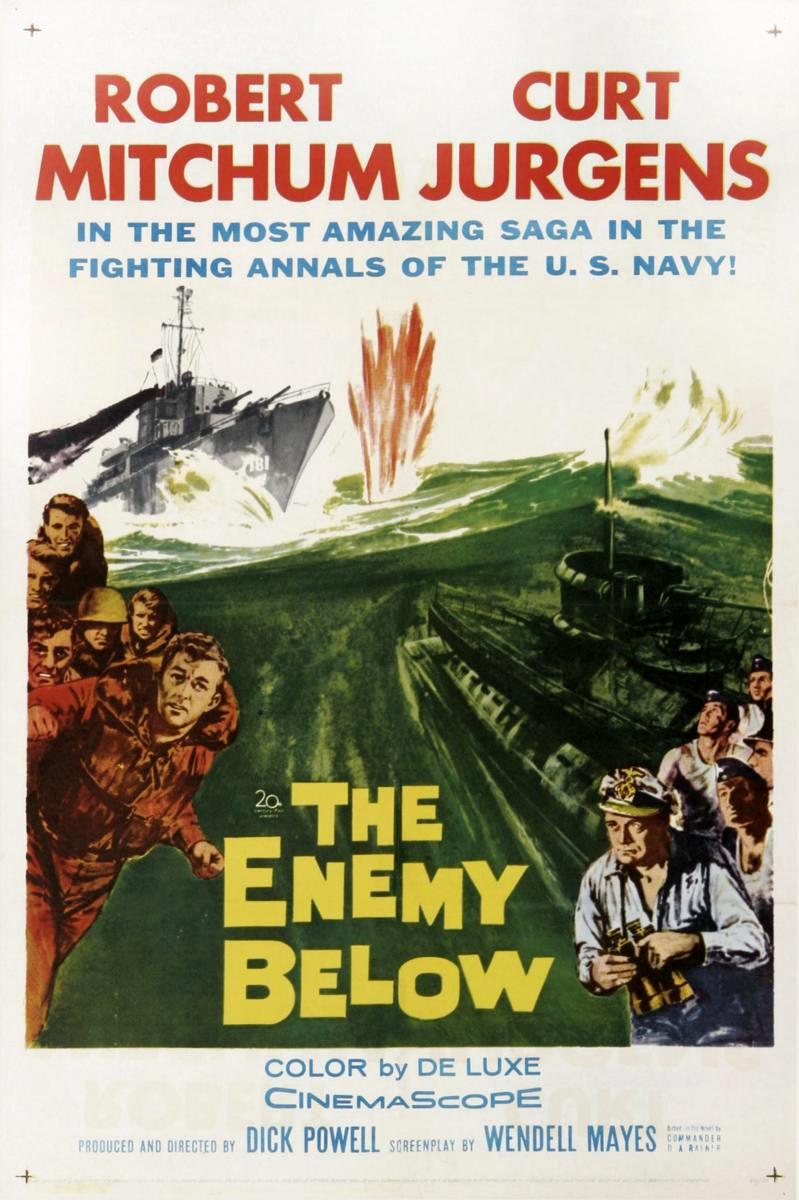
The Enemy Below (1957)

During World War II, the USS Haynes, an American destroyer escort discovers a German U-boat in the South Atlantic. A deadly duel between the two ships ensues, and Captain Murrell must draw upon all his experience to defeat the equally experienced German commander.
The Deadliest Cat and Mouse Game of the Sea!
Captain Murrell: I have no idea what he is, what he thinks. I don't want to know the man I'm... trying to destroy.
[the ship has just avoided two torpedoes]
Lieutenant Ware: The Miami yacht races were never like this!
[last lines]
Von Stolberg: I should have died many times, Captain, but I continue to survive somehow. This time it was your fault.
Captain Murrell: I didn't know. Next time I won't throw you the rope.
Von Stolberg: I think you will.
Hawaii, USA
Long Beach, California, USA
(rescue sequence)
20th Century Fox Studios - 10201 Pico Blvd., Century City, Los Angeles, California, USA
(Studio)





One of the technical consultants working on this movie was Albert Beck, a former German U-boat submariner, who advised on the submarine scenes.
In real life, the destroyer USS Borie (DD-215) rammed U-boat U-405 and sank it. The Borie was severely damaged, could not be salvaged and sank the next day. The crew was rescued by another vessel.
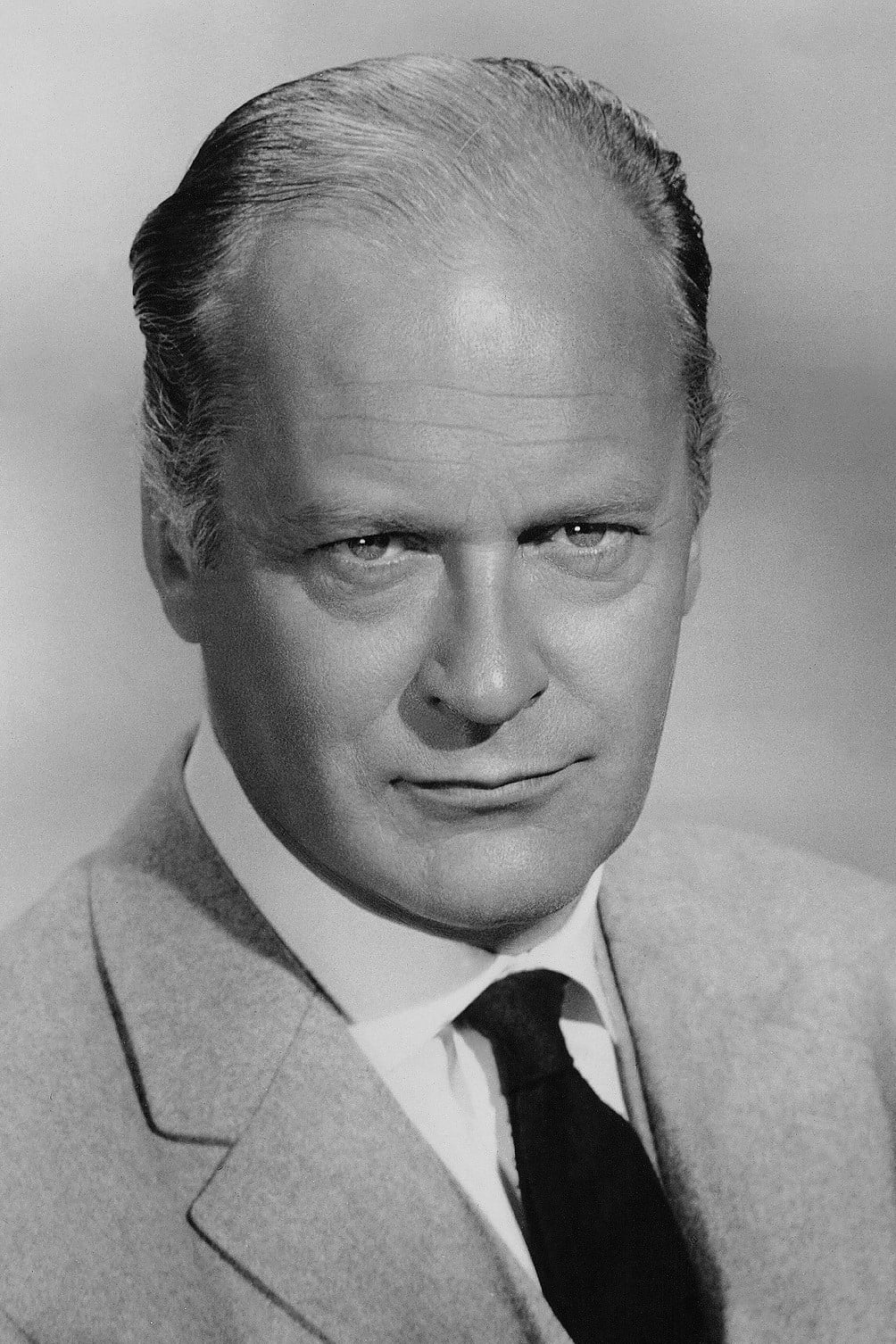
In an interview in July 1977 with 'The New York Times,' Curd J?rgens (who played the German submarine commander Capt. Von Stolberg), said: "This was an important picture for me because it was the first film after the war in which a German officer was not interpreted as a freak." Other reviews commented that the film was notable because the clash between the captains was not portrayed as black and white or good and evil.
Two endings were shot --- In one, both commanders die; in the other, a third vessel rescues them. The final ending was determined by preview results. The "USS Haynes" was in actuality the USS Whitehurst, captained by Walter R. Smith, who received a "technical advisor" credit and can be seen playing the ship's chief engineer. Eva Novak can be seen in a photo as the wife of Von Stolberg (Curd J?rgens).
The American ship used in this movie was the destroyer escort USS Whitehurst (DE 634). It was sunk as a target for a new torpedo on 28 April 1971.
Continuity
When Von Stolberg swings across to the Destroyer, he is holding the rope with his arm straight in front of him; but in the next shot, his arm is higher up the rope.
When the destroyer re-engages the sub after completing the triangle it drops a depth charge pattern and the sub turns left. The captain calls, "Left standard rudder," and the exec repeats, "Right standard rudder," down the comms tube.
After the crew abandons ship, the life rafts on the filming model are still in place.
When Capt. Murrell (USN) tosses the rope to the U-boat Captain, the bitter (loose) end of the rope after being wrapped around the U-boat bridge's pipes is short. When next seen, the bitter end is much longer.
After one depth charge attack, the captain is notified of a visible oil slick; that same oil slick is visible in an earlier scene prior to that particular attack.
Factual errors
When the U-boat captain first observes the Destroyer, he describes it to his first lieutenant, including the observation that it has "No tubes." The lieutenant refers to the manual and declares that it is a Buckley Class Destroyer. Buckley Class Destroyers were, in fact, equipped with a triple-mount of torpedo tubes, just aft of the stack.
The crew of the German U-boat was unusually clean shaven. Although some men have stubble, there is not a single full beard among the crew. This would be very unusual unless the crew was fresh from port. This is a fact attested to in the dialogue of Das Boot (1981) which was a much more concerned about historical accuracy.
Right after the burial-at-sea sequence on board the rescue destroyer, a watertight deck hatch can be seen rigged in the open position, with its escape scuttle also open. During wartime cruising (Condition III), Navy Regulations require all watertight doors, hatches, and scuttles on the weather decks to be closed while the ship is underway. Note: any deck exposed to the outside is classified as a "weather deck."
The DE has a doctor on board. A doctor was not part of the standard compliment of destroyer escorts.
When the U-boat is first sighted the captain says; "We might get close enough to get a shot at him before he pops under." At the reported range of 6,000 yards the U-boat was already an easy shot for the 3"/50 guns of a destroyer escort (14,600 yards max range, about 10,000 yards effective range).
Revealing mistakes
When the switches on the submarine's "attack computer" are turned prior to firing the first salvo of torpedoes, one switch knob flops around, but it is quickly corrected by the actor.
After receiving a particularly jarring depth charge attack where several of the U-boat crew are thrown off balance, a few leaks occur within the conning tower. To stop the leaks the Executive Officer reaches for a set of wrenches that are neatly and conveniently laid out on a table despite the submarine having been violently tossed side to side several times.
Anachronisms
At various points in the movie, a screen representing a radar display is shown. The round face with a sweeping radial arm anchored in the center has become a distinctive representation of Radar displays but did not exist during WWII.
The Little Orphan Annie comic book read by the engineering officer, is issue #2 June-August 1948, published three years after WWII ended.
Audio/visual unsynchronized
As the U-boat's destruct charges set by her crew finally explode, the sound is less like bombs and more similar to gunshots, such as those aimed at the DE when she is about to ram the U-boat.
Errors in geography
The opening credits of the film end with "World War II South Atlantic Ocean." Moments later, dialog among the crew reveals that the destroyer left Trinidad that morning. As the South Atlantic is more than 1200 miles from Trinidad, the ship cannot possibly be in the South Atlantic.
Character error
On board the U-boat the sea depth is given as "310 meters"; that's equivalent to 170 fathoms or 1,020 feet. The same depth is given on board the destroyer as "150 fathoms." Murrell converts it in his head first to meters, then to feet, even though as an experienced American seaman he would certainly know that 1 fathom is exactly 6 feet. Furthermore, although the fathom depth was wrong, he converts to the right value: "310 meters --- that's over 1,000 feet."
The dealer in the bridge game seems to finish with the player on his right. When dealing, the last card should go to the dealer.
In the Bridge game, dummy is placed on the table before the opening lead. The correct sequence is: opening lead and then the dummy hand is shown.
The bridge game bidding ends with 'pass and double.' The bid should be 'double,' and still must be followed by three consecutive 'pass' bids by the other players.
During the bridge deal, the dealer's partner (player opposite), picks up his cards before the end of the deal. His remaining card is dealt, but then picked up by the player to the dealer's right, resulting in a void hand.