
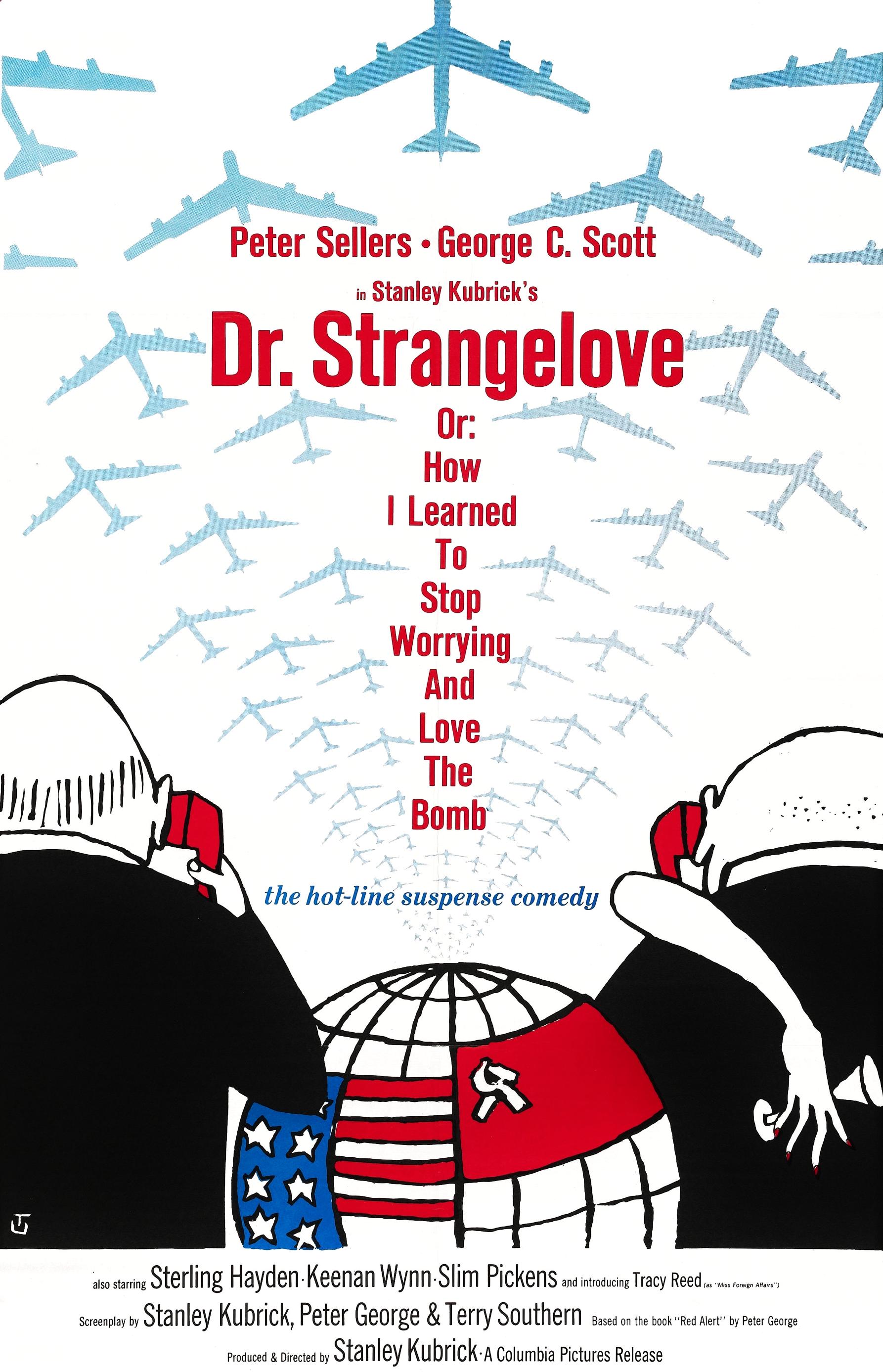
Dr. Strangelove Or How I Learned To Stop Worrying And Love The Bomb (1964)

Paranoid Brigadier General Jack D. Ripper of Burpelson Air Force Base, believing that fluoridation of the American water supply is a Soviet plot to poison the U.S. populace, is able to deploy through a back door mechanism a nuclear attack on the Soviet Union without the knowledge of his superiors, including the Chair of the Joint Chiefs of Staff, General Buck Turgidson, and President Merkin Muffley. Only Ripper knows the code to recall the B-52 bombers and he has shut down communication in and out of Burpelson as a measure to protect this attack. Ripper's executive officer, RAF Group Captain Lionel Mandrake (on exchange from Britain), who is being held at Burpelson by Ripper, believes he knows the recall codes if he can only get a message to the outside world. Meanwhile at the Pentagon War Room, key persons including Muffley, Turgidson and nuclear scientist and adviser, a former Nazi named Dr. Strangelove, are discussing measures to stop the attack or mitigate its blow-up into an all out nuclear war with the Soviets. Against Turgidson's wishes, Muffley brings Soviet Ambassador Alexi de Sadesky into the War Room, and get his boss, Soviet Premier Dimitri Kisov, on the hot line to inform him of what's going on. The Americans in the War Room are dismayed to learn that the Soviets have an as yet unannounced Doomsday Device to detonate if any of their key targets are hit. As Ripper, Mandrake and those in the War Room try and work the situation to their end goal, Major T.J. "King" Kong, one of the B-52 bomber pilots, is working on his own agenda of deploying his bomb where ever he can on enemy soil if he can't make it to his intended target.
"Gentlemen, you can't fight in here! This is the War Room!"
General "Buck" Turgidson: Gee, I wish we had one of them doomsday machines.
Banff National Park, Alberta, Canada
(aerial photography - outside bomber views at end of flight)
Qu?bec, Canada
(aerial photography - outside bomber views)
Arctic
(aerial photography - outside bomber views)
Iceland
(aerial photography - outside bomber views)
Rocky Mountains, Colorado, USA
(aerial photography - outside bomber views)

While shooting aerial footage over Greenland, the second unit camera crew accidentally filmed a secret US military base. Their plane was forced down, and the crew was suspected of being Soviet spies.
Peter Sellers was paid $1 million, 55% of the film's budget. Stanley Kubrick famously quipped "I got three for the price of six".
The scene where Gen. Turgidson trips and falls in the War Room, and then gets back up and resumes talking as if nothing happened, really was an accident. Stanley Kubrick mistakenly thought that it was George C. Scott really in character, so he left it in the film.
In the early 1960s the B-52 was cutting-edge technology. Access to it was a matter of national security. The Pentagon refused to lend any support to the film after they read the script. Set designers reconstructed the B-52 bomber's cockpit from a single photograph that appeared in a British flying magazine. When some American Air Force personnel were invited to view the movie's B-52 cockpit, they said it was a perfect copy. Stanley Kubrick feared that Sir Ken Adam's production design team had used illegal methods and could be investigated by the FBI.
The film led to actual changes in policy to ensure that the events depicted could never really occur in real life.
Continuity
A missile explodes on the bomber, damaging many of the interior systems and switches. Yet in the exterior shots that follow of the bomber, it appears undamaged.
When Gen. Ripper and Capt. Mandrake are using the belt-fed machine gun, in one shot Mandrake is holding a chair over his head for protection, but when it cuts and the camera is behind them and Ripper crawls away from the window, Mandrake isn't holding the chair, and the closest chair is 10 feet away from him.
The bomber flies past the same iceberg more than once.
The long scene with Mandrake and Ripper on the floor is shot from 3 camera angles. In each view Ripper is holding the machine-gun at different heights on the barrel. Notice the two air holes visible shifting to none.
Factual errors
Typos in the opening captions include "Base on the book Red Alert by Peter George," "ficticious" instead of "fictitious" and "occurence" instead of "occurrence."
When General Jack D. Ripper is firing the .30 caliber machine gun with the assistance of Group Captain Lionel Mandrake, he is holding the machine gun by the barrel. In reality, this would quickly cause serious burns and would not be possible for more than a few seconds.
The depicted capabilities of the airborne radar in the B-52 are fantasy. The B-52 never had a fully rotating radar with a PPI scope, it had a ground attack radar, and the gun turret radar didn't operate like that. No airborne radar in the 1960's could detect a target as small as a surface-to-air missile at 50 miles away. A sweeping radar would not be able to display the missile exploding in mid-sweep.
The hand grenades of Colonel Bat Guano's jacket are British Mills Bombs, not American hand grenades.
The pilots wings on General Turgidson are basic pilot wings. For a four star general they should be Command Pilot Wings with a wreath and star on top.
Incorrectly regarded as goofs
When the US-USSR hotline was set up in 1963, it used encrypted teletype machines, not a direct voice line. Thus, the conversation between Muffley and Kissoff would not have been possible. Naturally, for the purposes of both drama and Sellers' brilliant verbal delivery, the hot line is depicted as being a telephone.
While on the bomb run, Major Kong orders the bomb detonator set to zero altitude. Altitudes in aviation are calculated based on sea level (which is zero altitude). As the missile base they were attacking was in the mountains, and possibly higher than zero altitude, a bomb dropped with that setting might not go off. But the base on the valley floor, unlike surrounding mountains, may have been at zero altitude. Nuclear blasts are usually set for air burst because they are more effective than ground bursts, however, the airplane is supposedly flying at low altitude, such as might be engulfed in an air burst.
Captain Mandrake says that all he ever had to do was push the button in his Spitfire fighter, and a little later says that he was taken prisoner by the Japanese. While some might think that no spitfires were sent to eastern Asia during the war, during the final year of the war a number of Spitfire MKVIIIs did see action against the Japanese over Burma.
General Ripper says his entire wing of 34 B-52s are on airborne alert. Only a proportion of a wing's aircraft would be on such alert. It would not be possible to keep an entire wing on such an alert. The fact is that the General was mad and operating far beyond his brief. It was within his ability, being the aggressor, to send the entire wing if he wished.
The Coca-Cola machine squirts drink into the face of Colonel Guano after he shoots holes in it. However, there would be no reason for the bottles or cans in the machine to be under pressure, as the shooting wouldn't have shaken them up. Also, the bottles wouldn't be stored to the side of the vending door (where the bullet holes are), but above it. The style of machine shown mixes tap water from a water line attached to the building's plumbing with carbon dioxide and drink syrup stored in tanks inside the machine under pressure and dispenses it into a paper cup that drops into a chamber in the door which is plainly visible in the shot. Therefore, it is quite plausible that water would squirt from the machine under pressure if the tanks or water lines were pierced by gunfire. This style of machine used to be quite common when this film was made in the 1960's, but are now fairly rare, as the machines had to be restocked with raw drink syrup (a different tank of syrup for each drink flavor) and recharged with carbon dioxide. Otherwise, if the syrup, carbon dioxide, or both ran out, you often received either a cup of plain soda water, a "flat" soda with no bubbles, or worst of all, a cup of plain water if both the syrup and carbon dioxide tanks were empty. While this is correct, the whole point of this scene is comedy.
Revealing mistakes
The panel in the B-52 labeled "Auto Destruct" is in fact a flare launch control panel. Visible under the black paint are the instructions "INSTRUCTIONS 1) PULL COVER DOWN 2) MOVE MASTER (CENTER) SWITCH DOWN 3) RELEASE A FLARE BY MOVING EITHER SIDE SWITCH" While today's astronomical budgets can allow for all sorts of things, the fact is that the designers had to improvise virtually all of the interior. and on a limited budget. In addition, the only reference was a photo looking over a pilot's shoulder and through the windshield. The astonishing complexity of the interior was a true masterpiece for its time. In fact, when asked for their opinion, Air Force visitors on the set were stunned at how realistic it was. It was so real that Kubrick make the designer swear that none of his designs were based on classified material.
Wing attack Plan R, as read by Major Kong, includes an ICBM complex, to receive a 30-megaton bomb, airburst at 10,000 feet. In reality, such a target, being hardened (probably underground), would call for a ground burst.
When the radio operator gets the go code (FGD135) he opens the code book and pages to the "L" page, then the "J" page, then finally to the "F" page. All 3 of those pages are exactly identical, with all of the "F" go codes in fainter type. The "F" page go codes are in much darker type.
In the cockpit scenes, when the aircraft banks during evasive maneuvers, no change appears in the instruments: they continue indicating straight and level flight (notably the attitude indicator).
During the final bombing run, a few times a reflection can be seen, making visible the glass of the airplane from which the background footage was shot.
Miscellaneous
George C. Scott tripped on the slippery black Formica floor, recovered and then delivered a line. The fall was an accident but it worked so it was left in.
The air base is shown as being overgrown with weeds. In fact, domestic U.S. air bases are required to be maintained in immaculate condition.
Surely Major "King" Kong would not be able to hang on to the bomb as it was falling.
The bomber flies past the same iceberg more than once.
During scenes showing Major Kong's B-52, it casts a shadow of a B-17.
Anachronisms
During the assault on Burpleson air force base, one of the attacking soldiers is seen firing a WW2 German MP- 40 sub-machine gun at the Headquarters building. This weapon would certainly not be used by a U.S. Army soldier in 1964.
Audio/visual unsynchronized
When Mandrake finds the radio, it is on the shelf of an IBM 1403 high-speed printer, with the cover open. The printer is running; anyone who has ever been around a working 1403 printer knows that they are very loud. Operators had to shout to be heard. The printer is not making the loud noise it should be making while running in the shown 600 lines per minute mode with the cover open.
Crew or equipment visible
The background footage for the model B-52's is filmed from a Boeing B-17G, whose shadow can be seen on the ground. See also Trivia.
Errors in geography
Although General Turgidson says (in the War Room) that "the aircraft will begin penetrating Russian radar coverage in about 20 minutes," the map of Russia on the Big Board shows several aircraft either very close to, or in some cases actually over, the Russian border, well within the range of Soviet military radar.
General Turgidson learns from his secretary, Miss Scott, of General Ripper's ordered attack on the USSR at 3 a.m. Washington D.C. time. However, the concurrent scenes at Burpleson Air Force base (somewhere in the Western United States) take place in the daytime.
Although the War Room is supposed to be in Washington, DC (or Arlington, Virginia to be a stickler), its telephones have British GPO 700-series telephone handsets.
Plot holes
In the beginning narration it is stated that western leaders were hearing rumors that the Russians were building some type of Doomsday Machine. When the Russian ambassador informs the president that they do have a Doomsday device, the president and military leaders have no idea what the ambassador is talking about.
On the bombing run, the mile count as they approach target is separated by 19 seconds per mile, or approximately 3 miles per minute, or 180 MPH, with is considerably slower than its' low level bombing run speed of 375 MPH.
The weight and recoil of a .50 caliber machine gun - especially when firing - is not possible for a single human to handle, or keep aimed accurately.
Character error
Towards the end of the film, when Strangelove is fighting with his renegade right hand over control of his wheelchair and punches it several times out of frustration, the Russian Ambassador (Peter Bull) clearly corpses (laughs) at Peter Sellers' performance and then quickly regains his composure.
De Sadesky says that the fallout from the doomsday device has a half-life of 93 years, but then he also says that the fallout would circle Earth for 93 years. This is a contradiction: half-life is the time it takes for radiation to be halved, not completely dissipated. It is common however for people to confuse these concepts, and the dissipation time for the fallout from a nuclear weapon salted with cobalt is indeed about a century.
While checking the contents of his bailout kit, Major Kong removes his Colt 1911 pistol, cycles the slide and then pulls the trigger and drops the hammer. To do this without checking to see if the pistol is unloaded is an unforgivable breach of basic rules of safe firearms handling and would never be done by anyone with military training.
De Sadesky claims that the doomsday device are large nuclear weapons that have been jacketed with a compound of Cobalt and Thorium. While Cobalt is indeed a first choice when making such a weapon, using Thorium makes no sense at all since it will not be activated by the blast to form any dangerous fallout.
When General Ripper issues the attack plan he calls it "attack plan R, R as in Robert." The correct phonetic alphabet for "R" is "Romeo." Later, on the B-52, the correct term is used.