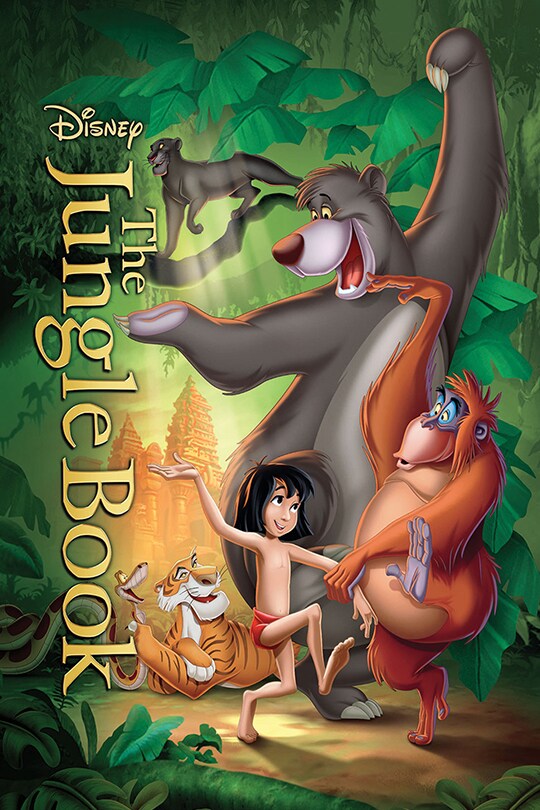
Disney's Jungle Book (1967)

Abandoned after an accident, baby Mowgli is taken and raised by a family of wolves. As the boy grows older, the wise panther Bagheera realizes he must be returned to his own kind in the nearby man-village. Baloo the bear, however, thinks differently, taking the young Mowgli under his wing and teaching him that living in the jungle is the best life there is. Bagheera realizes that Mowgli is in danger, particularly from Shere Khan the tiger who hates all people. When Baloo finally comes around, Mowgli runs off into the jungle where he survives a second encounter with Kaa the snake and finally, with Shere Khan. It's the sight of a pretty girl, however, that draws Mowgli to the nearby man-village and stay there.
The Jungle is JUMPIN'!
Baloo: You better believe it!
Walt Disney Studios, Burbank, California, USA
The last film personally overseen by Walt Disney.
Phil Harris, the voice of Baloo the bear in Disney's "The Jungle Book," also played the voice of a bear in another Disney film: he was Little John in Robin Hood (1973).
Baloo means bear in Hindi.
'Shere' as in Shere Khan means Tiger in Persian.
'Shere' as in Shere Khan means Tiger in Hindi.
Bagheera means panther in Hindi.
Hathi in 'Colonel Hathi' means elephant in Hindi.
This film was the last performance for actress Verna Felton who died the day before Walt Disney himself died.
A scene with a near-sighted, short-tempered rhinoceros named Rocky, who would encounter Baloo and Mowgli after the fall of King Louie's palace, was cut out of the script after Walt Disney figured that two comic scenes back-to-back was poor movie-making. Rocky was to be voiced by Frank Fontaine, who recorded his lines, and animation went as far as detailed storyboards.
Richard M. Sherman and Robert B. Sherman were hired as songwriters after Terry Gilkyson wouldn't distance himself from the "darker" side of The Jungle Book. His song "The Bare Necessities" was included in the film, and was the only song from the film to be nominated for an Academy Award. Two other songs written for the film (by Gilkyson) can be heard on the soundtrack CD: "Brothers All" and "The Song of the Seeonee."
Came seventh in the UK's Ultimate Film, in which films were placed in order of how many seats they sold at cinemas.
Walt Disney told his animation crew to "throw away" Rudyard Kipling's book, "The Jungle Book" because the resulting storyboards were too dark and dramatic. "Bear Necessities", was the only song he liked and kept because the music along with the draft was also too dark and dramatic.
According to Caroline Balestier, Rudyard Kipling's widow, "Mowgli" is pronounced "MAU-glee", not "MOH-glee". She reportedly never forgave Walt Disney for the gaffe.
Darleen Carr who played the voice of The Girl (Shanti) is the younger sister of The Sound of Music (1965) actress Charmian Carr (Liesl von Trapp).
The xerographic system, which had been used since One Hundred and One Dalmatians (1961), was further refined to combine both Xeroxed cels with hand inked details. For example, while the basic animation on the village girl at the end of the movie was with Xeroxed cels, her mouth was inked by hand. The backgrounds also moved back towards the more traditional look of earlier films.
The Vultures were originally going to be voiced by The Beatles. However, due to a change in schedule, they dropped out at the last minute. The look of The Vultures and the voices are now an homage to The Beatles.
This was the last film that Darleen Carr made at the Disney studios. She stopped working at the Disney studio's when Walt Disney died in 1966.
Walt Disney died during production of this film. Many people wondered at what the studio's fate would be, particularly the animation division. The film performed extremely well at the box office, ensuring that the animators would not be put out of work. Had the film failed, it is likely that animation would have been closed down at the Disney studio.
Voted number 19 in Channel 4's (UK) "Greatest Family Films".
When Mowgli is tackled by his pack-mates and enthusiastically welcomed home, these key frames were lifted from The Sword in the Stone (1963) when Wart/Arthur is welcomed home by the keep dogs.
Kaa's song "Trust in me" was originally written for Mary Poppins (1964) as "Land of sand" but not used.
The laughing heard from King Louie when he is tickled by Baloo was originally used in Song of the South (1946) as Brer Rabbit's laughing heard during the Laughing Place sequence.
All of the 'scatting' in the film was improvised by 'Phil Harris' and Louis Prima.
The Vultures song "That's What Friends Are For" was originally written with Beatles-style beat, but Disney insisted it was changed, so as not to date it to the Sixties. It was rewritten as a barbershop quartet, to make it timeless.
Her role as Winifred the Elephant (Colonel Hathi's mate) was the last film role for Verna Felton, before her death in December 1966. Coincidentally, her first role in an animated Disney film was also that of an elephant: she was The Elephant Matriarch in 'Dumbo (1941)'.
Winifred (Colonel Hathi's mate) is the only female animal to have any dialogue throughout the entire film, as though Raksha (the Mother Wolf) briefly appears at the beginning, she never actually speaks.
The 19th animated feature in Disney animated features canon, and the last to be personally supervised by Walt Disney, himself.
The first Disney film to be released after Walt Disney's death in 1966, just prior to the film's theatrical release.
Just after Mowgli runs away and Bagheera is trying to convince Col. Hati to look for him, Hati's wife Winifred announces if they don't help find him, she will take command of the herd. Hati is outraged at the thought of a female leading. The joke is that elephants herds are led by a matriarch (female), while adult males generally live alone. As the only apparent female in the herd, Winifred should be leading by default.
Continuity
Colonel Hathi breaks his stick; in the next scene it is intact, then broken again.
When Baloo and Bagheera are trying to rescue Mowgli from the monkeys, Baloo opens a door smashing it against Bagheera. The door has no handle. The next shot is a close-up of Bagheera's head with the door behind it; the door has now a handle.
When Bagheera drops baby Mowgli off with the wolf pack, he leaves the basket at the mouth of the cave den. When he leaves the baby, the basket is closed and when he looks back from his hiding place, the basket is open.
When Colonel Hathi orders the troops to halt it is clear that Winifred is at the front. However, later in the scene, a gray elephant appears to be at the front instead.
When the Indian girl is kneeling by the water at the end, singing, as she fiddles with one of her pigtails and flips it back you can see that it is still tied with the purple ribbon. However, the shot right after she fiddles with her other braid shows both ribbons as missing and her hair loose.
Incorrectly regarded as goofs
After the fight with the monkeys Baloo and Bagheera have a black eye. There is a later shot from below the water that some have misinterpreted as a reflected (mirror image) shot, showing the black eyes on the same sides as they have been throughout.
Factual errors
Wolves do not wag their tails yet several times wolf cubs are seen doing so.
Errors in geography
During the "The Bare Necessities" song, Baloo is shown picking the fruit off Prickly Pear cacti - a type of plant that only grows in North America and nowhere near India.
Errors made by characters (possibly deliberate errors by the filmmakers)
Baloo asks Mowgli to scratch his left shoulder, however when Mowgli scratches him, he scratches his right
The story takes place in India, yet King Louie is an orangutan - they live in Borneo and Sumatra.
The monkeys are hanging from their tails in several scenes, but monkeys with grasping tails are only found in South America.