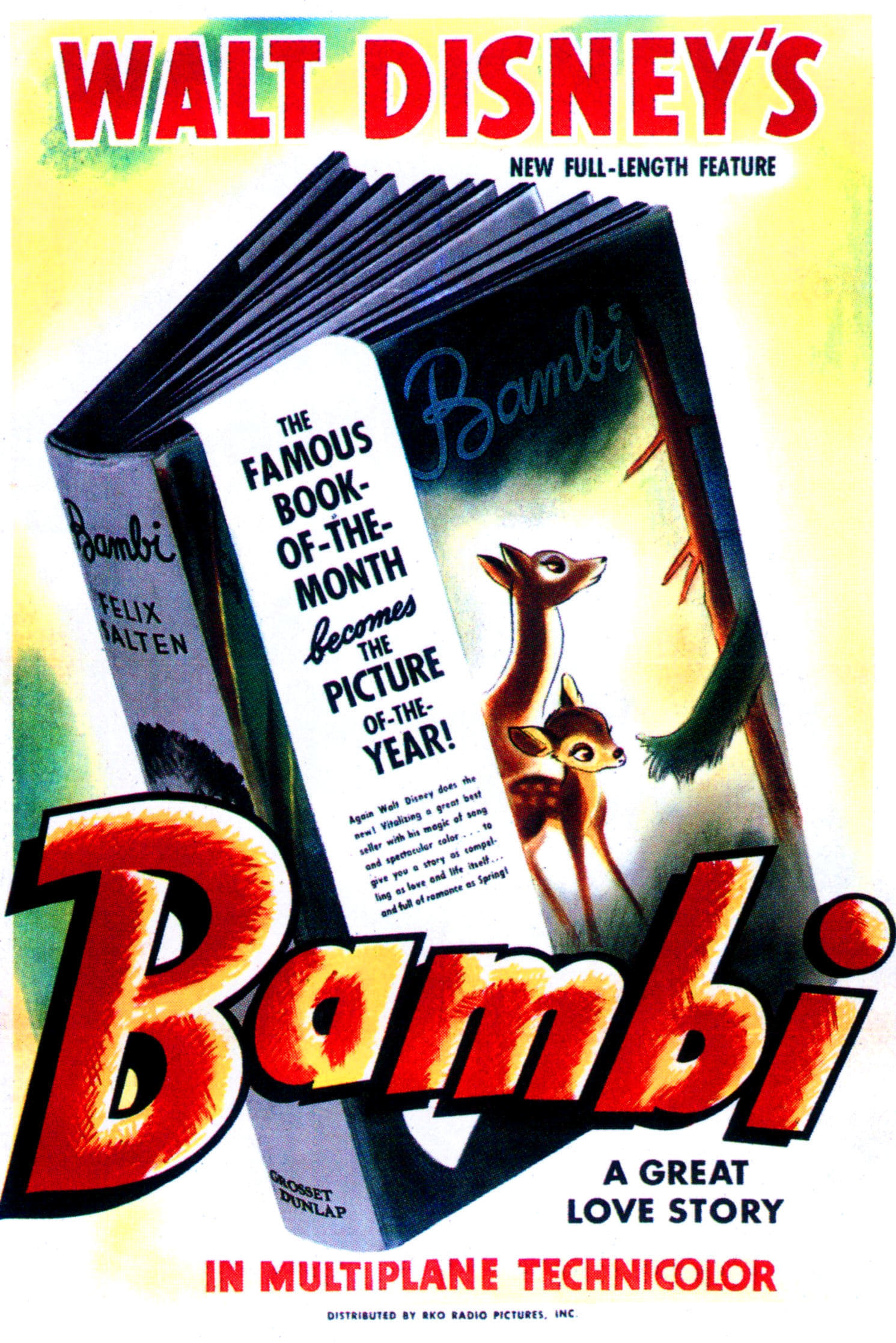
Disney's Bambi (1942)

The classic Felix Salter story Bambi provides the basis for this near-perfect Disney animated feature. We follow the male deer Bambi from birth, through his early childhood experiences with woodland pals Thumper the rabbit and Flower the skunk, the traumatic sudden death of Bambi's mother at the hands of hunters, his courtship of the lovely doe Faline, and his rescue of his friends during a raging forest fire; we last see the mature, antlered Bambi assuming his proper place as the Prince of the Forest. In the grand Disney tradition, Bambi is brimming with unforgettable sequences, notably the young deer's attempts to negotiate an iced-over pond, and most especially the death of Bambi's mother?and if this moment doesn't move you to tears, you're made of stone (many subsequent Disney films, including Lion King, have tried, most in vain, to match the horror and pathos of this one scene). The score in Bambi yielded no hits along the lines of "Whistle While You Work", but the songs are adroitly integrated into the action. Bambi was the last of the "classic" early Disney features before the studio went into a decade-long doldrums of disjointed animated pastiches like Make Mine Music.
Love Comes To The Forest Folk . . . and to you, in one of the world's greatest love stories!
Thumper: "Eating greens is a special treat, It makes long ears and great big feet. But it sure is awful stuff to eat." I made that last part up myself.
Walt Disney Studios, Burbank, California, USA
Pre-production began in 1936 and was intended to be Disney's second full-length animated film after Snow White and the Seven Dwarfs (1937). Disney's perfection and quest for realism delayed the project significantly, so that Pinocchio (1940), Fantasia (1940), The Reluctant Dragon (1941) and Dumbo (1941) were released earlier than Bambi.
Sidney Franklin originally initiated "Bambi" as a film project in 1933, envisioning it as a live action film. He had even gone to the stage of recording Margaret Sullivan and Victor Jory's voices for the soundtrack. Eventually he realized that the technology simply wasn't adequate enough to make the film. After seeing "Snow White and the Seven Dwarfs" (1937), it dawned on Franklin that there was someone who could realize "Bambi" as a movie. So he contacted Walt Disney who immediately leapt at the idea of working on the project. Disney started work on the film in 1936, though he was also developing "Fantasia", "Dumbo" and "Pinocchio" at the same time. All this explains why there is a dedication in the film's opening credits "To Sidney A. Franklin - our sincere appreciation for the inspiring collaboration".
A test animation of baby Bambi stuck on a fallen tree-trunk was sufficiently charming to convince Walt Disney to make the film.
The look of the film was inspired by the work of Tyrus Wong, a Chinese animator whose sketches used softened backgrounds. This meant that the focus was squarely on the beautifully drawn animals.
The fifth animated Disney feature.
Bambi and Thumper are the names of two female assassins that James Bond encounters in "Diamonds are Forever" (1971).
After "Dumbo" (1940), this is the second Disney animated feature to be set in the present day.
Two asteroids have been named after Bambi and Thumper.
For the film's DVD release in 2005, over 110,000 frames were cleaned up individually, requiring more than 9,600 hours of work. This was done from a copy of the original nitrate negative borrowed from the Library of Congress.
Unusually for the time, Disney insisted on children providing the voices for the animals when they were young, instead of using adults mimicking youngsters.
Austrian writer Felix Salten (real name Siegmund Salzmann) - an insurance clerk who began to write out of boredom - got the inspiration for his novel during a trip to Italy when he became fascinated with the Italian word "bambino".
The Disney studios were walking a very precarious line financially, and were constantly on the verge of bankruptcy. A studio strike and, of course, the outbreak of war - which deprived them of their lucrative European market - didn't help matters. Disney was able to secure another loan from the Bank of America, but when both "Fantasia" and "Dumbo" failed at the box office, a lot was riding on "Bambi" to be a success.
"Bambi" premiered August 8, 1942 in London - a very daring move in the midst of war - and a few days later in New York. Despite glowing reviews, it was an initial box office disappointment. This prompted Disney to re-release "Snow White and the Seven Dwarfs" in the summer of 1944, a tactic that the studio regularly adopts now for all their animated features.
There are approximately only 1,000 words of dialog throughout the entire film.
One of the many rejected ideas was to show the hunter killed by the very forest fire that he had accidentally started.
Disney animators spent a year studying and drawing deers and fawns to perfect the look of Bambi and his parents and friends. Deer are notoriously difficult to render in human terms as their eyes are on either side of their face, their mouth does not lend itself to speech and they have no real chin. Ultimately animator Mark Davis resolved these difficulties by infusing the character of Bambi with the traits of a human baby.
No matter how skilled the animator, the Disney cartoonists simply could not draw Bambi's father's antlers accurately. This was because of the very complicated perspectives required. To get round the problem, a plaster cast was made of some real antlers which was then filmed at all angles. This footage was then rotoscoped onto animation cels.
The character of Thumper does not appear in Felix Salten's original novel. He was added by Walt Disney to bring some much-needed comic relief to the script.
This was Walt Disney's favorite film.
Before Thumper's name was finalized, he was referred to as "Bobo" in some sketches.
Some scenes of woodland creatures and the forest fire are unused footage from Pinocchio (1940).
The movie was set for a world premiere at Radio City Music Hall in New York City on 30 July 1942, but was delayed due to the extended run of Mrs. Miniver (1942).
The world premiere of this film was scheduled to be in the tiny Lincoln Theater in Damariscotta, Maine, USA. Maurice Day, an animator with Disney, brought Felix Salten's book to the attention of Walt Disney, and when Walt decided to make the movie he thanked Maurice by planning to hold the premiere in Maurice's home town. However, the State of Maine objected, fearing that hunters would be offended by the film, and the actual world premiere was elsewhere.
The movie lost money at the box office for the first run, but began to recoup its considerable cost (over $2,000,000) during the 1947 re-release.
The Maine Development Commission sent two fawns, appropriately named Bambi and Faline, to the Disney studio, to be kept as pets while artists studied their movements and behavior. When they were fully grown, they were released in nearby Griffith Park. Other animals, such as skunks and squirrels, were kept in the Disney zoo for similar purposes.
The film was dubbed into Russian with new lyrics, narration and dialogue prepared by Russian-born Leonid Kinsky. It was also dubbed into many other languages, including Arapaho, to help encourage "Arapaho children to learn and preserve their language."
The hunter who shoots Bambi's mother was originally going to be included as a character in the movie. But, for a man to shoot the mother of the hero, he would have to be clearly cruel and villainous for children to accept him. Since Disney didn't want to be seen as maligning hunters as evil, the character was cut and never shown in the final version of the film.
To design Bambi's scenes, Walt Disney traveled to Argentina in 1941, and there he was inspired in the forests of Neuqu?n's province, southwest of Argentina.
Bambi was originally supposed to go back to his mother after she was shot and find her in a pool of blood. This idea was scrapped.
Donnie Dunagan, who was the voice for young Bambi, also was the model for Bambi's facial expressions.
In the original script Bambi was shot instead of his mother, but Walt Disney dismissed the idea and moved the shooting to Bambi's mother.
The first and one of the few Disney features where the songs were not sung by any of the film's characters. Each song was either sung off screen by a soloist or a choir.
Six-year-old Peter Behn auditioned with several other children for the voice roles of Mother Rabbit's children. When Behn said the line (in reference to Bambi), "Did the young prince fall down?", a casting director who was watching the audition in another room shouted, "Get that kid out of here! He can't act!" However, the Disney animators who heard the audition tape loved the sound of Behn's voice. Behn was called back to the studio, and the character of Thumper was created largely based on his vocal performance.
Animation from this film has been reused more often than animation from any other Disney film. Usually it is used as incidental animation of birds, leaves and the like. Only a few of the major characters have been reused. Bambi's mother, for example, appears in the very first shot of Beauty and the Beast (1991), and is the quarry of both Kay in The Sword in the Stone (1963) and Shere Khan in The Jungle Book (1967). Bambi and his mother fully appear then in The Rescuers (1977).
The opening multiplane shot is one of Disney's biggest use of the multiplane. It had been used on scenes in The Old Mill, Snow White and the Seven Dwarfs, Pinocchio, Fantasia, and Dumbo.
CASTLE THUNDER: Heard a few times when the storm in the "April Shower" sequence is about to start. It's also heard when the storm clouds are beginning to part and the sun begins coming out.
In the original American version of the film, the music for the opening song starts at the film's opening. However, in all the foreign versions, it oddly plays over the Walt Disney Pictures logo and the singing wrongly begins when the word "Bambi" shows up, whereas in the American versions, the singing begins at the "Walt Disney presents" screen.
"Man" was ranked the #20 villain on the American Film Institute's list of the 100 greatest heroes and villains - the only character on the list not to appear on-screen.
[June 2008] Ranked #3 on the American Film Institute's list of the 10 greatest films in the genre "Animation".
The movie is responsible for the so-called "Bambi-confusion" ("Bambi-Irrtum") in German-speaking countries. In the book Bambi is a roe-deer (German: Reh). But since there are no roe-deers in the US, Walt Disney changed Bambi's appearance to that of a white-tailed deer, which in turn is unknown in Europe. However, both the original German-dubbed version from 1950 and the re-dubbing from 1970 stuck to the original Salten-Version and called Bambi a roe-deer instead of a stag (German: Hirsch), which would be a lot more correct. Since the appearance of Bambi's father and Bambi in adult life resemble a red-deer (which is common in Europe) a lot closer than an adult roe-deer, kids in German-speaking regions for the past 60 years have come to believe that a Reh (roe-deer) is the younger version of a (Rot)Hirsch (Red deer). This confusion has never really been cleared up for many so that this is now even taught to children by their parents who saw the movie when they were young.
The last film for Otis Harlan (the voice of "Mr. Mole"), who died in 1940. Harlan had previously appeared as "Happy the Dwarf" in Snow White and the Seven Dwarfs (1937).
Continuity
In the meadow scene, Faline's eyes change from blue to brown then back to blue in later scenes.
When Bambi looks in the pond while in the meadow and sees Faline's reflection, he repeatedly looks at both his and her reflections. After Faline giggles, Bambi stops in awe and blinks twice. On the second blink, the reflection's eyes do not blink with Bambi's eyes.
When Bambi sees the possums hanging upside down from a tree, they are oriented such that the shortest is hanging on the left and the longest is on the right. Bambi rotates his head to look at them. Doing this, the longest should now be on the "left," but the longest is still on the right.
When Thumper is laughing at Bambi just after meeting Flower, he rolls on his back and his normally white tail is brown. When he rolls back onto his belly, his tail is white again. This appears to have been corrected for the 2005 DVD release.
When the animals gather around to see new-born Bambi, the spots on Bambi's coat disappear for a moment.
Factual errors
Skunks, although not particularly active in winter, do not hibernate.
The owl says that all animals, like the birds, become "twita-paited" in the spring. That time for deer is the fall rut. However, Bambi and Faline's twins are born in spring which is correct.
Thumper consistently thumps his hind leg on the ground for various reasons: announcing positive news, showing off, joy, calling his family, etc. In real life, rabbits only thump to warn other rabbits about concern for danger or unfamiliar surroundings.
Revealing mistakes
One baby raccoon disappears as it comes out of the water after the fire, instantaneously appearing elsewhere. This has been corrected on the 2005 DVD as well as the Blu-Ray.
When we first meet Faline as a fawn, her pond reflection stands up as the camera moves back, while she stays still.
When Bambi walks backwards as an attempt to get away from Faline, he's missing two hooves.
When Bambi's mother says, "Bambi. My little Bambi," her eyes lose her pupils for a second.
Before Bambi tries to talk, his eyes are mistakenly drawn to look as if they have split for a short second while the little songbirds fly around his head.