
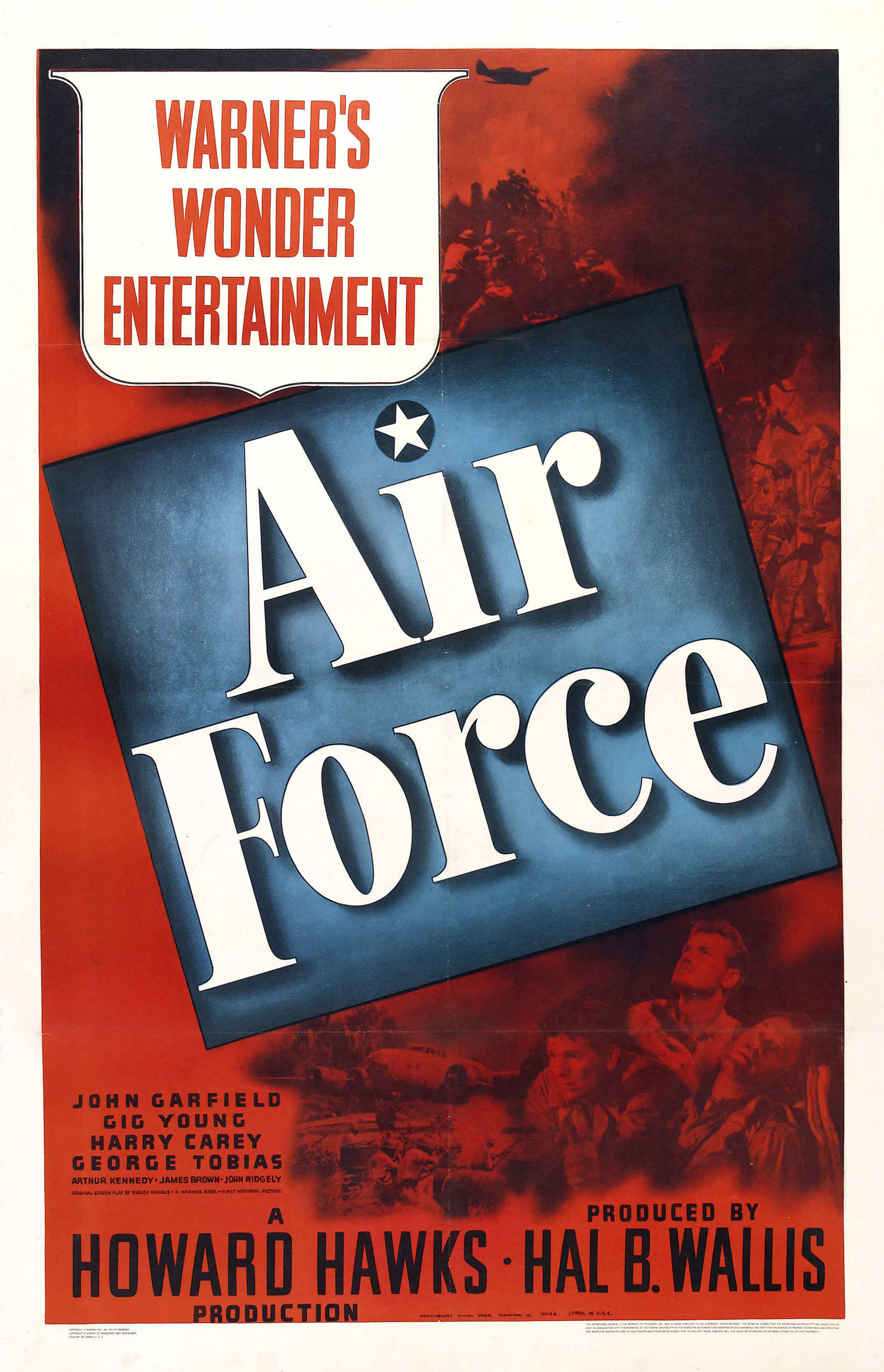
Air Force (1943)

On December 6, 1941 nine B-17 bombers set off on a flight from San Francisco to Hawaii. One of the bombers, the Mary Ann, is commanded by 'Irish' Quincannon. The bombardier, Tommy McMartin, has a sister living in Hawaii and the co-pilot, Bill Williams, is sweet on her. The men are all highly professional with the exception of aerial gunner Joe Winocki, a bitter man who has every intention of leaving the Army Air Corps. They arrive at Hickam Field on the morning of December 7, just as the Japanese are attacking Pearl Harbor and other military facilities. All of the men prepare to face the enemy, including Winocki whose attitude changes quickly. The bomber and its crew will participate in many missions but not all will survive.
GIANTS OF THE SKY...blazing a trail to victory!
Sgt. Joe Winocki: [overhearing the Pearl Harbor attack on the radio] Hey, Peterson, who you got tuned in, Orson Welles?
Santa Barbara, California, USA
(Miniature sea battles were staged in Santa Barbara Harbor)
Drew Army Air Field, Tampa, Florida, USA
Santa Monica Bay, California, USA
(B17 surf landing)
Tampa, Florida, USA
(aerial shots, exteriors)
San Antonio, Texas, USA
(aerial shots, exteriors)




Because of the constant noise in the planes, air crews wore "throat mics." These had two pickups that sat against the larynx (vocal cords) and picked the sound up directly from them. You will notice that whenever a crew member speaks he puts his hand up against the mic and presses it against his throat. This helped ensure good sound pickup.
Aerial scenes were filmed in Texas and Florida because airplanes appearing to be Japanese were not allowed on the west coast due to a fear of Japanese invasion.
Early in the film, an analyst is shown using a period-era teletype machine and a Hollerith punched card typewriter. This was very high-tech stuff for the time. Such devices became standard equipment on early digital computers, which were under development as this film was being produced in 1943. The punched card deck in particular became an essential component of so-called batch processing of large amounts of data, and for making hard copy of computer programs that could be rapidly (for the era) loaded into another computer.
This movie was produced during the war and was meant to be a morale booster, not a documentary. As a result, there are numerous incidents shown in the movie that are not 100% accurate, but these things should not be considered goofs as Hollywood was doing the best it could to support the war effort.
The sabotage by Japanese-Americans in Hawaii, as shown in the movie, never actually happened. Immediately after the attack on Pearl Harbor, there were rumors that the attack was preceded and/or followed by acts of sabotage by Japanese-Americans who were actually Japanese agents, but subsequent investigations showed that the rumors were all false.
Continuity
At the beginning of the film...during the pilot's flight briefing at Hamilton Army Airfield, Co-Pilot Gig Young's character is wearing a flight jacket that has captain's bars on it (about six minutes into the film)... but for the entire film...he is supposed to be a lieutenant and is addressed that way by crew members.
Throughout the movie, stock film of several different versions of the B-17 is used, often depicting the same aircraft. For example, Mary Ann is a B-17B, the earliest version of the aircraft in production, but the beach crash scene at the end of the movie uses film of a later B-17, probably a B-17C or D.
After landing at Pearl Harbor, the crew is shown painting over the large number 10 on the Mary Ann's tail. When the Mary Ann takes off again, the number is still there. In subsequent shots, the number is shown painted over once again.
When "Mary Jane" lands at Wake Field and taxis up to park, it has all four engines running; however, in the immediate next scene when a Clark officer drives and runs up to the plane, the number 2 engine is shut down. The plane is "Mary Ann," not "Mary Jane."
When the Americans prepare to attack the Japanese fleet, pilots are shown manning P-40s, however, P-39s are shown taking off.
Factual errors
Despite reports by Susan McMartin and other characters attributing the loss of planes at Hickham Field and attacks on civilians to Japanese-American saboteurs in bomb-ladened vegetable trucks, there were in fact no actual acts of sabotage. The reports made in the film were propaganda reflecting the hysteria of time.
Unseen "snipers" attack the "Mary Ann" while at Maui. No Japanese "snipers" landed anywhere in the Hawaiian Islands during the attack.
The destruction of any Japanese fleet by horizontal bombing B-17s never occurred in 1941 or in any of the ensuing years. The Japanese skillfully maneuvered their ships to avoid the bombers. Destruction of Japanese ships to the extent depicted in the movie did not occur until the Battle of Midway in June 1942, and that was primarily done by dive bombers.
There was no Japanese invasion fleet approaching Australia in December 1941.
At the end of the movie B-17 pilots are shown preparing to attack Japan, which is 862 miles away, according to a sign. Except for Doolittle's Raid in 1942 with two-engined North American B-25 "Mitchels" off a Navy carrier, the only bombers that attacked Japan were Boeing B-29 "Superfortresses," in 1944 and 1945, and Consolidated B-24 "Liberators" and Consolidated B-32 "Dominators" that bombed in 1945. The B-29s and B-32s flew from Saipan and Tinian, which were over 1,000 miles from mainland Japan. The B-24s flew from Okinawa, which were much closer. Americans never had airfields close enough from which B-17s could reach Japan.
Incorrectly regarded as goofs
Sergeant Winocki is described as being a "tail gunner" but the B-17D, the model used in the film, didn't have a tail gunner position. That came with the redesigned B-17E. It is important to note, however, that in the earlier B-17 models, the waist positions functioned as the tail gunners as well. This was accomplished by fishtailing the aircraft from side to side to give the waist gunners a clear shot behind the aircraft, as seen in the film. Referring to Winocki as a "tail gunner" is not incorrect, since any number of descriptions apply in this case.
Revealing mistakes
During the Wake Island scene, the dog's trainer can be heard giving the animal commands to kiss George Tobias.
The guns on the Japanese ships are capped.
When the American B-17s take off to meet the Japanese fleet approaching Australia, the planes are later models with larger vertical stabilizers. However, as they are winging towards the Japanese, the planes are the earlier models with the narrow vertical stabilizers.
The Japanese task force the Mary Ann spots through the clouds is moving across the water in the direction of the camera's travel at an oblique angle to their wakes, revealing that they are photographically superimposed. The effect was so bad that the ships appeared to be floating above the water.
The scene in which the Mary Ann is attacked by Japanese fighters was obviously done with static models or rear projection imaging. The size of the attacking aircraft never changes and they remain on screen for several seconds. In reality, the fighters should appear to get larger as they approach and given a top speed of 300-350 mph, the fighters should be on screen for a couple seconds at most.
Crew or equipment visible
During the attack on the Japanese warships, a civilian cabin cruiser can be seen in the background between two of the miniature ships, pulling a smoke generator. This happens near the end of the scene, shortly after the ship captain in the white uniform is killed.
Errors in geography
When the plane is approaching Hawaii, the plane is shown flying into the sun. After flying westward all night from San Francisco, they were arriving at Hawaii at dawn, when the sun should be behind them, unless they were somehow flying in the wrong direction.
When "Mary Ann" lands at Wake, there are tall trees surrounding the airfield. There were no tall trees on Wake Island; the vegetation was mainly scrubby trees and shrubs.
Pine trees could, indeed, be seen in the background as the "Mary Ann" lands on Maui. Norfolk Island, or Cook Pines, are quite common in the Hawaiian Islands as well as throughout the South Pacific.
The trees around "Clark Field" have Spanish Moss hanging in them. There was no Spanish Moss in the Philippines.
As "Mary Ann" lands and taxies at Hickam Field, tall trees surround the airfield. Hickam was a relatively new airfield and the whole area was virtually devoid of vegetation at the time of the Japanese attack.