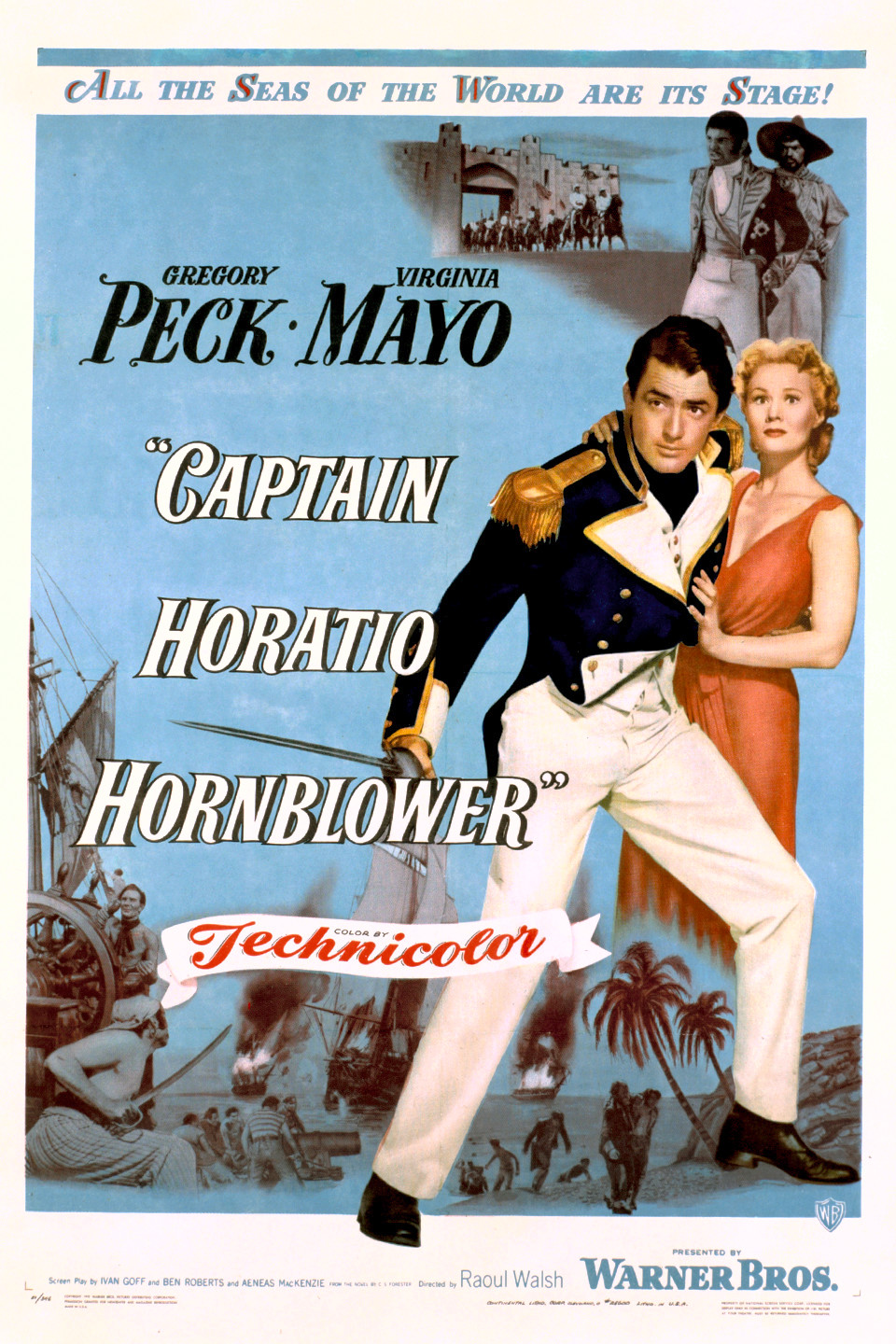
Captain Horatio Hornblower (1951)

In 1807, Captain Horatio Hornblower leads his ship the HMS Lydia on a perilous voyage around Cape Horn and into the Pacific. The men, even his officers, don't know exactly where he is leading them. England is at war with Napoleon and everyone wonders why they have been sent so far from the action. They eventually arrive on the Pacific coast of Central America where the HMS Lydia has been sent to arm Don Julian Alvarado, who is planning an attack against France's Spanish allies on the North American continent. The hope is that Alvarado's forces will require the French to divert some of their military resources to North American defense in the aid of their Spanish allies. He arrives to learn that a Spanish Galleon is en route and he no sooner captures it and hands it over to Alvarado that he learns the Spanish are now England's allies and he must take it from Alvarado. He also gets a very comely passenger in the form of Lady Barbara Wellesley, sister of the Duke of Wellington. The voyage is uneventful but Horatio and Barbara develop a deep affection for one another, despite that he is married and she is engaged. There are more battles ahead however for Hornblower and he finds himself under the command of Admiral Leighton, Barbara's new husband.
Wherever adventure beckons, you'll find Captain Horatio Hornblower!
Capt. Horatio Hornblower, R.N: If I am not back aboard the Lydia within one hour, she'll train her guns upon your fort and reduce it to rubble.
El Supremo: With you in it, Captain?
Capt. Horatio Hornblower, R.N: That is my order.
Villefranche-sur-Mer, Alpes-Maritimes, France
(Witch of Endor docked in Nantes: Quai de l'Amiral Courbet)
Portsmouth, Hampshire, England, UK
(Lord Nelson's flagship, H.M.S. Victory scene)
Rye, East Sussex, England, UK
(Hornblower's house on Mermaid Street)
Mediterranean Sea
(sea battle scenes)
Warner Brothers First National Studios, Teddington Studios, Teddington, Middlesex, England, UK
(interiors)




Once the flogging of Seaman Hommel (Peter Morton) was complete, vinegar was applied to the wound as an (unfortunately painful) antiseptic. If vinegar were not available salt could have been used instead, hence the saying "rubbing salt in the wound" whenever one trauma follows another.
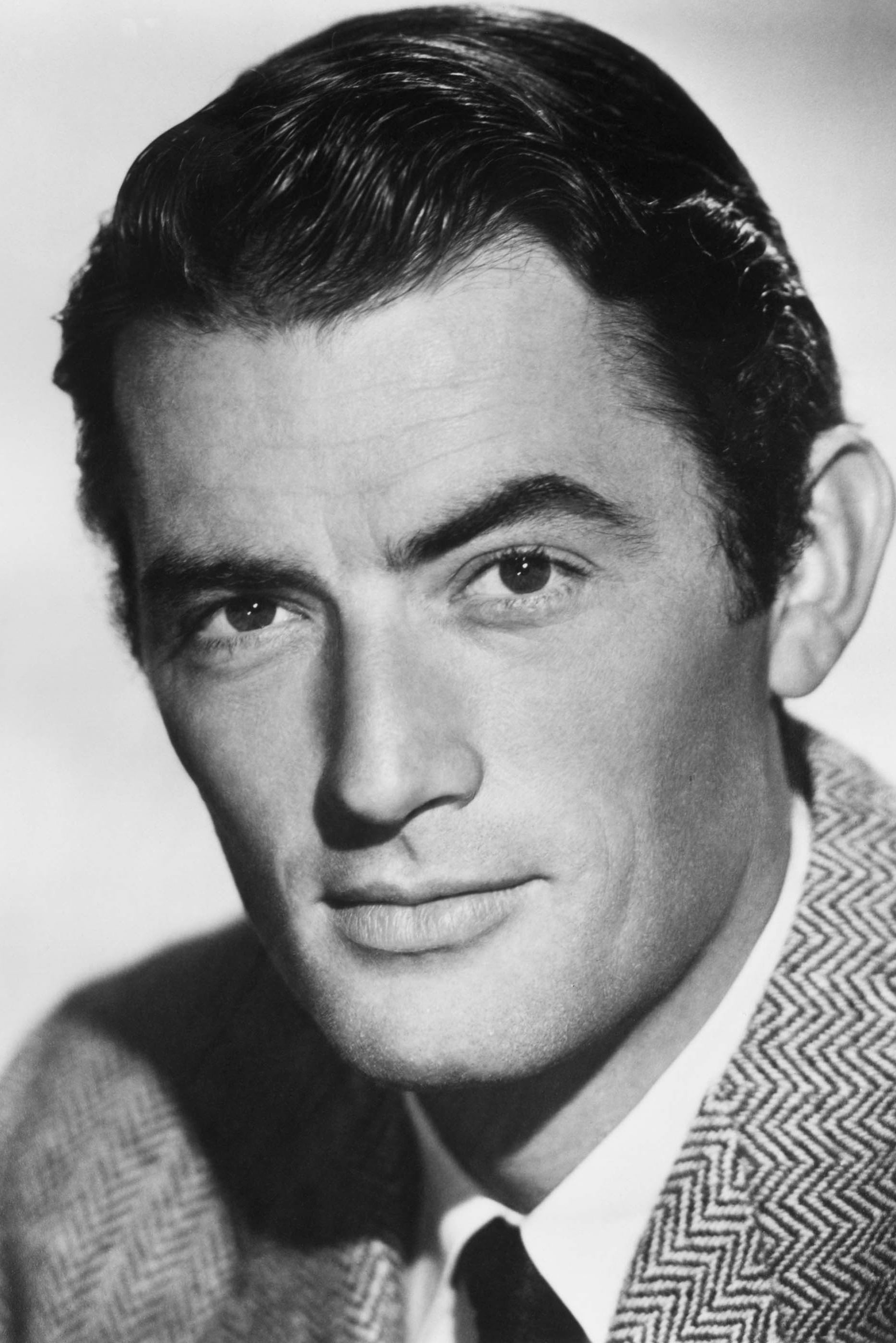
Gregory Peck said that director Raoul Walsh was not interested in dialogue scenes. During talky sequences, Walsh sat down and read the newspaper.
Stanley Baker had been struggling to find acting work, but after he was cast as Mr. Harrison the boatswain shortly before his 22nd birthday, he was never out of work again. His most prominent role would be the lead character in Zulu (1964).
The ship Lieutenant William Bush (Robert Beatty) and Captain Horatio Hornblower (Gregory Peck) board to meet the Admiral at the end of the movie is the actual H.M.S. Victory, currently dry-docked at Portsmouth, England. As Admiral Horatio Nelson's flagship at Trafalgar, she is still commissioned to the present day as an official vessel of the Royal Navy, and the only surviving original ship of the line still in existence.
The film is based on the first three "Hornblower" novels: "The Happy Return" (a.k.a. "Beat to Quarters"), "Ship of the Line" and "Flying Colours". These were all written between 1937 and 1938.
Continuity
In the Lydia's battle with the Natividad, the main topgallant staysail (top sail, middle mast) on the Lydia vanishes early in the battle. We can tell because the sail in front of it on the foremast is shot down. Later in the battle, the Natividad fires at the rigging, and then the main topgallant staysail is shot down. Also in the later shot, the top sail on the foremast briefly reappears. Then still later, both sails reappear for a shot of the Lydia sailing, and then they disappear again as the Lydia closes in to destroy the Natividad.
During the battle between the Lydia and the Natividad, on the Natividad, the railing between the upper and lower deck, where Alvarado is standing, loses and regains a drapery of ropes as the battle continues.
When the 'Lydia' arrives at the fortress of 'El Supremo,' Hornblower is told the ship is 'cleared for action' yet none of the guns on the quarterdeck are manned.
Several times sails shown already furled away in the wide shots, are still shown unfurled in the close-ups.
The date on the first captain's log entry is a date in September that is only correct for the year 1808. During action in October, Hornblower says the Lydia has been at sea for eight months, which would mean it departed England in February 1808. However, the introduction of the film states that the voyage began in 1807.
Factual errors
Set in 1807, the Lieutenants on Hornblower's ship all display the single shoulder epaulet - a rank insignia for Lieutenants which was not adopted by the Royal Navy until after 1812.
Just before the Lydia sights land, Hornblower orders Lt Gerard to have the ship cleared for action. Hornblower then settles down to eat lunch in his cabin. Aboard a frigate, the captain's cabin would not be usable to eat when either 'cleared for action' or being cleared for action. Part of the ships battery was contained in the captain?s cabin and the gun crews would be in the cabin removing bulkheads and preparing the guns for battle. Also all furniture was "struck below" (moved below deck) to provide room for the gun crews and minimize possible splinter injuries.
Throughout the battle with the Natividad, there is no significant change in the trim or setting of the sails on either ship, despite each making numerous changes in direction. The yards, and so the sails, should have been adjusted with each change of direction. Further, at times it can be seen that the sails of the ships are actually aback (being push backwards against a mast), a highly undesirable situation which would bring the ship to a stop. In at least one scene, this happens while the sails of the other ship, which is on a similar course, are well filled with wind.
Hornblower promises Lady Barbara "that she will be home in time for the 'first robin.'" He would have known that English robins, unlike American ones, are not migratory, and remain in gardens throughout the winter.
The scenes filmed on the deck of HMS Lydia (probably done at a studio set), show a mizzen-sail (square rigged mainsail on the after-most mast). This sail would have badly interacted with the spanker (gaff rigged sail trailing the mizzenmast). In the full shots this sail has (correctly) not even the rigging present to support it.
Incorrectly regarded as goofs
In the closing scene, Captain Hornblower orders the sails down in the harbor and the ship begins to move yet there is clearly no wind. The ship is moved away from the dock by the ebb-stream.
At the very end as the ship leaves the harbor for England, Hornblower orders the sails up (unfurled). A ship would be pulled out by rowing boats until away from the harbor else it would be thrashed in to the side of the dock by any wind strong enough to move it. Sail ships used to be launched by first letting the current (usually the ebb stream, though sometimes a strong river might provide enough current to do it independent of the tides) take her out into the open, then the sails would be set and trimmed to turn her around wind vane like until the sails can provide propulsion.
As the Lydia delivers an 11-gun salute to Don Julian as he boards her, none of the guns recoil as they are fired. They do not recoil because they are loaded only with powder, not shot. It would generally be a bad idea to shoot up the local harbor when firing a salute.
While free after escaping, the men see uniformed men in a rowboat and state that they are Dutch. One of the characters states that the Dutch are allied with France. Holland at the time was not as much an ally as a subject nation of France. During the time set in this film, Napoleon's brother Louis was the head of state of Holland.
Revealing mistakes
When Hornblower's ship, the Sutherland, is firing to "dismast" the French ships, the resulting damage is shown using close-ups of the French decks. In one, a huge portion of a mast falls onto the deck. But it bounces lightly, and shows that it has a smooth bottom, revealing that it is a prop.
When Hornblower first meets El Supremo, they are interrupted by a man bringing word of the Natividad being sighted. El Supremo translates this for Hornblower though Hornblower is fluent in Spanish (having been a prisoner in Spain while an acting Lieutenant) and would have understood the message himself. This translation was most likely done for the benefit of the audience.
During the battle between the Lydia and the Natividad, the model of the Natividad is clearly held down by visible ropes.
On the panning sequence just before the final battle between the Natividad and the Sutherland, the shot is clearly reversed, as evidenced by the waves disappearing and the men backwards.
As Hornblower's ship, the Sutherland, is entering the French harbor, the French flag on the fort is lowered and immediately raised again. However, there is a perceptible pause in the two actions as can be seen by a cloud in the background that suddenly jumps forward. This can also be seen when the Sutherland lowers the French flag and raises the British flag. In both instances, this is obviously done to eliminate a pause.
Miscellaneous
Once aboard the 'Witch of Endor,' Captain Hornblower calls on the the captured Royal Navy men being used as slave labor to take the vessel by force. During the ensuring fight, one man draws back his fist to punch a French soldier and his elbow can clearly be seen striking the man behind in the nose. The injured man then spends the remainder of the scene holding his nose and checking it for bleeding.
Hornblower says that this was the first time he had to engage in a sword fight since "midshipman school." This is inaccurate. By this time in the book series, he had been engaged in many such fights over a period of years. Besides, midshipmen are given daily lessons on board. There is no school.
The uniforms in this film bear only a passing resemblance to the uniforms of the day and in some cases no resemblance at all. For an accurate depiction of the uniforms, see the Hornblower series of TV movies, beginning with Horatio Hornblower: The Duel (1998).
When the Spanish captain is yelling "fuego, fuego!" to fire the cannons, this is an erroneous translation from English to Spanish. "Fuego" in Spanish does mean "fire," but it is not a verb having anything to do with a weapon. Someone who yells "fuego!" would be alerting you to something which is burning. The correct command for firing a gun or cannon would be the verb "disparar," which means "to shoot." Thus, the correct command in Spanish to "fire the cannons" would be "dispara los ca?ones!" Or, for just "shoot!" [fire!] = ?Dispara!.
Anachronisms
Hornblower asks whether Lady Barbara is related to the Duke of Wellington. This is in 1807. Sir Arthur Wellesley was elevated to the Peerage after the Battle of Talavera in 1809 and to a Dukedom in 1814 after the Army invaded France. In 1807, he was still Sir Arthur. The title of Duke of Wellington did not exist.
At one point Hornblower and his officers give the loyal toast whilst seated. While it is true that the Royal Navy do toast the King or Queen seated, this tradition only dates to the reign of William IV (1830-1837), aka the Sailor King. At the date when this film is set, RN officers would still have got to their feet to toast the King.
The lookout posted near Alvarado's fortress uses a flashing signal device. This was not the practice of the Royal Navy until 1867. Source: Wikipedia - Signal Lamps.
When Lady Barbara falls in love with Hornblower during their return to England, she wears a fairly low-cut dress at least twice, and again in the movie's final scene--instead of the modest lace usually seen in her bodice. During the scene below decks before reaching England, she comes within a fraction of an inch of revealing too much. This likely pleased Virginia Mayo's fans in 1951, but was hardly the daring fashion statement made by a British lady in 1807.
Crew or equipment visible
During the battle between the Lydia and Natividad, a disturbance may be observed at Lydia's stern -strongly suggesting that the model used may have had a propeller.
Errors in geography
During the opening narration, a world map is shown with "Ethiopia" in the middle of Africa (approx, where modern Zaire is located). In fact, Ethiopia occupies most of the "Horn of Africa," a peninsula on the east coast close -- it is across the Red Sea from the Arabian Peninsula in Asia and several hundred miles from the position shown. No Royal Navy map would make such an error.
When the Witch of Endor escapes from Nantes the shot shows only a clear horizon ahead of her. However, Nantes is on the Loire River, about 37 miles upstream from the ocean. Since the river is only several hundred feet wide at Nantes, land should be visible in every direction.