
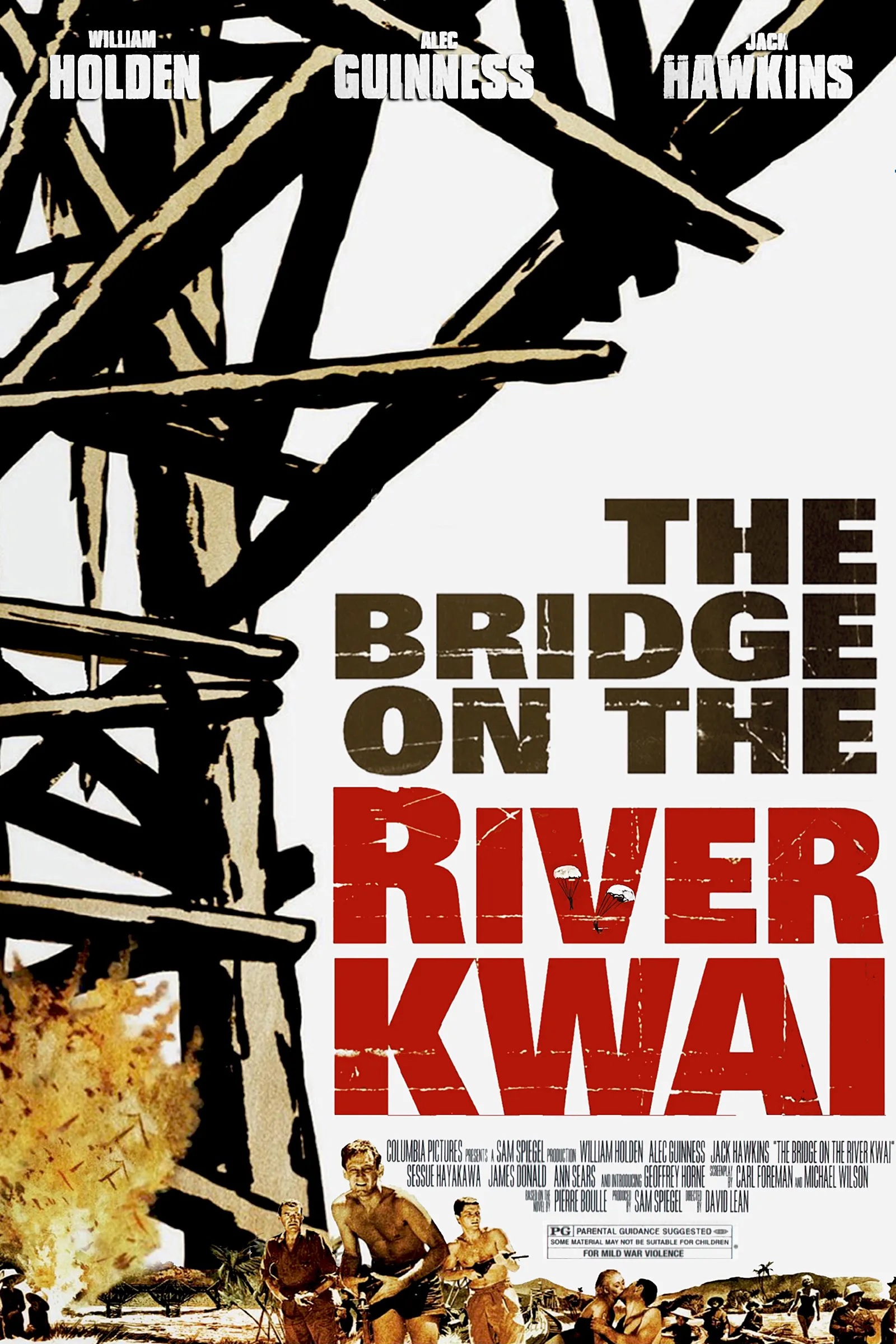
The Bridge On The River Kwai (1957)

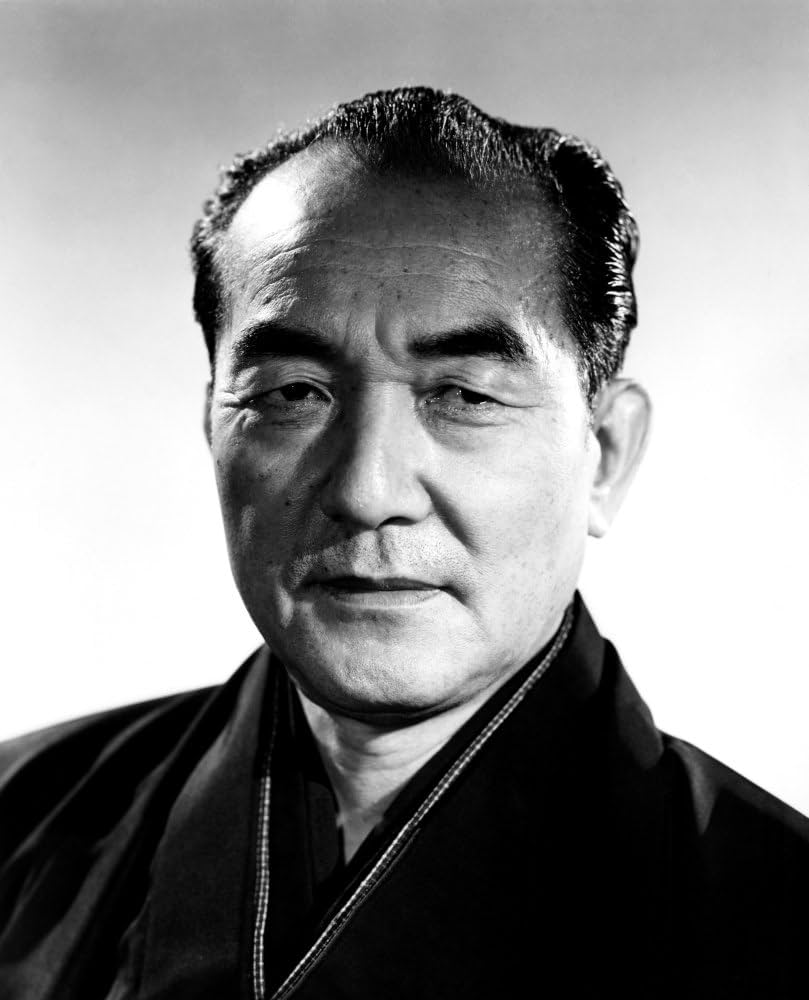
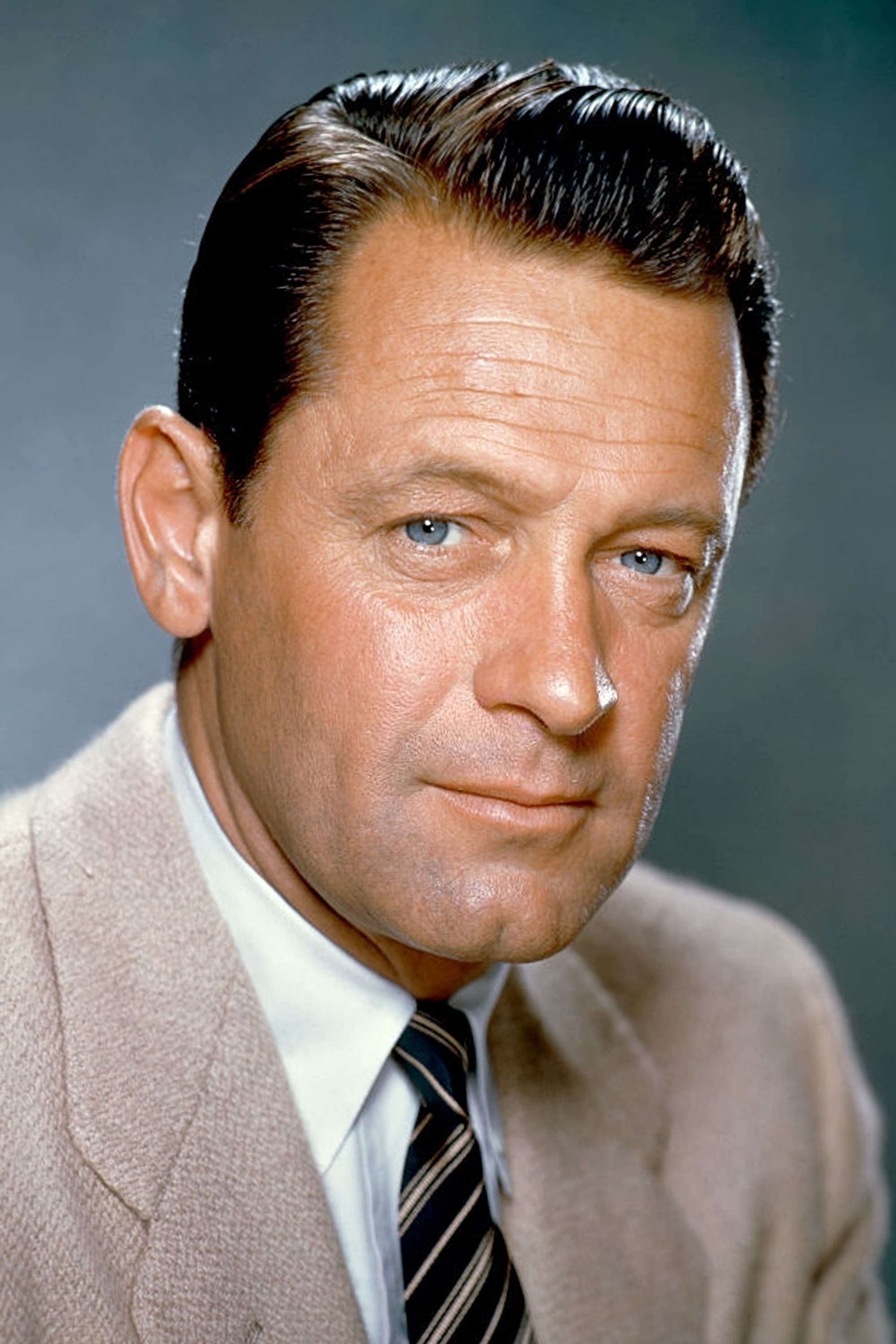
The Bridge on the River Kwai opens in a Japanese prisoner-of-war camp in Burma in 1943, where a battle of wills rages between camp commander Colonel Saito (Sessue Hayakawa) and newly arrived British colonel Nicholson (Alec Guinness). Saito insists that Nicholson order his men to build a bridge over the river Kwai, which will be used to transport Japanese munitions. Nicholson refuses, despite all the various "persuasive" devices at Saito's disposal. Finally, Nicholson agrees, not so much to cooperate with his captor as to provide a morale-boosting project for the military engineers under his command. The colonel will prove that, by building a better bridge than Saito's men could build, the British soldier is a superior being even when under the thumb of the enemy. As the bridge goes up, Nicholson becomes obsessed with completing it to perfection, eventually losing sight of the fact that it will benefit the Japanese. Meanwhile, American POW Shears (William Holden), having escaped from the camp, agrees to save himself from a court martial by leading a group of British soldiers back to the camp to destroy Nicholson's bridge. Upon his return, Shears realizes that Nicholson's mania to complete his project has driven him mad. Filmed in Ceylon, Bridge on the River Kwai won seven Academy Awards, including Best Picture, Best Director for the legendary British filmmaker David Lean, and Best Actor for Guinness. It also won Best Screenplay for Pierre Boulle, the author of the novel on which the film was based, even though the actual writers were blacklisted writers Carl Foreman and Michael Wilson, who were given their Oscars under the table.
It spans a whole new world of entertainment!
Colonel Nicholson: What have I done?
Ambepussa, Sri Lanka
Central Province, Sri Lanka
Colombo, Sri Lanka
Government Rest House, Kitulgala, Sri Lanka
Kandy, Sri Lanka
Kelani River, Sri Lanka
Kitulgala, Sri Lanka
(Village)
Mahara, Sri Lanka
Mount Lavinia Hotel - 104 Hotel Road, Mt. Lavinia, Sri Lanka
Mt. Lavinia Hotel, Sri Lanka
Mt. Lavinia, Sri Lanka
Peradeniya Botanical Gardens, Central Province, Sri Lanka
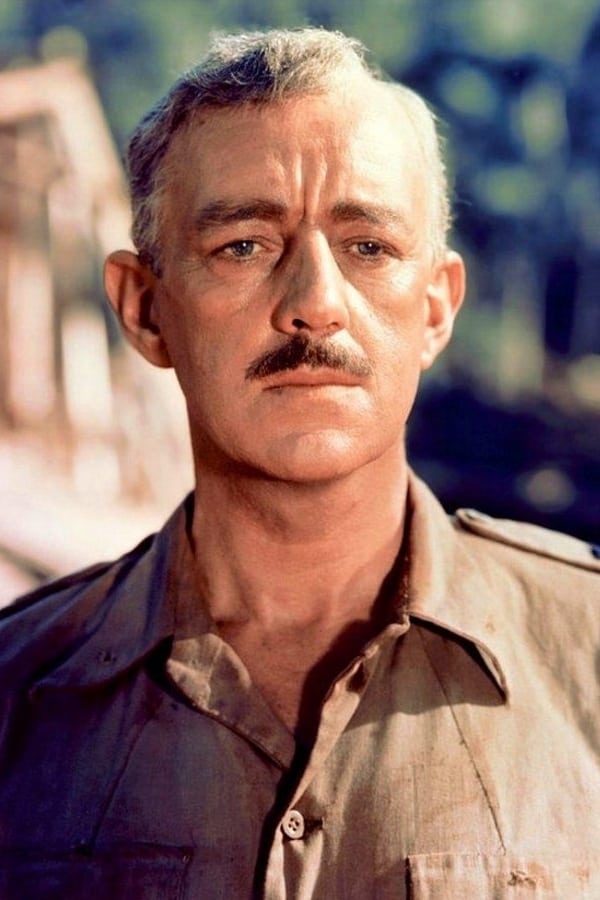
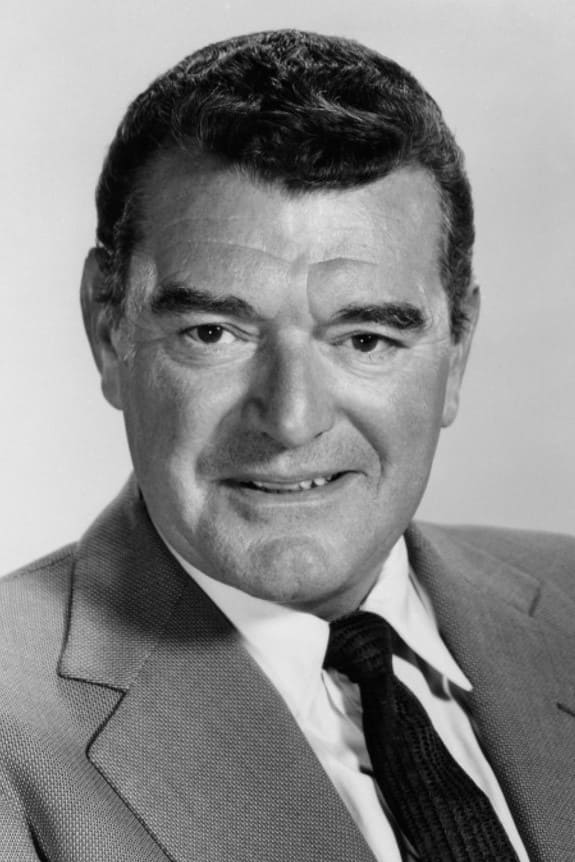
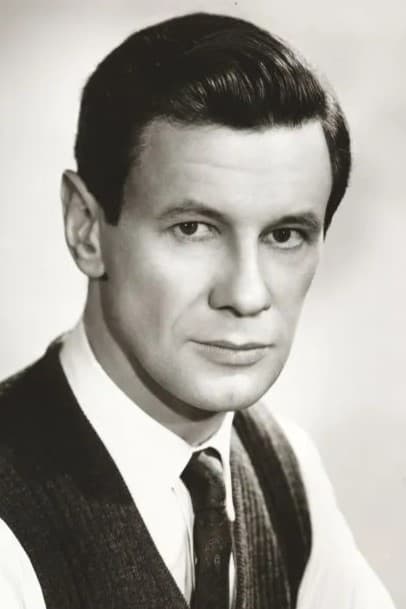
'Carl Foreman' wrote the screenplay with Humphrey Bogart in mind for the role of Shears, but Columbia Studios head Harry Cohn refused to allow Bogart out of another project. Cary Grant then was briefly considered to star as Colonel Nicholson, but his flop in a serious role in Crisis (1950) concerned the producer, Sam Spiegel. The role was offered to Laurence Olivier who turned it down. Alec Guinness was the next choice.
There are many rumors about the casting of the film, but most sources claim that Charles Laughton was the original choice of to play the role of Colonel Nicholson in The Bridge on the River Kwai (1957). Laughton turned down the part as he did not know how to play it convincingly as he did not understand the motivations of the character. He said he only understood the character after seeing the completed film and Alec Guinness' performance as Colonel Nicholson.
At one point, Sam Spiegel wanted Humphrey Bogart to star and Nicholas Ray to direct.
Alec Guinness initially turned down the role of Colonel Nicholson, saying, "I can't imagine anyone wanting to watch a stiff-upper-lip British colonel for two and a half hours." He had also clashed with David Lean when they made Oliver Twist (1948).
Howard Hawks was asked to direct, but declined. After the box-office failure of Land of the Pharaohs (1955), he didn't want a second one in a row, and he thought the critics would love this movie but the public would stay away. One particular concern was the all-male lead roles.
Screenwriters Michael Wilson and 'Carl Foreman' were on the blacklist of people with accused Communist ties at the time the film was made, and went uncredited. The sole writing credit, and therefore the Oscar for best adapted screenplay, went to Pierre Boulle, who wrote the original French novel but did not speak English. Clearly Pierre had not written the English script and this became a long-running controversy between the Academy and the actual authors to achieve recognition for their work. 1984 the Academy retrospectively awarded the Oscar to Wilson and Foreman. Sadly Wilson did not live to see this; Foreman died the day after it was announced. When the film was restored, their names were added to the credits.
In some prints of this movie, star Alec Guinness's surname is written as "Guiness".
Charles Laughton was announced as the star, but decided he couldn't handle the heat of Ceylon and withdrew. Among the actors considered as replacements were Ronald Colman, Noel Coward, 'Ralph Richardson', Ray Milland and James Mason.
The bridge cost $250,000 to build; construction began before anyone had been cast.
After the final scene was shot, producer Sam Spiegel shipped the film footage on five different planes to minimize the risk of loss.
When this film was first aired on commercial TV in the USA, on Sunday night, Sept. 25, 1966, ABC-TV pre-empted its entire evening's schedule so the film could be aired in one night, as opposed to two parts on consecutive nights. This was considered a bold move at the time. It was the longest single network telecast of a film up to then (three hours and 10 minutes with commercials; Ford Motor Co. was the lone sponsor), beating the previous record set by Laurence Olivier's Richard III (1955), which was telecast by NBC over three hours on March 11, 1956. An estimated 60 million viewers watched the program.
The train wrecked at the end of the film was purchased from an Indian maharajah for just that purpose.
The title of the English translation of the French novel "Le pont de la rivi?re Kwai" was "The Bridge Over the River Kwai".
It was Percy Herbert who suggested the idea of using Kenneth Alford's "Colonel Bogey March" to David Lean.
The actual Major Saito, unlike the character portrayed in the film by Sessue Hayakawa, was said by some to be one of the most reasonable and humane of all of the Japanese officers, usually willing to negotiate with the POWs in return for their labor. Such was the respect between Saito and the real-life Lieutenant-Colonel Toosey that Toosey spoke up on Saito's behalf at the war-crimes tribunal after the war, saving him from the gallows. Ten years after Toosey's 1975 death, Saito made a pilgrimage to England to visit his grave.
The film's story was loosely based on a true World War II incident, and the real-life character of Lieutenant Colonel Philip Toosey. One of a number of Allied POW's, Toosey was in charge of his men from late 1942 through May 1943 when they were ordered to build two Kwai River bridges in Burma (one of steel, one of wood), to help move Japanese supplies and troops from Bangkok to Rangoon. In reality, the actual bridge took 8 months to build (rather than two months), and they were actually used for two years, and were only destroyed two years after their construction - in late June 1945. The memoirs of the 'real' Colonel Nicholson were compiled into a 1991 book by Peter Davies entitled The Man Behind the Bridge.
The real life construction of the bridge over the River Kwai used about 100,000 conscripted Asian laborers. 12,000 prisoners of war died on the project.
John Ford, like Howard Hawks, was considered as a director before David Lean was chosen.
Fred Zinnemann was another choice to direct; Sam Spiegel very much wanted him to take the job, due to his box-office clout, but Zinneman didn't understand the novel and declined. Orson Welles was reportedly approached to co-star and direct, but Welles, too, dropped out after reading the script. William Wyler was considered but never formally approached. Ultimately, Spiegel explained the decision to hire David Lean (then virtually unknown outside of Britain) as being "In absence of anybody else."
John Gielgud was the first choice to play Major Warden (played by Jack Hawkins in the film) but rejected the role, saying it was "anybody's part".
Alec Guinness was always the first choice to play Colonel Nicholson, although he actually turned the part down when first offered it as he disliked the character and thought Pierre Boulle's original novel to be anti-British. Charles Laughton, James Mason, Ralph Richardson, Noel Coward and Anthony Quayle were all approached. It was only after Jack Hawkins had been cast in the part of Major Warden that Guinness reconsidered his position, largely at Hawkins' instigation.
William Holden, then a major star, was brought into the project to provide "box office appeal" after Cary Grant turned down the role. He received little money up front, but was guaranteed a hefty share of the profits, to be paid at the rate of $50,000 a year. Because the film made so much money, his share still has not been completely paid, and his heirs continue to receive $50,000 a year, and will for years to come. This is one reason why Holden sued to stop the first American TV showing of the film in 1966, claiming it would hurt future box office receipts, on which he was dependent. (The lawsuit was unsuccessful.)
David Lean initially wanted Nicholson's soldiers to enter the camp while singing "Hitler Has Only Got One Ball", a popular (during World War II) parody version of the "Colonel Bogey March" poking fun at Adolf Hitler and various other Nazi leaders. Sam Spiegel told him it was too vulgar, and the whistling-only version was used instead.
Original novelist Pierre Boulle actually had been a prisoner of war in Thailand. His creation of Colonel Nicholson was an amalgam of his memories of various French officers who collaborated with his captors.
Sessue Hayakawa edited his copy of the script to contain only his lines of dialog. This way, he remained oblivious to the real nature of his character's fate.
For the scene when Colonel Nicholson emerges from the oven after several days confined there, Alec Guinness based his faltering walk on that of his son Matthew when he was recovering from polio. Guinness regarded this one tiny scene as some of the finest work he did throughout his entire career.
At one point during filming, David Lean nearly drowned when he was swept away by a river current. Geoffrey Horne saved his life.
Sam Spiegel bought the railroad train from the Ceylonese government. It had previously belonged to an Indian maharajah and had seen 65 years of active service. Spiegel had it refurbished completely and then had one mile of railway track laid for it.
'Sam Spiegel (I)' was en route from Paris to London when he bought the then much-talked about novel by Pierre Boulle out of curiosity. By the time he arrived in London, he had read the novel and decided what his next film was going to be. He immediately flew back to Paris for a meeting with a surprised Boulle who agreed to sell him the film rights.
Producer 'Sam Spiegel (I)' - in his efforts for securing rights, casting, locations, etc. - flew around the world 4 times in the 3 years it took to get the film from page to screen.
For one sunset scene, David Lean specifically traveled 150 miles to capture it.
Assistant director John Kerrison was killed in a car crash on the way to one of the locations. A make-up man was badly injured in the same accident.
The Suez crisis of 1956 badly affected production too. Vital equipment that would normally have been shipped through the canal had to be flown out to the location instead.
There were no facilities on the island of Ceylon to process film rushes so the day's filming had to be flown to London to be processed and then flown back out to Ceylon.
For the scenes where William Holden, Jack Hawkins, Geoffrey Horne and the native girls had to wade through swamps, they were wading through specially created ones. The real swamps in Ceylon were deemed to be too dangerous. Nevertheless the leeches in the recreated swamps were real.
Calder Willingham also worked on the script although he and David Lean didn't get on.
The film was edited in Paris as David Lean was facing punitive divorce costs from the dissolution of his marriage to 'Ann Todd (I)' at the time in his native England.
Ian Watt, longtime professor of English at Stanford, and author of the landmark "The Rise of the Novel", was a prisoner in the camp, helped with the construction of the bridge, and served as an advisor during the making of the film.
Continuity
When Colonel Nicholson is examining the wire sticking out of the river, the current switches direction.
When the bridge is blown up, the pier on the left explodes first, and you can see smaller charges detonate from under the deck where the commandos never set their charges. Then 7 seconds later, the pier on the right explodes, which would not be possible with only one push of the plunger.
When Col. Saito leaves Col. Nicholson and the other officers standing in the sun, their shadows lengthen during the day. The scene then cuts to a view from inside the 'hospital' and the shadows of the officers are noticeably shorter.
When Major Warden is waiting with the mortar gun, the Thai woman helping him loads the gun twice, but it only fired once.
The explosives' plunger-firing-thing is placed hard up against a rock at the side of the little beach where Joyce is to fire it from. Moments later, when Nicholson's about to fall on it, it has moved 30 cm away from the rock so that he has space to fall without hitting the rock.
Factual errors
Japan was not a signatory of the Geneva Conventions until 1953, therefore there was no expectation by Allied prisoners of being treated in accordance with them. In fact, the Japanese mistreatment of prisoners of war led to the review and update of the conventions in 1949.
The movie credits have only one 'n' in Alec Guinness' name (this has been corrected in the "restored" version).
Nicholson and his engineers convince Saito to move the bridge 400 yards further down the river to take advantage of the narrower gap and solid river bottom. But no mention is ever made of how they're going to connect the new bridge to the railroad which was heading to the old bridge site.
The Japanese soldiers are never seen using anything except British weapons throughout the movie. The Japanese soldier on the train in the opening sequence has a variant of the Vickers machine gun, as do the soldiers in the back of the truck. All infantry are carrying either Lee Enfield (Mk III or IV) rifles or Thompson sub machine guns. There is no Japanese weapon at all in the film except for the officer's katana, or personal sword.
When Shears escapes from the camp the Japanese soldiers in pursuit are carrying British Army issue Lee Enfield SMLE MkIII rifles.
Incorrectly regarded as goofs
At the start of the movie, while the officer's and men are marching, they whistle. Unfortunately, while their whistling is meant to help keep them all in step, the music does not match their marching steps. In fact, had they been marching in step, their left foot would have been on the first and third beats of the song. This is done intentionally to show that at the beginning, the soldiers are disorganised and unable to whistle and march to the beat. When the theme plays again at the end, after the bridge has been built, they all whistle and march perfectly, showing their progress.
Many Japanese POW camp commandants equipped their guards with British equipment because of an abundance of British ordnance after the fall of Singapore in 1942 and the difficulties in equipping main line troops with new equipment so far from Japan, much less camp guards who would not be near the fighting and would not require constant resupply. The warring nations equipped prison camp guards with second hand equipment. As such, it is not a goof that the Japanese soldiers do not have Japanese weapons.
Baker is sent to sick bay with infected right foot but when Nicholson asks for volunteers for the bridge Baker then has an infected right arm instead. It's entirely possible that Baker has infections to both his foot and his arm.
While the prisoners are all supposed to be sick and/or mistreated, in fact all look reasonably healthy and even tanned, and none in any kind of starved or emaciated state. In reality, as numerous photographs of actual prisoners of the Japanese show, all prisoners were uniformly emaciated, having lost an enormous amount of weight, starved, and with skeletal frames - conditions noticeably absent from any of the prisoners in the film. However, Saito was based on one of the more humane commandants who was acquitted of war crimes after war's end. It also patently absurd to expect professional actors to be in the same emaciated state as actual POWs from the 1940s.
Major Shears and two others try to escape. It is indicated that two are killed and one drowns (supposedly Shears) but the Japanese carry three bodies back to camp to be buried. The third body is the Japanese guard Shears killed before he vanished into the bushes, and was chased into the river.
Revealing mistakes
The first time that Warden is seen to be looking at the bridge site through binoculars he is clearly actually only looking at the rock ledge, on which he is lying, a few inches in front of him.
In the finale the bridge is blown up and the train crashes into the river, but a moment later in a scene showing the destroyed bridge, there is no train.
Even though the setting of this movie is primarily jungle/rainforest, you never see a single insect or anyone swatting or shooing one.
Many of the extras are clearly Sri Lankan/Ceylonese, not Thai.
After Lt. Joyce has decoded the message they got from the radio he is reading it to them while it's supposedly still raining but the raindrops are only splashing on the close side of the river and not on the far side closer to the opposite bank.
Miscellaneous
When Nicholson and Col. Saito discover the det wire in the river bed Nicholson pulls the wire out of the mud and asks Col. Saito for a knife and Saito pats his pockets, finds nothing, conveniently forgetting he has a samurai sword on his belt.
When Shears is jumped when he first reports to the British commando school it's obvious that the knife blade is rubber when it constantly wobbles. However, one would expect a knife with a rubber blade to be used in this instance since this is a training session, not actual combat.
Anachronisms
When a Burmese woman spreads masking paint on Major Shears' legs, before they are to set charges onto the bridge, it's clear that William Holden is wearing 50's style loafers that not only do not fit the time, but don't fit the situation at all.
(at around 37 minutes) The calendar on Colonel Saito's office is correct for February 1943. However the pinup on that calendar was not drawn until 1955 by Gil Elvgren entitled "Waiting for You".
The movie is set in 1943, yet a 1946 Chrysler was shown as a military staff car.
The roofs of some of the buildings in the hospital scene have television aerials on them. Since the film was set during WWII, the only countries which had television in any significant capacity were either in North America or Europe. There shouldn't have been any television aerials as was no need for them.
Crew or equipment visible
After the three prisoners try to escape, the next day Major Clipton is talking to Saito in his hut about the men sabotaging the bridge. Saito says " I could have them all shot" to which Clipton replies "Then who would build your bridge?" Immediately after that if you look out the window, you can see a crew member running by in a white shirt and grey pants.
During the first two formations in front of Colonel Saito's office, the sun is behind the men, yet some shadows in the foreground caused by the movie lights behind or to the sides of the cameras are visible.
In the very last shot of Major Clipton, waves in the water caused by the helicopter pulling up to film the scene are visible.
Errors in geography
In the opening scene, the railway is 5'6" (1.676 m) broad gauge, as used in Ceylon (Sri Lanka), the filming location; but when tracks are shown on the finished bridge, they're much narrower, about 2' (60 cm). The actual line would have been 1 meter gauge, as it connected existing Thai and Burmese meter-gauge routes.
When Shears is escaping from the camp, he is shown traipsing through an arid, desert-like landscape. His empty canteen is dragging behind him and he appears to be thoroughly parched. He collapses on the edge of a Thai village. When he departs the village after having recovered his health, the village is shown to be on a river's edge and surrounded on all other sides by lush jungle. No arid landscape is in the vicinity.
The hospital entrance says: "Mount Lavinia Hospital Ceylon." The movie is set in Thailand/Burma but filmed in Sri Lanka (Ceylon).
Character error
It wouldn't have been necessary for Joyce, the Canadian, to go to the UK to enlist to fight against the Japanese, as he says when being interviewed to join the commando group going back to the Kwai. Canada joined the war only ten days after war was declared by the British, and Joyce could easily have enlisted at home in Montreal.
At the first officers' meeting, Col Nicholson says Jennings' name right, then he says it as Jenning.